Category: foundations

  • What is Open Space?

    What is Open Space?

    Image: Annette Zera: The Law Of Two Feet / Butterflies

    What is ‘Open Space’?

    Open Space Technology, commonly Open Space, is a social technology, a tool for helping people to rally around a shared challenge, with minimum obstacles and maximum efficiency. It is used to organise large meetings, gatherings, conferences, problem solving and summits in which everyone has the opportunity to participate on their own terms.

    Open Space is nothing new. The process was developed by Harrison Owen in the 1980’s and it has been applied countless thousands of times, in at least 135 countries, in a variety of ways, with groups of just a few people to several thousands, from hours to several days, and longer. However, the basic process and principles perhaps reach back into ancient human history.

    Open Space offers a clear framework for allowing us to achieve remarkable things. Open Space embraces complexity and chaos, yet it remains confoundingly simple while enabling creativity and productivity to flourish.

    The results can not only be dramatic, but its effect on participants used to the confines of careful planning, hierarchy, telling others what to do and being told what to do, can be transformative and enriching.

    “Everything the Power of the World does, is done in a circle.”
    Black Elk, in Black Elk Speaks

    Who is it for? What does it do?

    Open space events have many applications. The most obvious one is as an alternative form of a conference – a conference without speakers, where the participants’ heart-felt issues are at the centre of discussion. This form can be applied in a multitude of settings, wherever there is an issue people have a common passion about, in

    • communities
    • political gatherings
    • peace talks
    • neighbourhoods
    • research or
    • specialist areas.

    Open Space is a completely opt-in event, so invitations go out to many people and those passionate about the theme turn up.

    Within organisations Open Space can also be applied for more specific purposes.  Open Space can be used for:
    • product design and development (synchronisation)
    • strategy development, bringing in whole workforce
    • supply-chain issues, coordinating suppliers
    • redesigning the organisation, bottom up
    • innovation and prototyping, including customers
    • complexity problem solving using diverse perspectives
    • collective intelligence letting future emerge
    • inviting an organisational transformation process

    It is this latter application, inviting the relevant workforce to co-create an implementation or a transformation that our Caterfly Open Smart Transformation is concerned with.

    In all case Open Space is a way of inviting a larger number the workforce into the process, thus opening the space for a larger view of things, rather than leaving it to a few select people to manage.  This is particularly important where there are big issues at stake which ignite the passions of many people.  The self-organising aspect of Open Space enables any number of people to be involved efficiently and constructively.

    Open Space Events can be from 1/2 day to several days.  It should be noted, however, they are far more effective and powerful when run over 2 or 3 days.  This is because the first day tends to focus on current and past issues, and after a night’s sleep new ideas and energies are created which means the second and third (action planning) days are far more creative, and make use of the synergies of the minds present.

    How does it work?

    The basic process is counter intuitively straightforward:

    * Clearly define the challenge, and express it in a few words. This is what you are inviting participants to get enthused about.

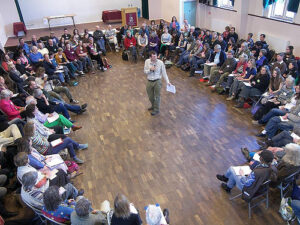
    Photo: Stanley Park / World Open Space on Open Space 2009
    Photo: Stanley Park / World Open Space on Open Space 2009

    * Everyone sits in a big circle. A facilitator gives some basic instructions, then lets them get on with it.

    * There is no prepared agenda, just a big blank board with available time slots and areas to use. Participants are invited to articulate what they really want to know, share, discuss or work on, and co-create the agenda with whatever sub topics they want.

    * People then work out what seems most important, urgent or interesting to them, and go there. Some people will likely end up either flitting about from discussion to discussion, or getting a cup of tea and serendipitously having just the brain wave or interaction they need right there.

    * Through the event people share what they’ve done, thus building a kind of ‘collective consciousness’ of the whole shebang.

    * Toward the end of the event, everyone comes back together in a big circle and shares what they did, learnt, or what they want to happen next.

    * Usually all participants get an anthology of the summaries of each session, perhaps with a plan of action, or key outcomes.

    * Go home and let go, until the time comes to do something again.

    Turn up if you want to, do what feels important, let others do what they feel is important, let go and allow it to happen in whatever way participants conspire to make happen. 

    The reason it seems to work

    Leaders and facilitators allow people to work it out for themselves and get out of the way. No one is coerced, and no one has to be there. Opt-in participation devolves responsibility to individuals to choose to follow their passion.

    light bulbs sketched on chalkboard Many small ideas make a big oneThere are some basic principles to help people let go of trying to be in control, and embrace what is actually happening. A metaphor would be a surfer, who rather than trying to direct the waves, finds the right place to catch one and ride it.

    There is just one firm rule, known as The Law Of Two Feet, although it is more of a playful hint than strict instruction. The Law says that ‘if you are neither learning nor contributing, it is your duty to find another place to be.’ Rather than choosing a session and being stuck in it or feeling obliged, participants are encouraged to move around, increasing impact and efficiency for the individual, for each sub group, and for the whole.

    Rather than try to solve a problem with just one brain, perhaps the boss or a management team, or trying to engage numerous individuals over a long period of time, Open Space harnesses the creativity and skills of everyone, all at once. What might take a dedicated team many months, gets accelerated over a very short burst, and results in more brilliant solutions that no one could have predicted.

    Organising people is hard work and inefficient. Helping people to organise themselves is surprisingly easy, effective and energising. Meanwhile, it becomes easier for people to really engage, and those voices can be heard which often aren’t.  Open Space works particularly well where there is no known outcome, with very complex issues and where any form of pre-planning is futile as letting the future emerge rather than trying to control is essential.
    Relax nothing is under controlA part of how Open Space came to be discovered, was Harrison Owen’s experience while co-organising a conference. It took a lot of effort. People showed up, and sat passively in rows of chairs listening to experts. But when the coffee breaks came, the event came alive, buzzing with spontaneous conversation. The coffee break was the best bit. Open Space is an attempt to turn the entire experience into something like the coffee break. Some people started thinking of it as the opposite of a conference, and now the term unConference has become more common.

    Lastly, Open Space events can also be significantly greener, utilising human resources more than material. I often refer to them as ‘compostable conferences.’

    And that’s it.

    “There is no order without chaos.”
    Harrison Owen at TEDx, Dancing with Shiva: Are we working too hard? 

    Further reading and Videos:

    Wikipedia: Open Space Technology

    Harrison Owen’s Brief History of Open Space

    Open Space World resources

    How Caterfly is pioneering Open Space for Innovation and Kaizen or using it in organisations to invite cultural transformation

    Caterfly’s model is based on Daniel Mezick’s innovative Prime/OS™ model, using Open Space to adopt Agile working and more

    Chris Corrigan article, on using Open Space to solve complex problems

    Huffington Post Business article, Opening The Space For Innovation

    Martin Grimshaw’s Open Space Facilitator’s Checklist

    Open Space Facilitators around the world: Open Space World Map

    A large collection of video samples in Evocative Open Space Videos, especially the following 3 short videos give a good overview of what Open Space is and what it looks like in action:

  • What is Kaizen?

    What is Kaizen?

    Kaizen is a philosophy that has transcended its development in Japanese car manufacturing management, where it was a critical component of the country’s post war economic transformation. Today, Kaizen is used across the world by life coaches, fitness and martial arts teachers, schools, healthcare and across all industries. Kaizen is at the heart of the Toyota Way, from which the Lean Management evolved, and is a fundamental component to Caterfly‘s model for embedding long term improvement in organisations.

    Great Small Things Van Gogh‘Kai’-‘zen’ means ‘good change’, or change for the better, done by everybody, everyday, everywhere. 

    Kaizen is a mind-set permeating throughout an organisation, which fosters a continuous search by all employees at all levels and departments to find small improvements in the workplace, the products, services or processes. This kaizen mind-set creates an organisational platform or culture which is fed by one question asked by everyone at least once a day:  ‘What is one small step you can do to improve the product or process you work on?’

    “Kaizen is a customer-driven strategy for improvcement… In Kaizen, it is assumed that all activities should eventually lead to increased customer satisfaction.” Masaaki Imai

    Kaizen is about improving products or services, but it is also about constantly improving processes such as operations, standards, office workflow, production, efficiency or sustainability, or indeed anything that may speed up, embellish, eliminate waste, simplify, reduce a step, remove toxins or fool-proof a process.  Kaizen is particularly useful in reducing human mistakes in routine work, by considering small steps that would prevent human errors recurring. Kaizen may include tools like PDCA problem-solving and visual management. By continuously focussing on small improvements the whole workforce is a state of continuous innovation and change – this in turns makes the organisation nimbler, and more responsive and adaptable to change.

    In Kaizen there may be no immediate results. But like compound interest, invisible to begin with, the benefits are enormous in the long run.

    Kaizen applied across the company creates a culture, a “kaizen culture”, of participation and development.  Kaizen helps improve the services or products of an organisation, but it has an even greater impact on strengthening the personal development of everyone.  Kaizen is a form of personal development that is directly relevant to, as well as emanates from the work being done. Kaizen enables experimentation, and requires leaders to listen to those doing the work with positive reinforcement. Kaizen not only allows innovation to flourish, it also motivates and engages the whole workforce.

    Kaizen is a platform for change, innovation and engagement across an organisation.

    You may also like our longer article: Kaizen – Rejuvenating your Organisation

    Save

    Save

  • Innovation and Kaizen

    Innovation and Kaizen

    Innovation and Kaizen

    The follow up Phase III of our Open Smart Transformation (OST) process is referred to as “Competence and Innovation / Kaizen”.  Competence relates to the successful mastery of the adopted approach to a degree that it is practically second nature to the organisation and does not require a lot of attention beyond maintenance.  Innovation / Kaizen refers to the integration of a Kaizen culture continuously seeking small improvements as described in ‘What is Kaizen’, integrated with an occasional intensive burst of Innovation activity, using an Open Space event.

    Masaaki Imai / Ofi Sofyan Gumelar
    Masaaki Imai / Ofi Sofyan Gumelar

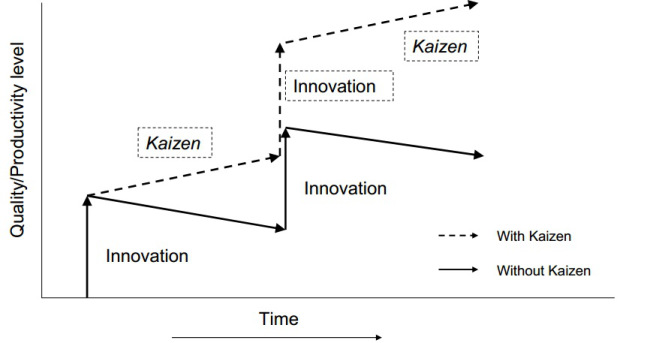
    Kaizen is often contrasted to Innovation – the latter representing big steps, big leaps, mega ideas. Innovation is more dramatic and produces spectacular improvements which, however, are not necessarily sustainable.  Big innovation and small Kaizen can be compared to the hare and the tortoise, the hare being innovation running fast in big leaps, the tortoise in little steps one step at a time. Both approaches are required. In a Kaizen culture one must be careful to avoid a Kaizen-only approach – that is an  organisation extremely adept at finely improving and perfecting methods or products, which are, however, completely out of date (e.g. the fax machine). It is therefore important for a kaizen organisation to sometimes break out of its Kaizen mode and do some substantial out-of-the-box radical thinking.

    “Kaizen is like a hotbed that nurtures small and ongoing changes, while innovation is like magma that appears in abrupt eruptions from time to time.” Masaaki Imai

    We believe this is best achieved using Open Space Technology.  Since disruptive out-of-the-box thinking cannot be pre-planned, it has to be done in a platform which is totally open and self-organised, both in terms of content as well as of participation. Pre-planning and organisation by definition defeat innovation. Serendipity and collective sensing are paramount. Open Space is based on self-organisation, opt-in participation and a market-place of ideas where people are free to follow their curiosity and passion through various clusters of interest.  In the third phase, therefore, we recommend an ongoing platform or culture of Kaizen continuous improvement, interspersed once or twice a year, or as needed, with a mega-burst of radical innovation activity through an Open Space Innovation event to which the whole relevant workforce is invited.


    Caterfly’s introduction of Open Space Technology to combine Kaizen and innovation is our unique contribution, which we hope will be taken up by others.


    You may also be interested in our short piece: What is Kaizen? and our longer article: Kaizen – rejuvenating your organisation


    Save

    Save

  • Prime/OS, Open Space and Caterfly

    “If I have seen further it is by standing on the shoulders of giants.” Isaac Newton

    The buzz about invitation – what inspired us

    Caterfly’s Open Smart Transformation model is a derivative of Prime/OS™. A good part of Caterfly’s approach and Open Smart Transformation model was initially inspired by Open Agile Adoption (OAA) developed by Daniel Mezick. Open Agile Adoption itself applies the work of Harrison Owen in Open Space Technology, commonly Open Space. Daniel Mezick identified some unique properties of Open Space Technology related to game theory, especially its characteristic (‘pull’) opt-in invitation approach (Law of 2 Feet) rather than by imposition (‘push’). What is unique about OAA in Daniel’s use of Open Space Technology, however, is his re-framing and application of Open Space for a specific purpose, specifically in applying two Open Space events to frame a transformation process. From this he developed OAA (Open Agile Adoption) for ‘pull’-style agile implementations.

    This work is based on Prime/OS™, published as an Open Source, Free Cultural Work via the CC-BY-SA license from Creative Commons.
    Download the Prime/OS™ Definition Here:
    http://www.prime-os.com/download-prime/

    Creative Commons, Free Culture licensing details here

    We have always maintained that the people affected by any form of system implementation or transformation must first and foremost be consulted and invited into the process and the decision-making, so we immediately recognised the relevance of Daniel’s work beyond its Agile application. In fact we are not Agile coaches and to that degree OAA is not directly relevant to us. However we recognised that the principle Daniel was propagating is relevant way beyond pure Agile adoption, indeed it is applicable to the adoption of any system, like lean, systems thinking, responsive org, sociocracy or sustainability management, or indeed to any form of organisational transformation.

    From this we developed the concept of the Caterfly, denoting the metamorphosis from caterpillar to butterfly, starting with the building of a protective cocoon and ending with the breaking out of it, with a long period of gestation in between; or in Caterfly a beginning and an end Open Space event each with various coaching iterations in between. The ‘cocoon’ is marked time-wise by the two Open Space events. The metamorphosis can represent any adoption, cultural change or transformation process an organisation seeks to undergo – and it does so not by mandating or imposing, but by inviting all affected to co-write the change or adoption story.

    Daniel Mezick had independently come to a similar conclusion and had renamed his extended application as Prime/OS™. Consequently we have agreed to regard our Open Smart Transformation as a derivative of Prime/OS™, under a Creative Commons license, which enables us to follow those before us in gifting our work to the Intellectual Commons. The approaches are similar at this point, although this may change with experience. The only modificaton we have made so far is in the follow up phase III where we introduce Kaizen. We believe a process of learning should continue beyond adoption, and Kaizen creates an excellent platform for this continous renewal, responsiveness and innovation.

    We are pleased to be connected with Daniel Mezick on this very important contribution to organisational transformation. We enjoy Daniel’s double-open space cocoon framework because it offers an excellent platform to invite the people affected by the change into the decision and planning process, and to co-create the change.

    As Open Space facilitators we would also like to acknowledge and appreciate the work of Harrision Owen and the hundreds of Open Space facilitators around the world who have run many thousands of Open Space events over more than 20 years and have proven that Open Space is one of the most effective transformation preparatory tools around.

    Caterfly’s predominant role is to support and enhance coaches and trainers running a transformation programme with Open Space events. We facilitate the framing Open Space events and leave the coaches and consultants to run their programme as usual.


    Further reading
    Daniel Mezick’s site is a great repository for further information and writing around the subject.
    * Find out more about Open Space at our ‘What is Open Space?’ page, where there are also links to further resources including Harrison Owen’s work.
    * Full description of the Open Smart Transformation model

  • Open Smart Transformation (OST) model

    Open Smart Transformation (OST) model

    OPEN SMART TRANSFORMATION (OST) MODEL
    Version 1.0

    Creative Commons BY-SACopyright (C) Martin Grimshaw, Francois Knuchel & Daniel Mezick (author of Prime/OS™) 2014-15

    Shared under a ‘Free Culture’ ‘Attribution-Share Alike’ Creative Commons Licence CC BY-SA 4.0 :

    You may use this work as you like, including creating derivatives and commercial use, but you MUST provide proper attribution and share your work on the same basis, using the same licensing. This is our gift to the ‘intellectual commons’, and this license ensures that it remains open for all to benefit from, always.
    Full details at http://caterfly.co.uk/what-we-do/intellectual-commons/ 

    Note:
    Open Smart Transformation
     (OST), a Caterfly brand, is a derivative of Prime/OS™ as described in http://www.prime-os.com, which also makes significant use of Open Space Technology (http://www.openspaceworld.org). OST has been developed by Francois Knuchel and Martin Grimshaw based on Daniel Mezick’s original work and Prime/OS™.

    This work is based on Prime/OS™, published as an Open Source, Free Cultural Work via the CC-BY-SA license from Creative Commons.  Prime/OS is also referred to as OSA when used in Agile Adoptions.
    Download the Prime/OS™ Definition Here:
    http://www.prime-os.com/download-prime/

    OST is a process implementation methodology that introduces transformation gently into a client organisation. OST implements a ‘passage‐rite’ structure that is framed by two organisation‐wide Open Space events. OST comprises and leverages the following core elements:

    • The Open Space meeting format [Open Space Technology, developed by Harrison Owen]
    • Game Mechanics (goals, rules, progress mapping, opt-in presence)
    • Invitation (including framing right questions)
    • Leadership Storytelling (and behaviour)
    • Principles of engagement, participative facilitation and respect
    • Cultural Anthropology (Passage Rites, “Master of Ceremonies”)

    OST applies these various elements across a timeline spanning several months. OST implements a passage-rite-like transformation, which has a clear beginning, middle and end. It is important to note and understand that OST is an organisation‐level transformation process rather than an individual-level one. The organisation is best viewed as a single entity (a single social system, rather than a collection of individuals) when implementing OST.

    By ‘SMART’ we mean Smarter ways of working.  These can be state-of-the-art systems, methods or organisational mind-sets which aim to enable a business or organisation to be more efficient, more responsive, leaner, more agile, more conscientious or more sustainable. We use the term Smarter Working as shorthand for a variety of more human, healthier, more responsible, whole system, self-organisation or self-management approaches to working together, including but not limited to: Agile, Lean, Responsive, Conscious Business, Sociocracy, Kaizen, Environmental or Sustainability Management Systems (EMS or SMS), Holacracy, Management 3.0 and more.

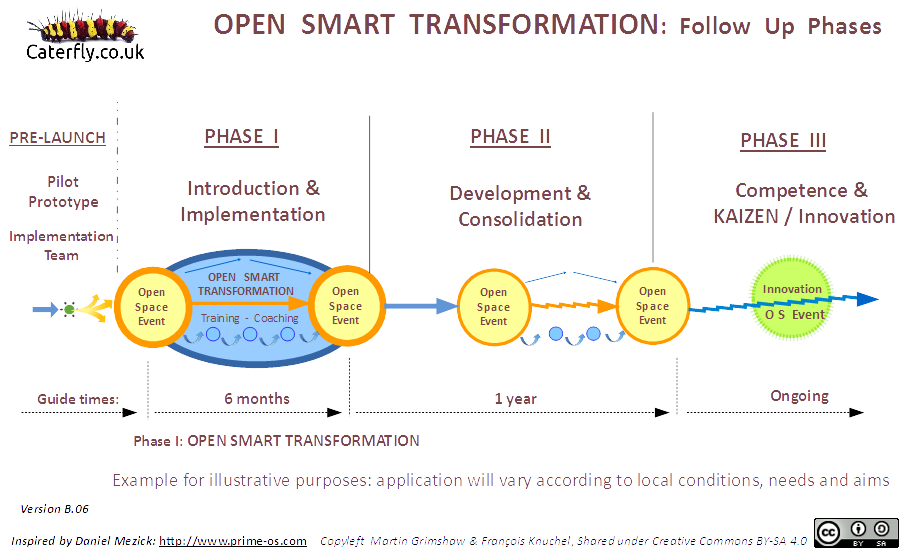
    The big picture of OST consists of 3 distinct “Phases”:

    Phase 1: Introduction and Implementation. The start and successful completion of the (first chapter of the) adoption process bound by time and two distinct beginning/ending Open Space iterations

    Phase 2: Development and Consolidation. Consolidating adoption through follow-up Open Space iterations, and/or Chapters 2, 3 … of adoption process following same Open Space events as in Phase 1 (where implementation is staged into more than one chapter)

    Phase 3: Competence and Continuous Learning. Successful completion of Phase 2, as evidenced by several “Chapters” spanning at least two chapters. Shift to learning organisation mode

    OST in more DETAIL:  Core Elements

    1. OST Phase 1: Introduction and Implementation. Experiencing engagement via opt‐in participation and Open Space.  This is the first level, the level of “introduction” to the basic SMART concepts being implemented, and facilities of the OST method: openness, invitation and opt‐in participation.

    • Opening Consulting with Leadership by Coach/Consultant, including planning for Open Space iterations
    • Invitation as the primary opt‐in mechanism
    • Open Space 1 (initial Open Space iteration, which marks the start of the transformation process, incorporating game mechanics: goals, rules, progress scoring and opt-in)
      • 2-3-day Open Space (minimum 1 day) – opening Open Space iteration
      • Minimum of 90 days of experiments and playing with practices (Beta-Lab cocoon mode), between the scheduled Open Space iterations
      • Output is learning and some deliveries
      • Leadership Signalling with Storytelling (and other highly symbolic behaviours, respect)
    • Open Space 2 (second Open Space meeting, which terminates “Chapter 1” of the process adoption and opens “Chapter 2” of the organisational “story” of adoption) – closing Open Space iteration
    • FOLLOW UP. Closing consulting with leadership
      • Processing of Proceedings
      • Respectful Leadership Signalling with Storytelling (and other highly symbolic behaviours)
      • Coaching consultant delivers specific coaching on what to (possibly) consider next
      • Depending on circumstances, coaching consultant vacates the organisation and does not communicate with it for at least 1 month, to trigger self‐sustaining independence self-organising behaviours on the part of the organisation
    • Open Space 3 if needed (all the steps above repeated)

    2. OST Phase 2:  Development and Consolidation. Minimum 1 year: recurring Open Space iterations about 6 months apart.  This is the stage of “consolidation towards competence”.

    • Evidence must be present first that the organisation has processed and completed Phase 1.
      • Several “Chapters” of learning, bound by two Open Space iterationss, may be needed for some organizations to reach this stage. Where the adoption program has been staged into more than one chapter, the subsequent chapter(s) would be introduced and implemented in the same manner as Phase 1, with two beginning/ending Open Space events
    • Repeat OST’s Open Space iterationss approximately every six months until a true learning organisation culture has been reached, with “all openness, all the time.”
    • Gradual introduction of Kaizen practices

    3. OST Phase 3: Competence and Continuous Improvement – Kaizen & Innovation.  No more scheduled Open Space iterations, due to a maturing of the organisation’s ability to sense, learn and respond, so Open Space on an as needed basis. Integration of Kaizen and Innovation practices for ongoing self-organised learning

    • Evidence must be present first, that the organisation has reached Phase 2, such as:
      • The scheduled Open Space iterations become less interesting, because the organisation now has an open culture that “is” open space in spirit and content
      • The organisation can consistently demonstrate a “safe-space” open culture.
        • Substantial changes to HR policies with intent to support an OST Phase 3 culture of responsiveness and participatory improvements
        • Establishment of norms for dealing with the ongoing conflict that is a natural consequence of independent thinkers working together in a volatile, high-change business environment
    • Pan-organisational program of Kaizen (continuous improvement) and Innovation practices to ensure the organisation is performing at peak, without stagnating, will full participation of all its people
    • Further follow-up Open Space and other events in the following years as required to guarantee continued self-organised learning. Major issues arising from new working practices, including the Kaizen and Innovation programs, can then be reviewed


  • Intellectual commons

    Intellectual commons

    The Intellectual Commons

    We believe creative solutions to the problems we all face, should be made freely available for the mutual benefit of everyone. We want to keep innovation for the common good, in the hands of the Commons. Like science.

    Too often great ideas, inventions and products get held back by the chains of ownership and a need to control. We want to set culture free. You may hence use the materials here under the following conditions:

    Creative Commons BY-SAUnless otherwise stated, all material here is licensed under a Free Culture, Copyleft, Creative Commons license:  Attribution-ShareAlike 4.0 International (CC BY-SA 4.0). The last word on the general  licensing conditions are here: http://creativecommons.org/licenses/by-sa/4.0/

    Caterfly’s Open Smart Transformation model is based on Prime/OS™, published as an Open Source, Free Cultural Work via the CC-BY-SA license from Creative Commons. Download the Prime/OS™ Definition Here: http://www.prime-os.com/download-prime/

    To summarise, you can use all the material here, and we hope you find it useful. A large part of our work is derived from other sources, which we acknowledge in our detailed description of Caterfly’s OST-model. In particular our work is informed by Open Space Technology, is a development of Daniel Mezick’s Open Agile Adoption, and is a derivative of Prime/OS™. To a large extent the essence of our work is derived from and is a combination of the work of others, together with the skills that we bring as facilitators and consultants.

    You may distribute this material, use it for your own commercial purposes, and remix it to make a derivative. However:

    You must properly attribute all co-creators of the material you are using including those we have derived our work from, in the way specified in the Creative Commons licence. You should also make clear that your work is a derivative, and provide a web link (URL) to our website, and to those of our predecessors, with address fully visible so that it remains readable even when printed on paper.

    You must share your work on the same basis, thus keeping these great ideas in the intellectual commons, for everyone’s benefit. The details of how to use this material are in the OST-model document.

    Please note that not all Creative Commons licenses are Free Culture or Copyleft; indeed some are quite restrictive and intended for purposes different from ours. The licence we have chosen is very close in spirit to the Free Software / Open Source culture’s General Public Licence (GPL) developed by GNU – the co-creators of the GNU-Linux operating system.

    If you have any doubts, please get in contact.

     “If I have seen further it is by standing on the shoulders of giants.” Isaac Newton

  • What is Kaizen?

    What is Kaizen?

    Kaizen is a philosophy that has transcended its development in Japanese car manufacturing management, where it was a critical component of the country’s post war economic transformation. Today, Kaizen is used across the world by life coaches, fitness and martial arts teachers, schools, healthcare and across all industries. Kaizen is at the heart of the Toyota Way, from which the Lean Management evolved, and is a fundamental component to Caterfly’s model for embedding long term improvement.

    Great Small Things Van Gogh‘Kai’-‘zen’ means ‘good change’, or change for the better, done by everybody, everyday, everywhere. 
    Kaizen is a mind-set permeating throughout an organisation, which fosters a continuous search by all employees at all levels and departments to find small improvements in the workplace, the products, services or processes. This kaizen mind-set creates an organisational platform or culture which is fed by one question asked by everyone at least once a day:  ‘What is one small step you can do to improve the product or process you work on?’

    “Kaizen is a customer-driven strategy for improvcement… In Kaizen, it is assumed that all activities should eventually lead to increased customer satisfaction.” Masaaki Imai

    Kaizen is about improving products or services, but it is also about constantly improving processes such as operations, standards, office workflow, production, efficiency or sustainability, or indeed anything that may speed up, embellish, eliminate waste, simplify, reduce a step, remove toxins or fool-proof a process.  Kaizen is particularly useful in reducing human mistakes in routine work, by considering small steps that would prevent human errors recurring.  By continuously focussing on small improvements the whole workforce is a state of continuous innovation and change – this in turns makes the organisation nimbler, and more responsive and adaptable to change.

    In Kaizen there may be no immediate results. But like compound interest, invisible to begin with, the benefits are enormous in the long run.

    Kaizen applied across the company creates a culture, a “kaizen culture”, of participation and development.  Kaizen helps improve the services or products of an organisation, but it has an even greater impact on strengthening the personal development of everyone.  Kaizen is a form of personal development that is directly relevant to, as well as emanates from the work being done. Kaizen enables experimentation, and requires leaders to listen to those doing the work with positive reinforcement. Kaizen not only allows innovation to flourish, it also motivates and engages the whole workforce.

    Kaizen is a platform for change, innovation and engagement across an organisation.

    You may also like our longer article: Kaizen – Rejuvenating your Organisation