Tag: buy-in

  • Discovering What is Possible

    Discovering What is Possible

    We live in a world where a mechanistic, “machine” view of organizations has served for some time. The end of this era is upon us, and the transition to a living-systems view is well underway.

    Organizations are more like living things than they are like machines. Without getting into all the details of “why,” this essay assumes the living-systems view is the more accurate view, the more useful view. The view that is actually closer to reality.

    In the living-systems view, change is not “managed.” Instead of having a definite end point, the process of change is based more on encouraging a general direction rather than a specific, ultimate destination with a date attached.

    Which brings me to the subject of this essay: discovering what is possible. For purposes of this essay, assume the organization under consideration has these properties:

    1. The org is a business entity, organized as a corporation
    2. The org is not focused on selling software. Instead it has a services or products that it sells.
    3. Leaders (formally authorized) are contemplating the “change management” that may be involved in helping the entire org change in some way; presumably to become more effective.
    4. The org employs at least one hundred people and may have thousands of employees.
    5. The “formally authorized leaders” (hereafter, the “FALs”) are entirely well-intentioned even as they may be ignorant of certain fundamentals with respect to the conditions necessary for manifesting an adaptive, resilient organization
    6. The people in the organization are for the most part quite familiar with the current cultural game, and are generally happy with the way things are. They know the expressed and implied goals, the rules, and how the overall culture works.

    Given these assumptions, the completely normal pattern goes something like this:

    1. Behind closed doors, the 100% well-intentioned FALs formulate a plan for change. This usually includes the “rolling out” of training, followed by some scheduled “coaching” with the help of highly paid consultants.
    2. An announcement of intent is issued. This is usually in the form of some emails from the FALs to the organization’s employees. These emails from the FALs describe what is about to happen.
    3. The program is initiated, usually with an immediate and pronounced uptick in everything that is being measured. This is reassuring- at least at first.
      1. Typically, measurement is happening in a meaningful way for the first time. Before long the highly paid consultants are busy doing their work.
    4. After a while, things start to wobble. There is some “murmuring” from the rank and file.
      1. Not just the rank and file resist the change. Some people who are in authority also are uncomfortable. Their direct reports sense this vibe and adjust accordingly.
      2. Those uncomfortable with the change do not simply vacate. Instead they serve to thwart the change by subtle moves intended to outwit, outplay and outlast the change issues from “on high.”
    5. The budget for consultants is consumed, and they leave. Shortly after that, the “change” begins the process of reversion to the mean. In other words, a backsliding to the starting point.

    Does this sound familiar to you? I certainly hope so. I have not told the whole story, but you get the idea.

    After a time, the “coaches” and consultants vacate. When they do, the org reverts back to it’s previous state, or, at a minimum, heads in that general direction immediately. At the end, the org has spent hundreds of thousands of dollars on a “change management program” that never did actually work.

    Screen Shot 2016-06-08 at 9.30.53 AM

    The Prime/OS approach short-circuits this by-now-familiar pattern of failure, by discovering what is possible.  By helping the FALs figure out the immediate next steps via quick, short, actionable “loops of feedback” that provide rich data for input into leadership decision-making.


    Prime/OS

    Instead of putting down a bet of hundreds of thousands of dollars with far less than 50-50 odds for success, Prime/OS invites everyone affected to come and discuss the change.

    Instead of following a monolithic “A-B-C” plan (typically the “framework” of a consulting firm,) Prime/OS invites everyone into the process of changing. And to write the new story. And be a character in this new story.

    Instead of an edict or mandate from management, Prime/OS suggests a series of experiments to be inspected.

    One of the goals of Prime/OS is to engage the people affected by the change. To do this, Prime/OS leverages the concept of invitation. Those who are curious and want to explore how to make change happen accept the invitation. Those who like things the way they are do not. In all cases, Prime/OS increases your chance of success by increasing the level of human engagement in the change.

    Prime/OS increases the level of engagement in the process of changing and this is why Prime/OS actually works.


    Avoiding the “Self Organized” Approach

    The idea that self-organization and self-management are messy any chaotic is actually quite false. Groups of people who share a common purpose and organize around it are often called “self organizing systems.” This label assumes that people are the same as birds, insects and fish that “self organize.” This is not strictly true, and I therefore prefer the term “self management” when describing how people self-organize. Where people in organizations are concerned, “self organization” is in fact self-management.

    Tremendous gains in productivity are possible when individuals and teams are self-managing.

    Self-management is only possible when the people involved are making decisions. Decisions are what engages people, and decisions are essential if the group is to self-manage. Since self-management requires enough authority to make decisions, FALs often freak out at the notion of  authorizing self-managed teams, departments and divisions. The assumption is that chaos will ensue.

    Screen Shot 2016-06-08 at 9.32.51 AM

    In Prime/OS, the FALs to do not encourage chaos and do not give up “control.” Instead, FALs create the very conditions for self-management by clearly identifying and communicating the following:

    1. The direction of the organization (an example might be “towards continuous improvement” or “towards more efficiency in operations.”)
    2. The “guardrails,” or limits outside of which are considered out-of-bounds. (an example might be a set or principles, or a set of rules for action.)

    Interestingly, the FALs in Prime/OS need to avoid defining the practices or “ABC” steps needed to get started. Instead, individuals and teams make decisions about the specifics. To encourage this, FALs stop well short of naming specific practices.  If specific practices must be specified, these are presented explicitly and repeatedly as “experiments with specific practices for a specific limited time”, or “a trial period after which we will inspect results.” The “why” behind this is quite obvious: we need the people who do the work to be making decisions if we are to engage them. The entire hypothesis of Prime/OS (and OpenSpace Agility) is very simple:

     Human engagement is essential for any change to be authentic, genuine and lasting.

    Sometimes, the definition of practices cannot be avoided. The solution here is to frame the entire thing as an temporary experiment to inspected. The org will “suspend disbelief” and “pretend” during the temporary/experiment period, confident that we will then inspect the results. This framing-the-experience-as–an-experiment is a way to bring everyone into the story of “inspect and adapt.” This is the way to introduce the idea of a change. The hypothesis is that those who resist the change can in fact assure failure. Experimentation affords those who may resist, with the opportunity to speak their mind after getting some experience with the contemplated change.


    A Practical Example for Your Consideration

    Let’s take a practical example: say you are a formally authorized leader who is going to be introducing some pretty big changes to your organization soon. Let us assume further that specific new practices are the content of the change. Here is your solution:

    1. Define a period of experimentation
    2. Start in “open space.” Call an enterprise-wide, “all hands” meeting to air concerns and issues. Assure everyone that this is an authentic experiment- that is, one to be inspected, 45 to 100 days hence.
    3. Do the experiment.
    4. End in “open space.” Call an enterprise-wide, “all hands” meeting to inspect the results.
    5. Use the wisdom harvested from this process to “go again” if necessary.

    The alternative? Simply announce the change, fire everyone who disagrees, and hire new people who agree to the new “game change” you want to implement. There is only one problem with this: it is traumatic for your organization, and will result in chaos, negative emotional energy, and also poor results for years to come, before stabilizing.

    A better approach is to view your leadership as cultivation and stewardship, rather than driving a vehicle or operating a machine. Your organization is more like a greenhouse than a train.

    Screen Shot 2016-06-08 at 9.37.17 AM

    Summary

    The Prime/OS approach actually works, if you define success as “reaching extremely high levels of engagement in the investigation of how to change.” It starts and ends in Open Space, a meeting that is optimized on creating the conditions for the highest levels of human engagement possible. A key hypothesis of Prime/OS is that for any lasting change to occur, the humans affected must be engaged. Prime/OS therefore encourages very high levels of engagement. And that is why it uses Open Space.

    Prime/OS is very simple and can lead to much higher performance across the organization. But to use it, if you are a formally authorized leader, you must first believe that for any change to be genuine and lasting, the humans affected must be engaged in the process of changing.

    Prime/OS is a tool for formally authorized leaders who actually believe this is true.

    See also:

    The Worldwide Employee Engagement Crisis (link)

    Prime/OS described (link)

    70% of USA Employees Not Engaged At Work (link)

  • Brexit & Shift: How can we transform the workplace together? Thurs 14 July, London

    Brexit & Shift: How can we transform the workplace together? Thurs 14 July, London

    After Brexit: How can we transform the workplace together?
    Shift : 14 July 16 : London UK
    http://events.caterfly.co.uk/
    #OrgShift
    Facebook
    Please help us spread the word


    In response to the shock, division and disaray unleashed by the Brexit referendum, we feel it is essential to make space for people to come together. This is a participant-led ‘Open Space’ event, so the experience and discussions you have is up to you. But with many people distracted from fancy notions of reinventing work by very real and immediate worry, fear, anger, despondency this is your time to let off steam, ask big questions, get support and support others, or get constructive.

    One thing seems certain: If it is true that many people have reacted to feeling ignored, impoverished and powerless, then making the workplace work for everyone, of making sure that everyone has a voice and can participate is more important than ever.

    How can we respond? How we drive this movement forward? How can we help make work better for everyone? What can you contribute?

    Thanks. In despair, in hope, and with determination…. see you there?


  • Shifting Organisations – What’s the Problem? 14 July London

    Shifting Organisations – What’s the Problem? 14 July London

    Open Space Event, Thurs 14 July ’16, London

    Caterfly Logo slogan url


    Caterfly presents: a 1 day event exploring the need for transforming the way we work together, the move toward more collaborative, responsive workplaces, for businesses that place the customer at the centre, with respect for people and planet, the reality, complexity and barriers to change, and ways to move forward.

    #OrgShift

    Share. Learn. Connect: Building alliances for collective impact

     http://events.caterfly.co.uk


    Just as the combined efforts of the powers-that-be in the 16th and 17th Centuries were unable to halt the progress of Copernicus’ Revolution in astronomy, so also today’s big hierarchical bureaucracies, though seemingly all-powerful, will ultimately succumb to the power of a better idea for running organizations—better for customers, better for employees, better for managers, better for society, and better for the organizations and their investors.

    Steve Denning, Forbes: The Copernican Revolution In Management


    What is Open Space?


    Eventbrite - Why aren't Organisations Shifting?

  • Ask, Then Invite to Co-create Change

    Ask, Then Invite to Co-create Change

    Scaled System Transformations in Organisations

    Have you ever been in an organisation where you were good at your job, efficient and productive, satisfied by what you achieved, hopeful about future prospects, respected in your expertise, and really feeling part of a good team? ……. and then all of a sudden, one day, out of the blue, you are told that some changes were going to happen; ……. and that a that a team of consultants were coming in to bring about these changes and introduce a new system (SAP, agile, lean………). This team then devotes time and energy explaining the purpose of the change, the why and how, and it all makes perfect logical sense, indeed the proposed changes are not dissimilar to changes you had proposed to your manager in the past. And yet, despite not disagreeing with the reasons for the change, your heart feels crushed, you somehow feel totally betrayed, utterly let down, completely undermined, leaving you shattered and dispirited.

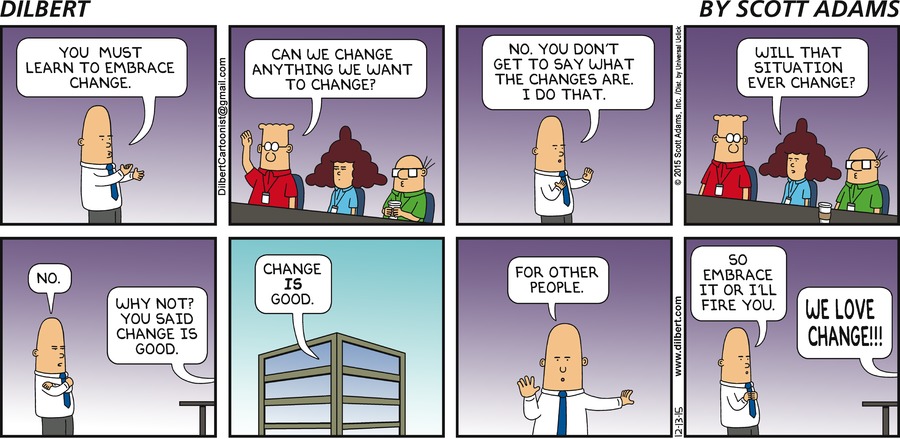
    Dilbert embrace change

    Why? Because nobody in the organisation, none of your superiors, ever bothered to ask you. The changes touch on the essence of your work, and still you were not even consulted. Instead someone at the top decided this was a good idea, let’s bring in some change experts in to implement it, and the team of consultants, who know nothing about the operational side of the work you do, are brought in to tell you what to do. Why aren’t you, as a long-time loyal employee, dedicated to achieving the aims of the organisation, being at least asked about the matter, never mind consulted? Obviously you feel disrespected and undermined, but also angry – your self-esteem is under attack. Suddenly this new system seems alien to you.

    While on reflection you would have been quite an enthusiastic proponent of the changes being proposed, because they were brought on over your head without your consent and without your views being heard, suddenly you feel estranged, and this new system appears alien. You lose motivation, you don’t want to be part of it, and you start silently resisting the change. Not because you disagree fundamentally or logically, but because of the manner this was done over your head. You were never given a say in the matter, nor a choice to opt in or out. You no longer feel respected and esteemed, you become cynical, and you, perhaps unconsciously, resist passively.

    Consequently you are now branded a change resister, and it is deemed you need to be “managed” with care. You are singled out as a laggard and for now ignored. It becomes a double blow, not only do you feel betrayed and undermined by the initial imposition, now you start losing confidence, your professional competence is called into question, you no longer feel part of the team, indeed resentment becomes stronger and stronger, you no longer want to listen, and a vicious cycle builds up. Suddenly you are a serious resister, an enemy of change, you are no longer for us but against “them”. While the consultants work on the more amenable employees, you become “the” problem, and your survival in the organisation becomes questionable, gradually instigating fear and a destructive atmosphere.

    And all because, initially, you were never asked. You were not invited to contribute to the new way forward, it was simply imposed on you from above. You feel alienated, because you were not invited to co-create the organisation’s future, and you no longer feel part of the team.

    Not consulting, not listening to, and not inviting those who do the work, those closest to the products/services and the users, and those most connected to the processes that create value, not bringing them in into the change process, not inviting them to co-create the change, are all prescriptions for failure. They reflect distrust and disrespect of an organisation’s own people. And yet this scenario happens again and again, person after person, time after time, organisation after organisation. What a waste of good resources! What a waste of energy! What a waste of great talent!

    The solution ‘should be’ fairly straight-forward, do exactly what’s missing: ASK! Invite the affected employees to co-create the change and thereby make it their own. Why don’t so many organisations follow this most basic of human leadership principles? Possibly a legacy of the command and control management attitudes of the last century? Possibly due to an inherent unconscious management distrust (and disrespect) of employees. Possibly due to lack of awareness of the inhumaneness of mandation, an unintended consequence of classical intervention. Possibly due to worries about having to “manage” large numbers of employees invited to co-create the change. And possibly simply, it has to be said, due to a lack of know-how – managers may know that engaging the workforce might be important, but they just don’t know how to go about it. The challenge is how to do it at scale.

    This is exactly the issue and the know-how a new book just silently published recently seeks to address. It is called The Open Space Agility Handbook. It is written and conceived by Daniel Mezick, respected senior agile coach in the Boston area, author of Culture Games, together with a team of experts, Mark Sheffield, Deborah Pontes, Louise Kold-Taylor, Harold Shinsato and OpenSpace Technology founder, Harrison Owen. ‘Agile’, for those of you not from the IT or software development world, is a working practice applied by software engineers, derived from ‘Lean’, which enables software development teams to be much closer to customers and to respond to their needs nimbly, thus being agile. The practice is anchored in the Agile Manifesto.

    openspaceagility_big_picture
    This diagram is copied directly from the Open Space Agility website. and represents an overview road map of OSA used in the book.
    1. Graphic (c) 2015 www.OpenSpaceAgility.com (OSA),
    2. All rights reserved; provided by permission of OSA.

    While this new book focusses on ‘Agile’, it is really about organisational transformation. The title, The Open Space Agility Handbook, sounds pretty technical and unobtrusive. And in one sense that’s all it is, as the title says, it’s a handbook on how to adopt agile practices, using a double Open Space Technology frame. What the book’s title doesn’t betray, however, is the transformative power of its approach. On one hand the book is simply a step by step guide on implementing agile. On the other hand it presents a revolutionary approach to agile adoptions, and beyond, in fact it tackles head-on one of the key challenges of organisational interventions and change management itself. As innocuous as the book may seem, don’t be fooled by its simplicity. It describes a simple solution to one of the most difficult challenges of management, that of scaled organisational change.

    While the handbook concentrates on agile only, the principles and philosophy behind the invitation approach is applicable beyond agile – you can replace “agile” with “lean”, “conscious” or “responsive”. The approach could just as easily apply to lean, teal, responsive, peer-to-peer learning, distributed leadership, conscious business, environmental sustainability, beyond budgeting, sociocracy and indeed any other form of organisational transformation. Thus whether you like agile or not, if you are involved in adoptions, implementations or transformations, this book is for you. Instead of mandating change from above, which leads to resistance or internal sabotage, the approach urges organisations to ask and invite the relevant work-force to co-create the change together, as a collaborative iterative effort, rather than imposing from above.

    The approach is based asking those doing the work about proposed adoptions or change and inviting them to co-create transformation together, using a combination of Open Space Technology and standard coaching iterative methods, ….. and thereby avoiding the tremendous waste of talent and resources arising from the imposition of change. As the concepts of INVITATION (as opposed to directed or imposed), PEER-BASED SELF-ORGANISED LEARNING (SOLE) and CHANGE CO-CREATION become increasingly understood and appreciated in organisations, so this simple how-to book will find a growing audience in and beyond agile. The approach is completely in line with what the Stanford and London Business School guru Gary Hamel has termed the ‘change platform’.

    _______________________________

    More details of the approach can be found here.

    This blog was first published in Medium on 21 December 2016
  • Thurs 20 – Fri 21 August ’15: Deep shift and radical innovation with Open Space

    The art of hosting participant-led unConferences, solving complex problems, accelerating action, leading change in organisations, and hosting conversations that matter.

    An experiential 2 day co-learning workshop: Brighton, with Martin Grimshaw and Francois Knuchel

    * We regret that this date has been postponed – we are currently arranging a new date in October ’15 – please contact us to request a preference and early bird discount *

     A very limited number of ‘pay-what-you-want’ tickets are available on application. You just need to tell us a dazzling (but short) story of why you think the world will be a better place for you being on the course.

    Also: Fri 12 June 1 day, London, Unleash The People With Open Space
    Tue 21 July, unConference: Shift – Why aren’t organisations shifting?

    Eventbrite - Deep shift and radical innovation with Open Space

     #OpenSpaceTech

    Why?

    PageLines- Collectiveintelligencegroupinnovationlightbulb.jpgDo you want a way to rapidly launch new projects, bring participation, engagement, equality and inclusion to your organisation or event? To harness collective ingenuity for problem solving? To lead transformation that is real and lasting? To drive innovation?

    What?
    Learn how to organise and facilitate gatherings using Open Space Technology, a method by which a large group of people can organise themselves into a conference, complete with agenda, break-out sessions, action planning and reports, with almost no preparation before-hand. Open Space allows each participant to do what they came to do, and can be a very effective way of launching large-scale change or responding to a looming crisis.

    Eventbrite - Deep shift and radical innovation with Open Space
    Who?

    This workshop invites those who are new to using Open Space and those who already have some or even extensive experience of using it, to co-learn together, deepen our practice, and share our experiences of using it. In this 2 day workshop we will have the opportunity to experience Open Space as attendees commonly do, with space to reflect and to go deeper into designing an event as part of a broader programme.

    How?
    This workshop will be run as an Open Space so that participants can learn experientially, while learning how to design, prepare and facilitate an Open Space event, including tips and tricks, likely issues that may be encountered, follow up and incorporating an event within a wider context or strategy.


    What is Open Space?
    Open Space Technology is a format for organising compostable conferences, unconferences, meetings, stakeholder engagement, BarCamps and CityCamps, with maximum efficiency and minimum time and resources. It is a form of ‘crowd sourcing’ which can be used to bring together a company or any group or organisation to focus on a specific problem or question. Open Space allows for participants to co-create experience, learning and solutions in a way that unlocks creativity.

    Open Space is used by large companies, local government, community activists, and forward thinking organisations everywhere, from gatherings of 5 to several thousand people, from a couple of hours to several days.

    Eventbrite - Deep shift and radical innovation with Open Space

    Please contact us if you would like to hire us as facilitators, consultants or trainers.

    Caterfly Logo slogan urlMartin and Francois also use the Open Smart Transformation model at Caterfly to bring about deep and lasting transformation or problem solving in organisations with Open Space.

    Find out more about Open Space here – What is Open Space?

    Please click on subscribe for low volume training and new articles, and click on events for schedule.

  • 12 June, London: Unleash the people with Open Space

    Caterfly in partnership with There’s Better Ways Of Working present:

    The art of hosting participant-led unConferences, solving complex problems, accelerating action, leading change in organisations, and hosting conversations that matter.

    #OpenSpaceTech

    An experiential co-learning workshop: London, one day, with Martin Grimshaw and Francois Knuchel

    Also: Thurs 20 – Friday 21 August, Brighton, Deep Shift And Radical Innovation with Open Space
    Tue 21 July, unConference: Shift – Why aren’t organisations shifting?
    facebook_32

    Eventbrite - Unleash the people with Open Space

    Why?
    Jigsaw puzzle handsDo you want a way to rapidly launch new projects, bring participation, engagement, equality and inclusion to your organisation or event? To harness collective ingenuity for problem solving? To lead transformation that is real and lasting? To drive innovation?

    What?
    Learn how to design and facilitate gatherings using Open Space Technology, a method by which a large group of people can organise themselves into a conference, complete with agenda, break-out sessions, action planning and reports, with almost no preparation before-hand. Open Space allows each participant to do what they need to do, and can be a very effective way of launching large-scale change or responding to a looming crisis.

    Who?
    This workshop invites those who are new to using Open Space and those who already have some or even extensive experience of using it, to co-learn together, deepen our practice, and share our experiences of using it.

    How?
    This workshop will be run as an Open Space so that participants can learn experientially, while learning how to design, prepare and facilitate an Open Space event, including tips and tricks, likely issues that may be encountered, follow up and incorporating an event within a wider context or strategy.

    Eventbrite - Unleash the people with Open Space

    What is Open Space?
    Open Space Technology is a format for organising compostable conferences, unconferences, meetings, stakeholder engagement, BarCamps and CityCamps, with maximum efficiency and minimum time and resources. It is a form of ‘crowd sourcing’ which can be used to bring together a company or any group or organisation to focus on a specific problem or question. Open Space allows for participants to co-create experience, learning and solutions in a way that unlocks creativity.

    Open Space is used by large companies, local government, community activists, and forward thinking organisations everywhere, from gatherings of 5 to several thousand people, from a couple of hours to several days, even with little notice or preparation.

     * A very limited number of ‘pay-what-you-want’ tickets are available on application. You just need to tell us a dazzling (but short) story of why you think the world will be a better place for you being on the course.


    Please contact us if you would like to hire us as facilitators, consultants or trainers.

    Caterfly Logo slogan urlMartin and Francois also use the Open Smart Transformation model at Caterfly to bring about deep and lasting transformation or problem solving in organisations with Open Space.

    Find out more about Open Space here – What is Open Space?

    More workshops and events: Going Deeper with Open Space (August, 2 days), Shift: Why Aren’t Organisations Shifting? (21 July). Click on events for details.

    Please click on subscribe for low volume training updates and new blogs

  • 21 July, London: Shift – Why aren’t organisations shifting?

    Caterfly Logo Url 313x148Caterfly presents: a 1 day participant-led ‘Open Space’ event exploring the need for transforming the way we work together, the move toward more collaborative, responsive workplaces, for businesses that place the customer at the centre, with respect for people and planet, the reality, complexity and barriers to change, and ways to move forward.

    Share. Learn. Connect: Building alliances for collective impact

    Full details: http://events.caterfly.co.uk

    #OrgShift

    Eventbrite - Why aren't Organisations Shifting?

    facebook_32

    Just as the combined efforts of the powers-that-be in the 16th and 17th Centuries were unable to halt the progress of Copernicus’ Revolution in astronomy, so also today’s big hierarchical bureaucracies, though seemingly all-powerful, will ultimately succumb to the power of a better idea for running organizations—better for customers, better for employees, better for managers, better for society, and better for the organizations and their investors.

    Steve Denning, Forbes: The Copernican Revolution In Management


    Butterflies Shift 26024690_ml

  • Do change mandates work?

    Do change mandates work?

    Do Organisational Change Mandates Work?


    It has been my contention for a long time that one of the reasons change mandates experience a 60%-80% failure rate (depending on definition, metrics etc) is not because there is anything wrong with the new system or working practice an organisation is implementing, nor because of poor communication or persuasion skills of the executives or consultants charged with the intervention, but rather very simply because the employees affected are often not asked nor consulted in the matter. They are simply informed of the changes as a fait accompli, they are not invited to co-create the future of the organisation. This in turns leads to disengagement, disenchantment or even cynicism, which can create a block in the change being implemented.

    Resistance to Change?

    This block is often expressed as “resistance” to change, and most change management programs are often about “managing” this alleged “resistance”.  Actually, however, in most cases it is not change itself people are resisting, but rather the imposition of a system or practice in which they had no involvement in creating, and is thus alien. Margaret Wheatley put it this way:

    [People don’t] … accept imposed solutions, pre-determined designs, or well-articulated plans that have been generated somewhere else.  Too often, we interpret their refusal as resistance.  We say that people innately resist change.  But the resistance we experience from others is not to change itself. It is to the particular process of change that believes in imposition rather than creation.  It is the resistance of a living system to being treated as a non-living thing.

    Or as Peter Senge says: “People don’t resist change, they resist being changed.”

    In other words the problem with change and the alleged resistance to change is not change itself, but rather the imposition or mandation of change from above. Japanese organisations have no problem with change, it is part of their culture. This is outwardly reflected in the agility of their buildings to adapt to changing environmental circumstances (typhoons, earthquakes), in traditional shrines being ‘rebuilt’ periodically, and in the fluidity between inner and outer space. In my experience Japanese organisations are continuously re-organising themselves according to changing circumstances, and this is done by all employees, down to the shop-floor, who are taught how to solve problems and how to adapt nimbly. Management consultancies hardly exist in Japan (yes, the McKinseys have plush show offices in Tokyo, but their clients are largely expatriate companies) – you do not need expensive change consultants when you can self-organise and change yourself.  Change in Japan is not something thought out at the top, but rather everyone in the organisation is engaged in co-creating the changes.

    The problem with Western organisational change, as I see it, is having too rigid organisational structures in the first place (inflexibility by design), imposing change from above without asking those doing the work first, and not giving the workforce the tools and authority to solve their own problems, and hence to co-create change when and as it is required.

    The Zappos Case

    Recently Zappos, the unique online shoe retailer based in Nevada, has been in the news about a memo from its CEO, Tony Hsieh, to its employees in which he offers all of them severance pay if they wish to leave the company because they are not comfortable in its new management environment. In the last 18 months the 1,500 strong company has been embarking on a massive change program, converting from a ‘command and control’ management structure, to one without formal managers, giving all employees equivalent decision-making powers to elect people to specific needs-based tasks or roles in a self-managed manner. The approach is known as ‘holacracy’, a derivative of the Dutch Quaker creation ‘sociocracy’ (find out more here). This full scale adoption of holacracy is the largest of its kind to date, hence many are following the story with keen interest.

    The implementation requires a “roll-out” of a substantial amount of training (running meetings, consent decision-making, circle formations), and the program is now running to a first completion stage. It is clear that it has faced certain difficulties, both successes as well departures by disenchanted staff. Here are a few links to recent reports:

    The Zappos story is actually a more interesting case, in my view, than most change programs: in a manner of speaking management here is mandating to abolish itself.  The self-organising aspect of holacracy is, in my view, somewhat similar to Japanese management styles. True Japanese firms have managers in a hierarchy, but managers are more like mentors who attribute authority to solutions their staff have come up with and consented to.  Moreover the fundamental information flow is horizontal working towards satisfying customers, rather than vertically serving shareholders.  Prof Kichiro Hayashi (Tokyo Aoyama University) has referred to Japanese (and Oriental in general) management as organic.  This organic style is very flexible and agile at adapting to changing circumstances, yet rather inefficient and seemingly disorganised in a static world; whereas Western ‘mechanical’ management is super-efficient in a stable world, but lacks the capacity to self-organise and self-change.

    Ordering no more Orders

    The Zappos story is thus to me an interesting Western attempt to address this, and in light of the perceived need to transform our capitalism it is being observed by many with keen interest.  You might expect employees to embrace the opportunity to take on more responsibility, without having to be accountable to the eccentricities of a boss. Many do. But as Erich Fromm has shown, many also fear freedom. For some, in a world where they have been used to receiving orders, operating without them is scary and may create in them profound disorientation.

    Nevertheless with support and coaching most people could easily get used to the new approach, though the bigger the organisation the more difficult it is to do. At the same time, however, there is a felt contradiction in the CEO being required to order that there would be no orders from hence on. To be fair to holacracy, its website says this about this apparent paradox of the CEO needing power to adopt holacracy: “Holacracy is a fundamental shift of authority: it changes the seat of power from the CEO to the Holacracy Constitution, which then distributes that power through specific processes. You cannot shift the seat of power without the CEO’s approval (and shouldn’t be able to). …, you need a formal agreement from that CEO to vest her/his power into something else — in this case the Holacracy Constitution. Without this formal agreement, you would just be “pretending” to work differently

    So what is it, then, that is causing the CEO to posit such an ultimatum “self-organize or leave the company”? Why is this change program evoking such drastic measures? True, the severance package is very generous, yet the dictum feels a little like a dictator forcing subjects to participate, initiate (with their own views) and be engaged. I cannot speak for holacracy, but that would defeat the purpose of its parent methodology, sociocracy, which envisions “people working together as different, unique persons on the basis of mutual equivalence in decision-making” – yet seemingly no differences are allowed at Zappos.  This contravenes the desirability for diversity in order to create richness in decision-making. Unintentionally I suspect, it does look like Zappos want clones of each other. Yet can you really offer severance packages to family members?

    So why resistance?

    So why is there resistance, what is it some staff are riling against? The issue I believe is that holacracy was mandated or imposed. Staff were never asked or consulted whether they wanted holacracy, nor were they invited to co-develop the holacracy transformation. It was simply imposed on them. Somewhat paradoxically, but imposed nevertheless. What people are really rejecting is not holacracy itself, but being forced to change without consultation. This comes back to what I said initially, it is not the system or new behaviour that people are resisting, but the way it is being mandated and imposed. Holacracy may be a great idea, but mandating it doesn’t work. In the case of Zappos, this was already predicted a year ago in March 2014 in the blog “The Mandate of Holacracy at Zappos” by Daniel Mezick, author of Culture Games and agile coach, who was investigating why it was that 80% of agile adoptions were considered unsuccessful.

    In short it is mandation which is the problem, not holacracy nor resistance to change in general. This is what we at Caterfly are trying to address with the Open Smart Transformation model, involving a special framework of two Open Space Technology events, where all affected personnel are invited to hold deep dialogues about the change. The two events also demark a period of 3 – 6 months, a cocoon of iterations, in which all employees are trained and coached in the new approach, are asked to suspend judgement and instead apply the new way on a trial and error basis, learning and prototyping, enabling all affected to be involved and engaged in the transformation process. This open ended playful period ends with a second Open Space event where everyone can work on sorting out what worked, what needs adapting and what to reject. In other words the new approach thereby becomes customised to the particular organisation, rather than being something off the shelf, and this work is all done collaboratively by the staff.  Consequently they own the change, it is no longer an alien system, they all co-created the transformation together.

    This process was initially developed and applied with great success fo agile adoptions where typically 70 – 80% failed. We realised that the fundamental principles of the new approach are true beyond just agile. They apply to adopting lean, responsive, management 3.0, conscious capitalism, environmental management, and holacracy/sociocracy too, and indeed of any new systems implementation or organisational transformation / change management. While what Tony Hsieh is trying to do is not only extremely noble and brave, and is being done with a great deal of generosity and candidness, it is a great pity it had been mandated initially. I am sure he could have avoided this “accept holacracy or get out” dilemma, if Zappos had invited the staff to co-create the change rather than imposing it on them. However generous the severance package offer may be, it now puts Tony Hsieh in a difficult position – some staff may see him, in trepidation, as the ultimate arbiter of who is to stay and who is to go.

    Change Platform

    In short, mandation or imposition does not work well! This is also summarised in Gary Hammel’s McKinsey article late 2014 “Build a Change Platform, not a Change Program”. Caterfly’s iterative cocoon-forming double open-space framework and follow up is such a platform, we believe, or at the very least helps establish one. Fundamentally we need to change change itself from a mandation mind-set to one of invitation: inviting all affected persons to co-create the new order of things, and thereby co-own it.  Open Space Technology, doubled to form an iterative cocoon platform, is the only offline synchronous platform I am aware of that enables this to scale with large numbers of people, effectively, rapidly and sustainably.


    Come join us at Shift: Why Aren’t Organisations Shifting? 21 July 2015, London
    Details www.caterfly.co.uk/events

    Further reading:
    Why telling people what to do doesn’t work – click
    The problem with change management – click


  • The problem with change management

    The problem with change management

    The Problem with Change Management

    As a coach I have always steered away from ‘change management’, even though it is a huge industry and I would probably have done quite well in it. Intuitively change management has always struck me as unfair or oppressive, even when it was well-intentioned and perfectly rational. It has appeared to me one-sided, often with senior management wanting to enforce a new system or a new way of working, yet were themselves unwilling to change their own habits or behaviours. I even felt this sense of unease when I was a ‘senior manager’ myself!  ‘Change management’ renders an air of blame, injecting fear, and when things are not working it’s ‘because the staff are incompetent, or lazy, or otherwise doing things wrong – they need to change’. It is not a genuinely collaborative effort.

    Change has often seemed to me to be imposed. Moreover it is rarely ever on a level playing field, and seldom a two-way process. I have observed so many situations in companies, for instance, where improvements have been suggested by more junior staff which have then simply been brushed off as ‘get on with your work’, ‘that’s not your job’ or ‘we know what we are doing’. The voices of staff are often ignored, even though they are the ones actually doing the work and would be in a better position to know. The Stafford hospital scandal is a typical case where staff were not listened to – after all “what do nurses know about management?” I personally experienced the inner sarcasm felt by the Heathrow T5 staff before the new terminal opened, who knew exactly where all the problems were long before the opening, but were simply ignored – the ensuing fiasco could well have been avoided, if they had been listened to.

    Even where there is a recognition that some form of consultation needs to take place, more often than not this is done only after the major decisions have already been taken, and there is little influence staff can have. Instead senior executives are advised by consultants that they need to brush up their communication skills, the reason change is not working is because staff have not been informed well enough about the purpose of the change, what it will look like and who is responsible for what. Malfunctioning change programs are often blamed on poor communication, as if better persuasive skills would make the change work.

    “People don’t resist change, they resist being changed.” Peter Senge

    Overall I agree with Ron Ashkenas in his Harvard Business Review blog Change Management Needs to Change that the poor success rate of change management initiatives lies less in the content or strategy of change, but in the poor preparation and skills of the senior executives in implementing the change. Implementation is often delegated down to an army of ‘consultants’ and ‘champions’. For every 100 business books on strategy, 98 are on strategy development and only 2 on implementation. We are sorely lacking in implementation skills and the way implementation itself will and should inform strategy. Not surprisingly this gives rise to the deep disconnect between managers and the managed, between politicians and the electorate, between “the system” and its participants.

    The same fundamental problem exists in day to day operations, never mind change management, in ordinary decisions. Decisions are taken without consulting the affected staff; these are then poorly executed or sometimes even simply sabotaged by the staff – fundamentally because they were never asked. It never ceases to amaze me how corporate decisions are made without even asking, never mind eliciting suggestions from, the staff affected, those who actually do the work. Executives expect the decisions to somehow be carried out, as if mechanically, and are then surprised when things do not get done, blaming the reticence of staff. Executives spurt out strategies and wonderful soundbites left right galore, but when it comes to implementation they are rather thin on the ground.

    “Separating knowledge and decision making authority leads to bad decisions.” Mark Seuffert

    The basic problem is simple: people are not asked. Strategies and change programs are developed by executives behind closed doors, and then mandated. What should be happening is that those affected need to be invited into the process, invited to co-author the new story. This is often viewed as time-consuming and unnecessary, despite statistical evidence to the contrary, even though there exist good processes or practices (like Open Space Technology) which can make this very effective. Adoptions need to involve the whole workforce, and not a few elite making the decisions and ‘rolling’ them out. All staff need to be invited, to explore what, how and why change or improvement could be executed, how we can all work on it together, and most importantly to truly listen to all the suggestions, ideas and different perspectives from the workforce.

    You cannot impose (command) participation or engagement, it’s a contradiction of terms – yet this is precisely what many change management programs still try to do. Words like ‘buy-in’ send a cringe down my spine – it implies being sold to, being had or manipulated, without a real equivalent discussion. ‘Empowerment’ implies that someone has power and passes some of it on – what an insult! Even change programs which are supposed to distribute decision-making among the work force, like agile or holacracy, have been mandated, often with resulting unexpected high staff turnover. As a lean-kaizen and sociocratic coach I also need to be very careful not to impose these brilliant systems on others, but rather to invite all into the process. It is not the quality of the new system which is in question, but the quality of the collaboration, implementation and initial consent. Invitation is the key – inviting all affected to co-create the change.  The simplest, yet most difficult, thing to do is simply to ask.

    Wouldn’t you like to be invited and consulted every time those around you change something?

    Find out more about how we use the power of invitation and collaborative transformation at Caterfly.

    Further reading:
    More on the Stafford hospital crisis and simple shifts for more effective working and inclusion – click
    Why telling people what to do doesn’t work – click
    What is Open Space? – click

  • What is Open Space?

    What is Open Space?

    Image: Annette Zera: The Law Of Two Feet / Butterflies

    What is ‘Open Space’?

    Open Space Technology, commonly Open Space, is a social technology, a tool for helping people to rally around a shared challenge, with minimum obstacles and maximum efficiency. It is used to organise large meetings, gatherings, conferences, problem solving and summits in which everyone has the opportunity to participate on their own terms.

    Open Space is nothing new. The process was developed by Harrison Owen in the 1980’s and it has been applied countless thousands of times, in at least 135 countries, in a variety of ways, with groups of just a few people to several thousands, from hours to several days, and longer. However, the basic process and principles perhaps reach back into ancient human history.

    Open Space offers a clear framework for allowing us to achieve remarkable things. Open Space embraces complexity and chaos, yet it remains confoundingly simple while enabling creativity and productivity to flourish.

    The results can not only be dramatic, but its effect on participants used to the confines of careful planning, hierarchy, telling others what to do and being told what to do, can be transformative and enriching.

    “Everything the Power of the World does, is done in a circle.”
    Black Elk, in Black Elk Speaks

    Who is it for? What does it do?

    Open space events have many applications. The most obvious one is as an alternative form of a conference – a conference without speakers, where the participants’ heart-felt issues are at the centre of discussion. This form can be applied in a multitude of settings, wherever there is an issue people have a common passion about, in

    • communities
    • political gatherings
    • peace talks
    • neighbourhoods
    • research or
    • specialist areas.

    Open Space is a completely opt-in event, so invitations go out to many people and those passionate about the theme turn up.

    Within organisations Open Space can also be applied for more specific purposes.  Open Space can be used for:

    • product design and development (synchronisation)
    • strategy development, bringing in whole workforce
    • supply-chain issues, coordinating suppliers
    • redesigning the organisation, bottom up
    • innovation and prototyping, including customers
    • complexity problem solving using diverse perspectives
    • collective intelligence letting future emerge
    • inviting an organisational transformation process

    It is this latter application, inviting the relevant workforce to co-create an implementation or a transformation that our Caterfly Open Smart Transformation is concerned with.

    In all case Open Space is a way of inviting a larger number the workforce into the process, thus opening the space for a larger view of things, rather than leaving it to a few select people to manage.  This is particularly important where there are big issues at stake which ignite the passions of many people.  The self-organising aspect of Open Space enables any number of people to be involved efficiently and constructively.

    Open Space Events can be from 1/2 day to several days.  It should be noted, however, they are far more effective and powerful when run over 2 or 3 days.  This is because the first day tends to focus on current and past issues, and after a night’s sleep new ideas and energies are created which means the second and third (action planning) days are far more creative, and make use of the synergies of the minds present.

    How does it work?

    The basic process is counter intuitively straightforward:

    * Clearly define the challenge, and express it in a few words. This is what you are inviting participants to get enthused about.

    Photo: Stanley Park / World Open Space on Open Space 2009
    Photo: Stanley Park / World Open Space on Open Space 2009

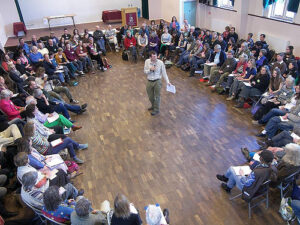
    * Everyone sits in a big circle. A facilitator gives some basic instructions, then lets them get on with it.

    * There is no prepared agenda, just a big blank board with available time slots and areas to use. Participants are invited to articulate what they really want to know, share, discuss or work on, and co-create the agenda with whatever sub topics they want.

    * People then work out what seems most important, urgent or interesting to them, and go there. Some people will likely end up either flitting about from discussion to discussion, or getting a cup of tea and serendipitously having just the brain wave or interaction they need right there.

    * Through the event people share what they’ve done, thus building a kind of ‘collective consciousness’ of the whole shebang.

    * Toward the end of the event, everyone comes back together in a big circle and shares what they did, learnt, or what they want to happen next.

    * Usually all participants get an anthology of the summaries of each session, perhaps with a plan of action, or key outcomes.

    * Go home and let go, until the time comes to do something again.

    Turn up if you want to, do what feels important, let others do what they feel is important, let go and allow it to happen in whatever way participants conspire to make happen. 

    The reason it seems to work

    Leaders and facilitators allow people to work it out for themselves and get out of the way. No one is coerced, and no one has to be there. Opt-in participation devolves responsibility to individuals to choose to follow their passion.

    light bulbs sketched on chalkboard Many small ideas make a big oneThere are some basic principles to help people let go of trying to be in control, and embrace what is actually happening. A metaphor would be a surfer, who rather than trying to direct the waves, finds the right place to catch one and ride it.

    There is just one firm rule, known as The Law Of Two Feet, although it is more of a playful hint than strict instruction. The Law says that ‘if you are neither learning nor contributing, it is your duty to find another place to be.’ Rather than choosing a session and being stuck in it or feeling obliged, participants are encouraged to move around, increasing impact and efficiency for the individual, for each sub group, and for the whole.

    Rather than try to solve a problem with just one brain, perhaps the boss or a management team, or trying to engage numerous individuals over a long period of time, Open Space harnesses the creativity and skills of everyone, all at once. What might take a dedicated team many months, gets accelerated over a very short burst, and results in more brilliant solutions that no one could have predicted.

    Organising people is hard work and inefficient. Helping people to organise themselves is surprisingly easy, effective and energising. Meanwhile, it becomes easier for people to really engage, and those voices can be heard which often aren’t.  Open Space works particularly well where there is no known outcome, with very complex issues and where any form of pre-planning is futile as letting the future emerge rather than trying to control is essential.

    Relax nothing is under controlA part of how Open Space came to be discovered, was Harrison Owen’s experience while co-organising a conference. It took a lot of effort. People showed up, and sat passively in rows of chairs listening to experts. But when the coffee breaks came, the event came alive, buzzing with spontaneous conversation. The coffee break was the best bit. Open Space is an attempt to turn the entire experience into something like the coffee break. Some people started thinking of it as the opposite of a conference, and now the term unConference has become more common.

    Lastly, Open Space events can also be significantly greener, utilising human resources more than material. I often refer to them as ‘compostable conferences.’

    And that’s it.

    “There is no order without chaos.”
    Harrison Owen at TEDx, Dancing with Shiva: Are we working too hard? 

    Further reading and Videos:

    Wikipedia: Open Space Technology

    Harrison Owen’s Brief History of Open Space

    Open Space World resources

    How Caterfly is pioneering Open Space for Innovation and Kaizen or using it in organisations to invite cultural transformation

    Caterfly’s model is based on Daniel Mezick’s innovative Prime/OS™ model, using Open Space to adopt Agile working and more

    Chris Corrigan article, on using Open Space to solve complex problems

    Huffington Post Business article, Opening The Space For Innovation

    Martin Grimshaw’s Open Space Facilitator’s Checklist

    Open Space Facilitators around the world: Open Space World Map

    A large collection of video samples in Evocative Open Space Videos, especially the following 3 short videos give a good overview of what Open Space is and what it looks like in action: