Tag: leadership

  • What is Open Space?

    What is Open Space?

    Image: Annette Zera: The Law Of Two Feet / Butterflies

    What is ‘Open Space’?

    Open Space Technology, commonly Open Space, is a social technology, a tool for helping people to rally around a shared challenge, with minimum obstacles and maximum efficiency. It is used to organise large meetings, gatherings, conferences, problem solving and summits in which everyone has the opportunity to participate on their own terms.

    Open Space is nothing new. The process was developed by Harrison Owen in the 1980’s and it has been applied countless thousands of times, in at least 135 countries, in a variety of ways, with groups of just a few people to several thousands, from hours to several days, and longer. However, the basic process and principles perhaps reach back into ancient human history.

    Open Space offers a clear framework for allowing us to achieve remarkable things. Open Space embraces complexity and chaos, yet it remains confoundingly simple while enabling creativity and productivity to flourish.

    The results can not only be dramatic, but its effect on participants used to the confines of careful planning, hierarchy, telling others what to do and being told what to do, can be transformative and enriching.

    “Everything the Power of the World does, is done in a circle.”
    Black Elk, in Black Elk Speaks

    Who is it for? What does it do?

    Open space events have many applications. The most obvious one is as an alternative form of a conference – a conference without speakers, where the participants’ heart-felt issues are at the centre of discussion. This form can be applied in a multitude of settings, wherever there is an issue people have a common passion about, in

    • communities
    • political gatherings
    • peace talks
    • neighbourhoods
    • research or
    • specialist areas.

    Open Space is a completely opt-in event, so invitations go out to many people and those passionate about the theme turn up.

    Within organisations Open Space can also be applied for more specific purposes.  Open Space can be used for:
    • product design and development (synchronisation)
    • strategy development, bringing in whole workforce
    • supply-chain issues, coordinating suppliers
    • redesigning the organisation, bottom up
    • innovation and prototyping, including customers
    • complexity problem solving using diverse perspectives
    • collective intelligence letting future emerge
    • inviting an organisational transformation process

    It is this latter application, inviting the relevant workforce to co-create an implementation or a transformation that our Caterfly Open Smart Transformation is concerned with.

    In all case Open Space is a way of inviting a larger number the workforce into the process, thus opening the space for a larger view of things, rather than leaving it to a few select people to manage.  This is particularly important where there are big issues at stake which ignite the passions of many people.  The self-organising aspect of Open Space enables any number of people to be involved efficiently and constructively.

    Open Space Events can be from 1/2 day to several days.  It should be noted, however, they are far more effective and powerful when run over 2 or 3 days.  This is because the first day tends to focus on current and past issues, and after a night’s sleep new ideas and energies are created which means the second and third (action planning) days are far more creative, and make use of the synergies of the minds present.

    How does it work?

    The basic process is counter intuitively straightforward:

    * Clearly define the challenge, and express it in a few words. This is what you are inviting participants to get enthused about.

    Photo: Stanley Park / World Open Space on Open Space 2009
    Photo: Stanley Park / World Open Space on Open Space 2009

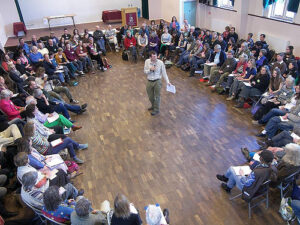
    * Everyone sits in a big circle. A facilitator gives some basic instructions, then lets them get on with it.

    * There is no prepared agenda, just a big blank board with available time slots and areas to use. Participants are invited to articulate what they really want to know, share, discuss or work on, and co-create the agenda with whatever sub topics they want.

    * People then work out what seems most important, urgent or interesting to them, and go there. Some people will likely end up either flitting about from discussion to discussion, or getting a cup of tea and serendipitously having just the brain wave or interaction they need right there.

    * Through the event people share what they’ve done, thus building a kind of ‘collective consciousness’ of the whole shebang.

    * Toward the end of the event, everyone comes back together in a big circle and shares what they did, learnt, or what they want to happen next.

    * Usually all participants get an anthology of the summaries of each session, perhaps with a plan of action, or key outcomes.

    * Go home and let go, until the time comes to do something again.

    Turn up if you want to, do what feels important, let others do what they feel is important, let go and allow it to happen in whatever way participants conspire to make happen. 

    The reason it seems to work

    Leaders and facilitators allow people to work it out for themselves and get out of the way. No one is coerced, and no one has to be there. Opt-in participation devolves responsibility to individuals to choose to follow their passion.

    light bulbs sketched on chalkboard Many small ideas make a big oneThere are some basic principles to help people let go of trying to be in control, and embrace what is actually happening. A metaphor would be a surfer, who rather than trying to direct the waves, finds the right place to catch one and ride it.

    There is just one firm rule, known as The Law Of Two Feet, although it is more of a playful hint than strict instruction. The Law says that ‘if you are neither learning nor contributing, it is your duty to find another place to be.’ Rather than choosing a session and being stuck in it or feeling obliged, participants are encouraged to move around, increasing impact and efficiency for the individual, for each sub group, and for the whole.

    Rather than try to solve a problem with just one brain, perhaps the boss or a management team, or trying to engage numerous individuals over a long period of time, Open Space harnesses the creativity and skills of everyone, all at once. What might take a dedicated team many months, gets accelerated over a very short burst, and results in more brilliant solutions that no one could have predicted.

    Organising people is hard work and inefficient. Helping people to organise themselves is surprisingly easy, effective and energising. Meanwhile, it becomes easier for people to really engage, and those voices can be heard which often aren’t.  Open Space works particularly well where there is no known outcome, with very complex issues and where any form of pre-planning is futile as letting the future emerge rather than trying to control is essential.

    Relax nothing is under controlA part of how Open Space came to be discovered, was Harrison Owen’s experience while co-organising a conference. It took a lot of effort. People showed up, and sat passively in rows of chairs listening to experts. But when the coffee breaks came, the event came alive, buzzing with spontaneous conversation. The coffee break was the best bit. Open Space is an attempt to turn the entire experience into something like the coffee break. Some people started thinking of it as the opposite of a conference, and now the term unConference has become more common.

    Lastly, Open Space events can also be significantly greener, utilising human resources more than material. I often refer to them as ‘compostable conferences.’

    And that’s it.

    “There is no order without chaos.”
    Harrison Owen at TEDx, Dancing with Shiva: Are we working too hard? 

    Further reading and Videos:

    Wikipedia: Open Space Technology

    Harrison Owen’s Brief History of Open Space

    Open Space World resources

    How Caterfly is pioneering Open Space for Innovation and Kaizen or using it in organisations to invite cultural transformation

    Caterfly’s model is based on Daniel Mezick’s innovative Prime/OS™ model, using Open Space to adopt Agile working and more

    Chris Corrigan article, on using Open Space to solve complex problems

    Huffington Post Business article, Opening The Space For Innovation

    Martin Grimshaw’s Open Space Facilitator’s Checklist

    Open Space Facilitators around the world: Open Space World Map

    A large collection of video samples in Evocative Open Space Videos, especially the following 3 short videos give a good overview of what Open Space is and what it looks like in action:

  • Why coercion doesn’t work

    Why coercion doesn’t work

    Tuesday 21 July 15, Victoria, London: Shift, a participant-led Open Space event
    Why aren’t organisations shifting? www.events.caterfly.co.uk

    “People don’t resist change, they resist being changed.” Peter Senge

    As any parent knows, as soon as a child starts to develop a sense of identity, they start to assert their boundaries and free will by saying No.

    Human nature being what it is, we have an innate hardwired resistance to change and to being told what to do, that starts as children and generally lingers from thereon. Attempts to creatively and positively work with this phenomenon can be seen in alternative education, where teaching at pupils is replaced by self-led learning, encouraging autonomy and curiosity.

    Achieving Buy-in

    In the workplace getting others to do what is wanted of them, and getting them to engage, care and want it, is known as ‘achieving buy-in.’ It is the classic and everyday challenge faced by leadership and management trying to get staff to do stuff, and at its worst it feels like coercion. Attempts to lead organisational change are often met with cultural inertia.

    Throwing Unconscious Spanners

    I remember sitting in a team meeting many years ago and witnessing something that led to a profound insight that has stayed with me ever since. A member of staff, arms crossed and a look of consternation on her face, responded to the manager with something like, ‘Well, I never did really agree with that strategy we initiated fours ago.’

    That strategy was the manager’s, introduced upon staff who all nodded along and set about it with varying degrees of compliance, enthusiasm, disgruntlement or sabotage depending on how much they quietly thought it was a good or bad idea. That strategy probably worked to some extent without really catching fire, despite staff being paid to do what they are told and annual performance appraisals.

    I have seen this pattern repeated over and over. In the workplace, we commonly consciously or unconsciously throw spanners in the works of someone else’s well laid plan.

    Or as a friend told me recently, “I got an F in GCSE electronics because my project was made entirely of wood.” Which neatly illustrates to me the fallacy and depressing failings of coercive education.

    Consent is sexy, as they say

    “The ultimate weapon has always existed. Every man, every woman, and every child owns it. It’s the ability to say No and take the consequences.” It is what distinguishes us from robots.
    Hagbard Celine, The Illuminatus! Triology, Robert Shea and Robert Anton Wilson. 

    Rather than attempting to ‘achieve buy-in’, why not allow people to solve problems and draw up their own action plans? People tend to find solutions that they have helped to co-create more exciting, and once genuine or even enthusiastic consent has been reached, tend to set about the task with gusto. Participation doesn’t just work, it is more effective in the long run, and if harnessed well then multiple view points can lead to smarter decisions. Allowing people to set their own pace and write their own story, helps to dissolve change fatigue so common in organisations, where staff might be under a constant barrage of brilliant new ideas, at the mercy of merry-go-round leadership and consultants.
    Barriers and the Bottom-up Manifesto

    There are barriers too. We are habituated into patterns of behaviour that were often set early in life and reinforced in school and work for all but the more maverick and rebellious of us. We’re used to being told what to do. Working stuff out for ourselves can feel daunting and unusual. We tend not to be brilliant at collaborative decision making, and too often remain stuck in the competitive need to win, rather than seek the win-win. Tools that encourage self-organisation and ownership bring out the better in us, but also bring out the rest in us. Over time behaviour shifts, but habits are notoriously persistent.

    Self-propelled learning and problem solving also means that managers need to learn to let go of control, which can also be discomforting and even threatening. Positive results and an enthused workforce, however, soon illustrate the benefits of new approaches. Rather than well-intentioned directives cascading down the hierarchy to be met with indifference or the feigned relish of the easily replaced, how about asking staff to collaborate with leaders to find pathways that finally utilise their long ignored insight? Why not try introducing some bottom-up alongside the old top-down?

    Leaders and managers might just discover that the expertise they seek was hiding under their noses all along.


    See also: The Problem With Change Management

    Beyond unConferencing: New Uses of Open Space

  • Kaizen – rejuvenating your organisation

    You may also like our short piece: What is Kaizen? and our explanation of how Caterfly is pioneering the combination of Open Space with Kaizen: Innovation and Kaizen

    “A journey of a thousand miles begins with a single step.” (Lao Tsu)

    What does Kaizen mean?

    Kaizen means different things to different people. Some see Kaizen as part of the Toyota Production System, or the essence of Lean. Some have positioned Kaizen as the umbrella concept of Lean or Six Sigma. Others view it merely as a set of techniques or practices. Meanwhile, it is also seen as a leadership style or culture. Toyota see it as the “soul of the company”. To me Kaizen is a pan-organisational attitude and questioning mind-set, which fosters co-creative betterment.

    Source: Taivara

    Kaizen is fundamentally very simple. It’s nothing more than everyone (in an organisation) asking themselves a single question every day, everywhere they work: “What small step can I take to improve …. (whatever they are working on)?” The emphasis is on small, i.e. it is easy and immediate to implement. For example if you want to lose weight, reducing one lump of sugar in your coffee would be a small ‘doable’ step – as opposed to the big step of going on a full 2-month cruel diet. The Kaizen mind-set is so easy to explain, yet difficult to apply in many corporate settings.

    Kaizen is normally translated as ‘continuous improvement’, and indeed that is its effect, continuously improving the workplace, product, processes and so on, little by little. The literal translation of ‘kai’-‘zen’ is ‘good change’ (kai, kaeru = change; zen, yoshi = good), or change for the better. Indeed, strictly speaking the word Kaizen does not actually say anything about small or continuous. Masaaki Imai, who initially introduced Kaizen (as applied in Japanese companies) to the West further adds: Good change “by Everybody, Everyday, Everywhere” – and this is crucial, just little incremental steps but done by everyone regularly (continuously).

    Kaizen is not just about improving products or services; it is also about constantly improving processes (operations, standards, office workflow, production, efficiency, sustainability…..), indeed anything that may speed up, embellish, eliminate waste, simplify, reduce a step, remove toxins, fool-proof a process and so on. Kaizen is particularly useful in reducing human mistakes in routine work, by considering small steps that would prevent human errors recurring.

    We all sometimes do some simple Kaizen without knowing it, for instance in the kitchen we may move things around to make it easier to cook. Indeed we often treat our homes with a kaizen mentality in a way we don’t in the workplace. Where many people work in the same place, however, some form of standardisation is required; we cannot implement ideas willy nilly, it needs the consent of all affected. In a Kaizen workplace small Kaizen meetings are encouraged to consent to and implement these small changes – which are then also jointly celebrated, and periodically reviewed.

    Take the first step in faith; you don’t have to see the whole staircase. Just take the first step.” Martin L. King

    Kaizen culture

    Organisationally Kaizen is about culture, a ‘Kaizen culture’. Kaizen has more to do with human encouragement and development (‘hitotsukuri’) than with improving the service or product of the organisation (‘monotsukuri’). It represents personal development, but not in the abstract, rather it is totally connected to the work being done. Put the other way round, although Kaizen is deeply connected to the workplace, its products and processes, it fundamentally celebrates the human side, the personal and professional development, of all the organisation’s employees.

    “Don’t look with your eyes, look with your feet. Don’t think with your head, think with your hands.“ Taiichi Ohno

    Tim Mojonnier

    Kaizen encourages improvements by everyone, everywhere, all the time. Everyone is involved in Kaizen activities, from the top of a company (role model) to the office or shop floor, where the work is done. A Kaizen culture forces managers to actively encourage small improvements, to listen to ideas, and to enable them to be implemented. Even where there is no immediate financial gain, if it improves the working environment, it helps create happy employees, increased motivation and more engagement, which in the long run are more productive. Everyone does Kaizen – a manager’s job is to create conditions so that Kaizen can happen, an innovation platform – absolutely everyone at all levels and stations is encouraged to think autonomously and creatively.

    This means all employees are listened to, appreciated and respected (and this ties in well with the Gemba philosophy of ‘go see, ask why and respect’). Contrast this to organisations where views of subordinates are ignored, with a “that’s not your job” or “we’re already taking care of that”, or even if they are heard, managers tend to then step in and interfere or micro-manage; this in turn irks staff and engenders an attitude of ‘why bother?’ or ‘whatever!…..’. Kaizen is practiced at every level of organisation, all are involved – a structured yet liberating approach.

    “A leader must lower himself like water and give credit to his subordinates. If he wants to take credit, they will leave him soon. If a leader frequently interferes with subordinates, they will protest. A leader’s job is to create an atmosphere in which they want to do (work) for themselves with enthusiasm and can fulfil their potential.” Lao Tzu, Tao Te Ching.

    Kaizen & innovation

    Kaizen is often contrasted to Innovation – representing the big steps, the big leaps, the mega ideas. Innovation is more dramatic and produces spectacular improvements (though not necessarily sustainable). Innovation and Kaizen can be compared to the hare and the tortoise, the hare being innovation running fast with big leaps, the tortoise little steps one step at a time. Both are required. Kaizen takes a far more long-term view, there are no immediate results and so it cannot be tied to performance targets. For that reason Kaizen is often ignored in the West. But like compound interest, invisible to begin with, the benefits are enormous in the long run.

    “Kaizen is like a hotbed that nurtures small and ongoing changes, while innovation is like magma that appears in abrupt eruptions from time to time.” Masaaki Imai

    Source: Masaaki Imai / Ofi Sofyan Gumelar
    Source: Masaaki Imai / Ofi Sofyan Gumelar

    Both Kaizen and Innovation must prevail: while it is imperative that everyone is involved in small incremental Kaizen activities to create a change-ready platform, sometimes outright disruptive innovation, out-of-the-box thinking, is also needed to avoid the situation of constantly improving the wrong things, e.g. out of date products – for example continuing to refine the fax machine is largely going to be futile. There is a potential danger to watch out for where Kaizen ends up stifling innovation – radicalism is sometimes also needed. Kaizen works well for performance-improving innovations (product upgrades) and efficiency innovations, whereas out of the box innovations are better suited to market-creating innovations.

    Innovation gurus sometimes argue that management should not be ‘bogged down’ by ‘petty’ minutiae of Kaizen. But there is a difference between taking an interest in other people’s ideas and micro-controlling them – Kaizen is about encouraging people to have ideas and take initiative independently in the context of the organisation’s aims, it’s not about managing those ideas top down! Yes Kaizen may be the petty cash, while innovation are the big notes. However petty cash is the bread and butter of innovation and if ignored or belittled, one risks stifling innovation, too.

    The issue is not about whether it is innovation OR Kaizen. BOTH should co-exist and complement each other. Kaizen and innovation are different sides of the same coin. It is not one or the other, both should be applied in a complementary way.   While innovation can achieve big leaps, what Kaizen does well is enable a plethora of small stress-free improvements in all areas of an organisation by all employees to emerge, and this sustains continuity and motivation of the whole workforce.

    Does Kaizen work outside of Lean?

    Kaizen appears to be difficult to implement in the West. We are trained to think in big steps, with big goals and big ideas. As managers we have to leave our mark or legacy, or so we think. Little steps are often not taken seriously, especially in organisational settings. This contrasts completely to the Asian spirit, coming from a Taoist / Confucian philosophy, as expressed in the saying:

    “A journey of a thousand miles begins with a single step.” Lao Tsu

    It is somewhat ironic then that Kaizen as applied in organisations was first articulated by the American W. Edwards Deming. He asked Japanese workers to think every day ‘what is one small step you can do to improve the product or process?’ – Deming was talking to the right people, they valued the small tortoise-like approach (whereas his ideas were considered largely irrelevant in America). The Kaizen questioning mind found a natural home and popularity in Japan.

    Kaizen later spread to the West via Toyota’s successful Toyota Production System (TPS), where it was implemented as part of Lean Management practice. Actually Kaizen is independent of Lean. Because of its association with Lean, however, it has not really found such a foothold in the West outside of Lean as one might expect. Nevertheless, Kaizen can be applied to any form of organisational platform, whether Lean, Agile, Conscious, sustainable or Sociocratic, as well as outside work in healthcare, family and self-development.

    “Grain by grain, a loaf. Stone upon stone, a palace.” (George Bernard Shaw)

    The tools

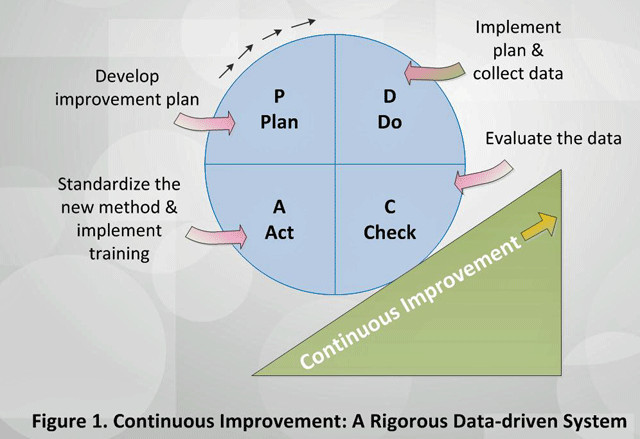
    So, what small step can you take to improve your product, your process, your life, your health, your wealth, your relationships, your ….? Kaizen applies both within work, organisations and personally in life. Coupled with Lean, however, Kaizen employs the same tools as for problem-solving, like the 7 quality tools, PDCA, 5-whys, 5-Ss (visual management), A3-thinking and Horenso (bottom up communication) etc. In larger organisations dedicated Kaizen teams are there to support the implementation of Kaizen ideas (to build little jigs etc.). But the most fundamental tool is the daily discipline, like exercising daily for 5 minutes, of simply asking the question what little steps can you take to improve the work – and this is encouraged by both superiors and peers.

    “Progress is impossible without the ability to admit mistakes.” Masaaki Imai

    Masaaki Imai / Kaizen Inst. India

    Because Kaizen ideas are small steps, they can be tried out, experimented with and further improved – and if in the end they don’t work as expected they can be dropped, all done in a playful tone. Experimentation is important: mistakes are not only allowed and unpunished, they are actively encouraged in a spirit of trying things out. Even where more experienced staff can see juniors, for instance, making errors, their job is not to stop them – on the contrary people only learn from their mistakes, so it’s important to let them ‘fail’, in the spirit of learning. Their only job is to contain the scale of the error, to avert major harm. In the Kaizen spirit of keeping things small, this is simple.

    Little steps are easy to enact and they eliminate fear (which is the enemy of creativity). Kaizen is well aligned to the plasticity of the brain, with multiple cells each doing a bit: neurologists call it mind sculpture. Asking the simple question of ‘what one small thing can I do to improve the work?’ trains the cortex in looking for solutions rather than blame. This promotes collaboration, team spirit, and a positive attitude. Consider the difference between ‘what little step can you think of to improve your workplace’ with ‘what major contribution can you make to improve the bottom line of company’ – the latter being fear inducing.

    “Confront the difficult while it is still easy. Accomplish the great tasks by a series of small acts” (Tao Tai Ching)

    Hurdles to Kaizen

    So why is Kaizen so difficult to implement in the West? Kaizen requires self-esteem (to overcome the urge to want to achieve mega-results by yesterday), optimism (belief that it will contribute to something larger at some point) and a common vision or purpose for Kaizen take you to. You cannot control the size of the result by controlling the size of the step – yet that is precisely what many managers try to do. Kaizen is possibly not suited to a command and control culture or a top-down business improvement culture; however, times are changing, and as leadership evolves and becomes increasingly distributed, so Kaizen will find a more natural home here too.

    Source: Art Of Work blog
    Source: Art Of Work blog

    Kaizen has often failed in the past, because:

    a) it was seen as a short term project, rather than a long-term platform, and thus dropped before it bore fruit,

    b) targets and KPIs were overemphasised, reflecting fear-inducing short-termism which stifled the longer-term benefits, and

    c) management only paid lip service to Kaizen, thus starving its potential.

    Kaizen needs to be supported at all level to succeed. Kaizen is a mind-set, and a mind-set cannot be imposed or mandated. But it can and should be encouraged and nurtured, and given the freedom to flourish.

    Kaizen and innovation, while different, are not exclusive – on the contrary they should work hand in glove. Everyone does small steps regularly, ideas build up on ideas with a compound interest effect, and innovation grows exponentially. Some ideas may grow large, but one cannot predict which idea might lead to a major breakthrough. Many big innovations actually did not come about by a ‘mega-aha’ in one leap; more often A has idea, this sparks a new idea in B, which in turn sparks idea in C, and all of sudden the accumulative effect becomes mega – even if the original idea A that set the chain off wasn’t all that good – nevertheless if A had not been allowed to linger, the subsequent mega idea might never have come about. So all Kaizen ideas initially should be treated equivalently.

    “Kaizen… is the key to Japanese competitive success.” Masaaki Imai

    When to apply Kaizen?

    So, when should Kaizen be applied? All the time of course. By everyone, everywhere. But Kaizen is also particularly useful after a failed innovation (to break out of ‘failure’ mode, back to basics), as well as after a successful innovation or transformation (to sustain its momentum and make further improvements on it – and to prevent stagnation or hubris). This is why Caterfly proposes applying Kaizen as the third phase of an implementation or change program (agile, sociocracy, EMS/SMS), making innovation strategy.

    Although Kaizen was formulated in Lean, as a philosophy it can be applied to life, family, healthcare etc., in all kinds of contexts. This is why I prefer to treat Kaizen separately from Lean, as a pan-organisational attitude of small ongoing innovations. Yes, Lean needs Kaizen, but Kaizen does not need Lean. I would argue that a Kaizen culture, however counter-intuitive Kaizen itself may appear for managers to implement, may be a better way to achieve change, engagement or innovation in an organisation, than many other interventions aimed directly at ‘change’, ‘engagement’ or ‘innovation’.

    Kaizen opens up communication, and enables an organisation to become more responsive and adaptable to a changing world. Kaizen is a platform for continuous change and improvement, change towards a better emergent future. It is a platform for engagement, putting the organisation in the right mind-set to swim swiftly in the natural flow of change.

    “Small is smart” Soichiro Honda