As a coach I have always steered away from ‘change management’, even though it is a huge industry and I would probably have done quite well in it. Intuitively change management has always struck me as unfair or oppressive, even when it was well-intentioned and perfectly rational. It has appeared to me one-sided, often with senior management wanting to enforce a new system or a new way of working, yet were themselves unwilling to change their own habits or behaviours. I even felt this sense of unease when I was a ‘senior manager’ myself! ‘Change management’ renders an air of blame, injecting fear, and when things are not working it’s ‘because the staff are incompetent, or lazy, or otherwise doing things wrong – they need to change’. It is not a genuinely collaborative effort.
Change has often seemed to me to be imposed. Moreover it is rarely ever on a level playing field, and seldom a two-way process. I have observed so many situations in companies, for instance, where improvements have been suggested by more junior staff which have then simply been brushed off as ‘get on with your work’, ‘that’s not your job’ or ‘we know what we are doing’. The voices of staff are often ignored, even though they are the ones actually doing the work and would be in a better position to know. The Stafford hospital scandal is a typical case where staff were not listened to – after all “what do nurses know about management?” I personally experienced the inner sarcasm felt by the Heathrow T5 staff before the new terminal opened, who knew exactly where all the problems were long before the opening, but were simply ignored – the ensuing fiasco could well have been avoided, if they had been listened to.
Even where there is a recognition that some form of consultation needs to take place, more often than not this is done only after the major decisions have already been taken, and there is little influence staff can have. Instead senior executives are advised by consultants that they need to brush up their communication skills, the reason change is not working is because staff have not been informed well enough about the purpose of the change, what it will look like and who is responsible for what. Malfunctioning change programs are often blamed on poor communication, as if better persuasive skills would make the change work.
“People don’t resist change, they resist being changed.” Peter Senge
Overall I agree with Ron Ashkenas in his Harvard Business Review blog Change Management Needs to Change that the poor success rate of change management initiatives lies less in the content or strategy of change, but in the poor preparation and skills of the senior executives in implementing the change. Implementation is often delegated down to an army of ‘consultants’ and ‘champions’. For every 100 business books on strategy, 98 are on strategy development and only 2 on implementation. We are sorely lacking in implementation skills and the way implementation itself will and should inform strategy. Not surprisingly this gives rise to the deep disconnect between managers and the managed, between politicians and the electorate, between “the system” and its participants.
The same fundamental problem exists in day to day operations, never mind change management, in ordinary decisions. Decisions are taken without consulting the affected staff; these are then poorly executed or sometimes even simply sabotaged by the staff – fundamentally because they were never asked. It never ceases to amaze me how corporate decisions are made without even asking, never mind eliciting suggestions from, the staff affected, those who actually do the work. Executives expect the decisions to somehow be carried out, as if mechanically, and are then surprised when things do not get done, blaming the reticence of staff. Executives spurt out strategies and wonderful soundbites left right galore, but when it comes to implementation they are rather thin on the ground.
“Separating knowledge and decision making authority leads to bad decisions.” Mark Seuffert
The basic problem is simple: people are not asked. Strategies and change programs are developed by executives behind closed doors, and then mandated. What should be happening is that those affected need to be invited into the process, invited to co-author the new story. This is often viewed as time-consuming and unnecessary, despite statistical evidence to the contrary, even though there exist good processes or practices (like Open Space Technology) which can make this very effective. Adoptions need to involve the whole workforce, and not a few elite making the decisions and ‘rolling’ them out. All staff need to be invited, to explore what, how and why change or improvement could be executed, how we can all work on it together, and most importantly to truly listen to all the suggestions, ideas and different perspectives from the workforce.
You cannot impose (command) participation or engagement, it’s a contradiction of terms – yet this is precisely what many change management programs still try to do. Words like ‘buy-in’ send a cringe down my spine – it implies being sold to, being had or manipulated, without a real equivalent discussion. ‘Empowerment’ implies that someone has power and passes some of it on – what an insult! Even change programs which are supposed to distribute decision-making among the work force, like agile or holacracy, have been mandated, often with resulting unexpected high staff turnover. As a lean-kaizen and sociocratic coach I also need to be very careful not to impose these brilliant systems on others, but rather to invite all into the process. It is not the quality of the new system which is in question, but the quality of the collaboration, implementation and initial consent. Invitation is the key – inviting all affected to co-create the change. The simplest, yet most difficult, thing to do is simply to ask.
Wouldn’t you like to be invited and consulted every time those around you change something?
Find out more about how we use the power of invitation and collaborative transformation at Caterfly.
Further reading:
More on the Stafford hospital crisis and simple shifts for more effective working and inclusion – click
Why telling people what to do doesn’t work – click
What is Open Space? – click
Kaizen is a philosophy that has transcended its development in Japanese car manufacturing management, where it was a critical component of the country’s post war economic transformation. Today, Kaizen is used across the world by life coaches, fitness and martial arts teachers, schools, healthcare and across all industries. Kaizen is at the heart of the Toyota Way, from which the Lean Management evolved, and is a fundamental component to Caterfly‘s model for embedding long term improvement in organisations.
‘Kai’-‘zen’ means ‘good change’, or change for the better, done by everybody, everyday, everywhere.
Kaizen is a mind-set permeating throughout an organisation, which fosters a continuous search by all employees at all levels and departments to find small improvements in the workplace, the products, services or processes. This kaizen mind-set creates an organisational platform or culture which is fed by one question asked by everyone at least once a day: ‘What is one small step you can do to improve the product or process you work on?’
“Kaizen is a customer-driven strategy for improvcement… In Kaizen, it is assumed that all activities should eventually lead to increased customer satisfaction.” Masaaki Imai
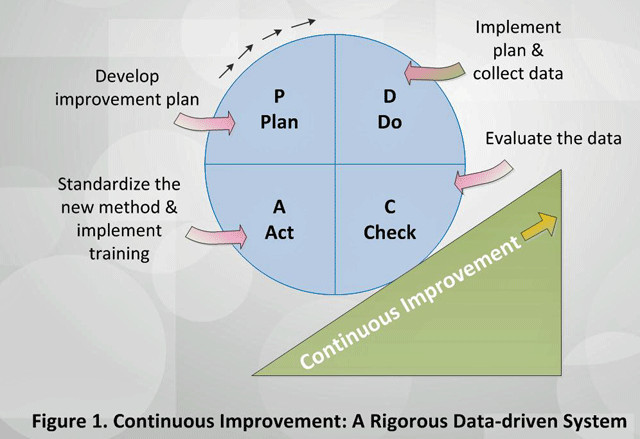
Kaizen is about improving products or services, but it is also about constantly improving processes such as operations, standards, office workflow, production, efficiency or sustainability, or indeed anything that may speed up, embellish, eliminate waste, simplify, reduce a step, remove toxins or fool-proof a process. Kaizen is particularly useful in reducing human mistakes in routine work, by considering small steps that would prevent human errors recurring. Kaizen may include tools like PDCA problem-solving and visual management. By continuously focussing on small improvements the whole workforce is a state of continuous innovation and change – this in turns makes the organisation nimbler, and more responsive and adaptable to change.
In Kaizen there may be no immediate results. But like compound interest, invisible to begin with, the benefits are enormous in the long run.
Kaizen applied across the company creates a culture, a “kaizen culture”, of participation and development. Kaizen helps improve the services or products of an organisation, but it has an even greater impact on strengthening the personal development of everyone. Kaizen is a form of personal development that is directly relevant to, as well as emanates from the work being done. Kaizen enables experimentation, and requires leaders to listen to those doing the work with positive reinforcement. Kaizen not only allows innovation to flourish, it also motivates and engages the whole workforce.
Kaizen is a platform for change, innovation and engagement across an organisation.
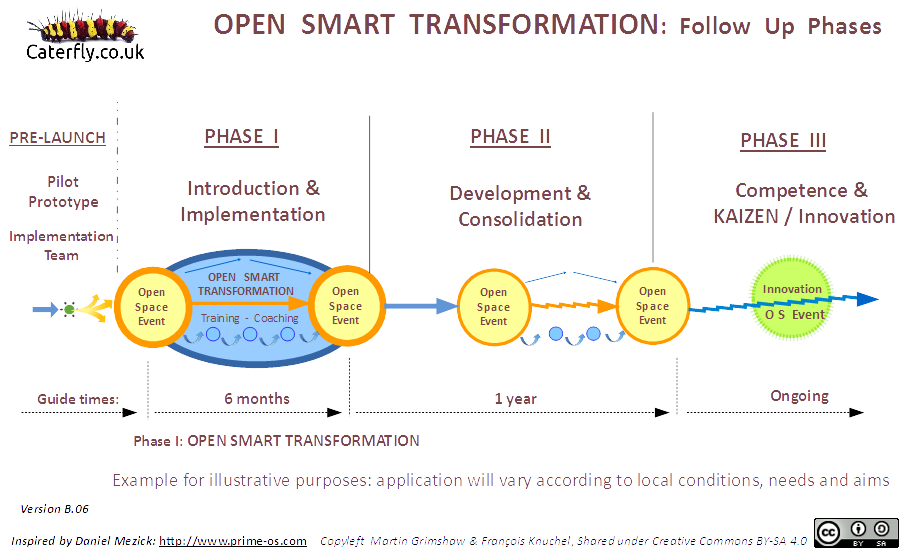
The follow up Phase III of our Open Smart Transformation (OST) process is referred to as “Competence and Innovation / Kaizen”. Competence relates to the successful mastery of the adopted approach to a degree that it is practically second nature to the organisation and does not require a lot of attention beyond maintenance. Innovation / Kaizen refers to the integration of a Kaizen culture continuously seeking small improvements as described in ‘What is Kaizen’, integrated with an occasional intensive burst of Innovation activity, using an Open Space event.
Masaaki Imai / Ofi Sofyan Gumelar
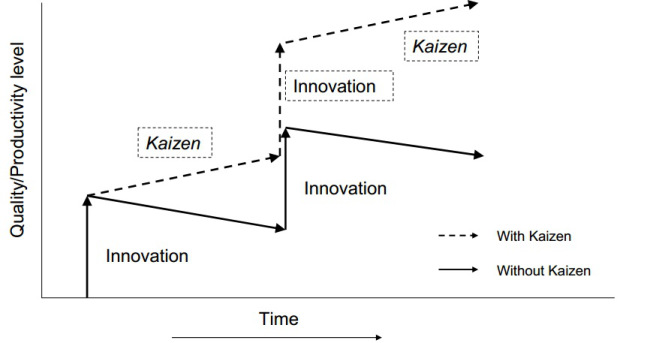
Kaizen is often contrasted to Innovation – the latter representing big steps, big leaps, mega ideas. Innovation is more dramatic and produces spectacular improvements which, however, are not necessarily sustainable. Big innovation and small Kaizen can be compared to the hare and the tortoise, the hare being innovation running fast in big leaps, the tortoise in little steps one step at a time. Both approaches are required. In a Kaizen culture one must be careful to avoid a Kaizen-only approach – that is an organisation extremely adept at finely improving and perfecting methods or products, which are, however, completely out of date (e.g. the fax machine). It is therefore important for a kaizen organisation to sometimes break out of its Kaizen mode and do some substantial out-of-the-box radical thinking.
“Kaizen is like a hotbed that nurtures small and ongoing changes, while innovation is like magma that appears in abrupt eruptions from time to time.” Masaaki Imai
We believe this is best achieved using Open Space Technology. Since disruptive out-of-the-box thinking cannot be pre-planned, it has to be done in a platform which is totally open and self-organised, both in terms of content as well as of participation. Pre-planning and organisation by definition defeat innovation. Serendipity and collective sensing are paramount. Open Space is based on self-organisation, opt-in participation and a market-place of ideas where people are free to follow their curiosity and passion through various clusters of interest. In the third phase, therefore, we recommend an ongoing platform or culture of Kaizen continuous improvement, interspersed once or twice a year, or as needed, with a mega-burst of radical innovation activity through an Open Space Innovation event to which the whole relevant workforce is invited.
Caterfly’s introduction of Open Space Technology to combine Kaizen and innovation is our unique contribution, which we hope will be taken up by others.
You may also like our short piece: What is Kaizen? and our explanation of how Caterfly is pioneering the combination of Open Space with Kaizen: Innovation and Kaizen
“A journey of a thousand miles begins with a single step.”(Lao Tsu)
What does Kaizen mean?
Kaizen means different things to different people. Some see Kaizen as part of the Toyota Production System, or the essence of Lean. Some have positioned Kaizen as the umbrella concept of Lean or Six Sigma. Others view it merely as a set of techniques or practices. Meanwhile, it is also seen as a leadership style or culture. Toyota see it as the “soul of the company”. To me Kaizen is a pan-organisational attitude and questioning mind-set, which fosters co-creative betterment.
Source: Taivara
Kaizen is fundamentally very simple. It’s nothing more than everyone (in an organisation) asking themselves a single question every day, everywhere they work: “What small step can I take to improve …. (whatever they are working on)?” The emphasis is on small, i.e. it is easy and immediate to implement. For example if you want to lose weight, reducing one lump of sugar in your coffee would be a small ‘doable’ step – as opposed to the big step of going on a full 2-month cruel diet. The Kaizen mind-set is so easy to explain, yet difficult to apply in many corporate settings.
Kaizen is normally translated as ‘continuous improvement’, and indeed that is its effect, continuously improving the workplace, product, processes and so on, little by little. The literal translation of ‘kai’-‘zen’ is ‘good change’ (kai, kaeru = change; zen, yoshi = good), or change for the better. Indeed, strictly speaking the word Kaizen does not actually say anything about small or continuous. Masaaki Imai, who initially introduced Kaizen (as applied in Japanese companies) to the West further adds: Good change “by Everybody, Everyday, Everywhere” – and this is crucial, just little incremental steps but done by everyone regularly (continuously).
Kaizen is not just about improving products or services; it is also about constantly improving processes (operations, standards, office workflow, production, efficiency, sustainability…..), indeed anything that may speed up, embellish, eliminate waste, simplify, reduce a step, remove toxins, fool-proof a process and so on. Kaizen is particularly useful in reducing human mistakes in routine work, by considering small steps that would prevent human errors recurring.
We all sometimes do some simple Kaizen without knowing it, for instance in the kitchen we may move things around to make it easier to cook. Indeed we often treat our homes with a kaizen mentality in a way we don’t in the workplace. Where many people work in the same place, however, some form of standardisation is required; we cannot implement ideas willy nilly, it needs the consent of all affected. In a Kaizen workplace small Kaizen meetings are encouraged to consent to and implement these small changes – which are then also jointly celebrated, and periodically reviewed.
“Take the first step in faith; you don’t have to see the whole staircase. Just take the first step.” Martin L. King
Kaizen culture
Organisationally Kaizen is about culture, a ‘Kaizen culture’. Kaizen has more to do with human encouragement and development (‘hitotsukuri’) than with improving the service or product of the organisation (‘monotsukuri’). It represents personal development, but not in the abstract, rather it is totally connected to the work being done. Put the other way round, although Kaizen is deeply connected to the workplace, its products and processes, it fundamentally celebrates the human side, the personal and professional development, of all the organisation’s employees.
“Don’t look with your eyes, look with your feet. Don’t think with your head, think with your hands.“ Taiichi Ohno
Tim Mojonnier
Kaizen encourages improvements by everyone, everywhere, all the time. Everyone is involved in Kaizen activities, from the top of a company (role model) to the office or shop floor, where the work is done. A Kaizen culture forces managers to actively encourage small improvements, to listen to ideas, and to enable them to be implemented. Even where there is no immediate financial gain, if it improves the working environment, it helps create happy employees, increased motivation and more engagement, which in the long run are more productive. Everyone does Kaizen – a manager’s job is to create conditions so that Kaizen can happen, an innovation platform – absolutely everyone at all levels and stations is encouraged to think autonomously and creatively.
This means all employees are listened to, appreciated and respected (and this ties in well with the Gemba philosophy of ‘go see, ask why and respect’). Contrast this to organisations where views of subordinates are ignored, with a “that’s not your job” or “we’re already taking care of that”, or even if they are heard, managers tend to then step in and interfere or micro-manage; this in turn irks staff and engenders an attitude of ‘why bother?’ or ‘whatever!…..’. Kaizen is practiced at every level of organisation, all are involved – a structured yet liberating approach.
“A leader must lower himself like water and give credit to his subordinates. If he wants to take credit, they will leave him soon. If a leader frequently interferes with subordinates, they will protest. A leader’s job is to create an atmosphere in which they want to do (work) for themselves with enthusiasm and can fulfil their potential.” Lao Tzu, Tao Te Ching.
Kaizen & innovation
Kaizen is often contrasted to Innovation – representing the big steps, the big leaps, the mega ideas. Innovation is more dramatic and produces spectacular improvements (though not necessarily sustainable). Innovation and Kaizen can be compared to the hare and the tortoise, the hare being innovation running fast with big leaps, the tortoise little steps one step at a time. Both are required. Kaizen takes a far more long-term view, there are no immediate results and so it cannot be tied to performance targets. For that reason Kaizen is often ignored in the West. But like compound interest, invisible to begin with, the benefits are enormous in the long run.
“Kaizen is like a hotbed that nurtures small and ongoing changes, while innovation is like magma that appears in abrupt eruptions from time to time.” Masaaki Imai
Source: Masaaki Imai / Ofi Sofyan Gumelar
Both Kaizen and Innovation must prevail: while it is imperative that everyone is involved in small incremental Kaizen activities to create a change-ready platform, sometimes outright disruptive innovation, out-of-the-box thinking, is also needed to avoid the situation of constantly improving the wrong things, e.g. out of date products – for example continuing to refine the fax machine is largely going to be futile. There is a potential danger to watch out for where Kaizen ends up stifling innovation – radicalism is sometimes also needed. Kaizen works well for performance-improving innovations (product upgrades) and efficiency innovations, whereas out of the box innovations are better suited to market-creating innovations.
Innovation gurus sometimes argue that management should not be ‘bogged down’ by ‘petty’ minutiae of Kaizen. But there is a difference between taking an interest in other people’s ideas and micro-controlling them – Kaizen is about encouraging people to have ideas and take initiative independently in the context of the organisation’s aims, it’s not about managing those ideas top down! Yes Kaizen may be the petty cash, while innovation are the big notes. However petty cash is the bread and butter of innovation and if ignored or belittled, one risks stifling innovation, too.
The issue is not about whether it is innovation OR Kaizen. BOTH should co-exist and complement each other. Kaizen and innovation are different sides of the same coin. It is not one or the other, both should be applied in a complementary way. While innovation can achieve big leaps, what Kaizen does well is enable a plethora of small stress-free improvements in all areas of an organisation by all employees to emerge, and this sustains continuity and motivation of the whole workforce.
Does Kaizen work outside of Lean?
Kaizen appears to be difficult to implement in the West. We are trained to think in big steps, with big goals and big ideas. As managers we have to leave our mark or legacy, or so we think. Little steps are often not taken seriously, especially in organisational settings. This contrasts completely to the Asian spirit, coming from a Taoist / Confucian philosophy, as expressed in the saying:
“A journey of a thousand miles begins with a single step.” Lao Tsu
It is somewhat ironic then that Kaizen as applied in organisations was first articulated by the American W. Edwards Deming. He asked Japanese workers to think every day ‘what is one small step you can do to improve the product or process?’ – Deming was talking to the right people, they valued the small tortoise-like approach (whereas his ideas were considered largely irrelevant in America). The Kaizen questioning mind found a natural home and popularity in Japan.
Kaizen later spread to the West via Toyota’s successful Toyota Production System (TPS), where it was implemented as part of Lean Management practice. Actually Kaizen is independent of Lean. Because of its association with Lean, however, it has not really found such a foothold in the West outside of Lean as one might expect. Nevertheless, Kaizen can be applied to any form of organisational platform, whether Lean, Agile, Conscious, sustainable or Sociocratic, as well as outside work in healthcare, family and self-development.
“Grain by grain, a loaf. Stone upon stone, a palace.” (George Bernard Shaw)
The tools
So, what small step can you take to improve your product, your process, your life, your health, your wealth, your relationships, your ….? Kaizen applies both within work, organisations and personally in life. Coupled with Lean, however, Kaizen employs the same tools as for problem-solving, like the 7 quality tools, PDCA, 5-whys, 5-Ss (visual management), A3-thinking and Horenso (bottom up communication) etc. In larger organisations dedicated Kaizen teams are there to support the implementation of Kaizen ideas (to build little jigs etc.). But the most fundamental tool is the daily discipline, like exercising daily for 5 minutes, of simply asking the question what little steps can you take to improve the work – and this is encouraged by both superiors and peers.
“Progress is impossible without the ability to admit mistakes.” Masaaki Imai
Masaaki Imai / Kaizen Inst. India
Because Kaizen ideas are small steps, they can be tried out, experimented with and further improved – and if in the end they don’t work as expected they can be dropped, all done in a playful tone. Experimentation is important: mistakes are not only allowed and unpunished, they are actively encouraged in a spirit of trying things out. Even where more experienced staff can see juniors, for instance, making errors, their job is not to stop them – on the contrary people only learn from their mistakes, so it’s important to let them ‘fail’, in the spirit of learning. Their only job is to contain the scale of the error, to avert major harm. In the Kaizen spirit of keeping things small, this is simple.
Little steps are easy to enact and they eliminate fear (which is the enemy of creativity). Kaizen is well aligned to the plasticity of the brain, with multiple cells each doing a bit: neurologists call it mind sculpture. Asking the simple question of ‘what one small thing can I do to improve the work?’ trains the cortex in looking for solutions rather than blame. This promotes collaboration, team spirit, and a positive attitude. Consider the difference between ‘what little step can you think of to improve your workplace’ with ‘what major contribution can you make to improve the bottom line of company’ – the latter being fear inducing.
“Confront the difficult while it is still easy. Accomplish the great tasks by a series of small acts” (Tao Tai Ching)
Hurdles to Kaizen
So why is Kaizen so difficult to implement in the West? Kaizen requires self-esteem (to overcome the urge to want to achieve mega-results by yesterday), optimism (belief that it will contribute to something larger at some point) and a common vision or purpose for Kaizen take you to. You cannot control the size of the result by controlling the size of the step – yet that is precisely what many managers try to do. Kaizen is possibly not suited to a command and control culture or a top-down business improvement culture; however, times are changing, and as leadership evolves and becomes increasingly distributed, so Kaizen will find a more natural home here too.
Source: Art Of Work blog
Kaizen has often failed in the past, because:
a) it was seen as a short term project, rather than a long-term platform, and thus dropped before it bore fruit,
b) targets and KPIs were overemphasised, reflecting fear-inducing short-termism which stifled the longer-term benefits, and
c) management only paid lip service to Kaizen, thus starving its potential.
Kaizen needs to be supported at all level to succeed. Kaizen is a mind-set, and a mind-set cannot be imposed or mandated. But it can and should be encouraged and nurtured, and given the freedom to flourish.
Kaizen and innovation, while different, are not exclusive – on the contrary they should work hand in glove. Everyone does small steps regularly, ideas build up on ideas with a compound interest effect, and innovation grows exponentially. Some ideas may grow large, but one cannot predict which idea might lead to a major breakthrough. Many big innovations actually did not come about by a ‘mega-aha’ in one leap; more often A has idea, this sparks a new idea in B, which in turn sparks idea in C, and all of sudden the accumulative effect becomes mega – even if the original idea A that set the chain off wasn’t all that good – nevertheless if A had not been allowed to linger, the subsequent mega idea might never have come about. So all Kaizen ideas initially should be treated equivalently.
“Kaizen… is the key to Japanese competitive success.” Masaaki Imai
When to apply Kaizen?
So, when should Kaizen be applied? All the time of course. By everyone, everywhere. But Kaizen is also particularly useful after a failed innovation (to break out of ‘failure’ mode, back to basics), as well as after a successful innovation or transformation (to sustain its momentum and make further improvements on it – and to prevent stagnation or hubris). This is why Caterfly proposes applying Kaizen as the third phase of an implementation or change program (agile, sociocracy, EMS/SMS), making innovation strategy.
Although Kaizen was formulated in Lean, as a philosophy it can be applied to life, family, healthcare etc., in all kinds of contexts. This is why I prefer to treat Kaizen separately from Lean, as a pan-organisational attitude of small ongoing innovations. Yes, Lean needs Kaizen, but Kaizen does not need Lean. I would argue that a Kaizen culture, however counter-intuitive Kaizen itself may appear for managers to implement, may be a better way to achieve change, engagement or innovation in an organisation, than many other interventions aimed directly at ‘change’, ‘engagement’ or ‘innovation’.
Kaizen opens up communication, and enables an organisation to become more responsive and adaptable to a changing world. Kaizen is a platform for continuous change and improvement, change towards a better emergent future. It is a platform for engagement, putting the organisation in the right mind-set to swim swiftly in the natural flow of change.
While we don’t claim any originality to our use of the term, we have coined the term Smarter Working in this context to help us define the kind of systems, tools and processes that we work with, or which align with them. Smarter systems of working are modern approaches to work which might emphasise participation, collaboration, integrity, sustainability, self-organising or self-managing teams, and a wiser, 21st Century approach to leadership and hierarchy. Smarter systems of working do not conflict with the needs of society and planet. They are in alignment with life, rather than exploiting it. They promote personal, organisational and planetary wellbeing, with ethics at their centre.
Smarter Working includes, but is not limited to: Responsive, Lean, Agile, participatory Environmental or Sustainability Management Systems (EMS or SMS), Sociocracy, Management 3.0, Conscious Business, Holacracy, Kaizen, and so on.
Smarter Working means re-imagining what it means to be at work, as if were something we wanted to do, that was genuinely useful, to be enjoyed, a source of pride and contentment, and a place for learning and growth. Smarter Working means re-imagining working relationships and working together with common purpose in a way that is more enjoyable, healthier and happier, while taking a sustainability-first or even restorative attitude to our relationship to Earth.
Kaizen is a philosophy that has transcended its development in Japanese car manufacturing management, where it was a critical component of the country’s post war economic transformation. Today, Kaizen is used across the world by life coaches, fitness and martial arts teachers, schools, healthcare and across all industries. Kaizen is at the heart of the Toyota Way, from which the Lean Management evolved, and is a fundamental component to Caterfly’s model for embedding long term improvement.
‘Kai’-‘zen’ means ‘good change’, or change for the better, done by everybody, everyday, everywhere.
Kaizen is a mind-set permeating throughout an organisation, which fosters a continuous search by all employees at all levels and departments to find small improvements in the workplace, the products, services or processes. This kaizen mind-set creates an organisational platform or culture which is fed by one question asked by everyone at least once a day: ‘What is one small step you can do to improve the product or process you work on?’
“Kaizen is a customer-driven strategy for improvcement… In Kaizen, it is assumed that all activities should eventually lead to increased customer satisfaction.” Masaaki Imai
Kaizen is about improving products or services, but it is also about constantly improving processes such as operations, standards, office workflow, production, efficiency or sustainability, or indeed anything that may speed up, embellish, eliminate waste, simplify, reduce a step, remove toxins or fool-proof a process. Kaizen is particularly useful in reducing human mistakes in routine work, by considering small steps that would prevent human errors recurring. By continuously focussing on small improvements the whole workforce is a state of continuous innovation and change – this in turns makes the organisation nimbler, and more responsive and adaptable to change.
In Kaizen there may be no immediate results. But like compound interest, invisible to begin with, the benefits are enormous in the long run.
Kaizen applied across the company creates a culture, a “kaizen culture”, of participation and development. Kaizen helps improve the services or products of an organisation, but it has an even greater impact on strengthening the personal development of everyone. Kaizen is a form of personal development that is directly relevant to, as well as emanates from the work being done. Kaizen enables experimentation, and requires leaders to listen to those doing the work with positive reinforcement. Kaizen not only allows innovation to flourish, it also motivates and engages the whole workforce.
Kaizen is a platform for change, innovation and engagement across an organisation.

 ‘Kai’-‘zen’ means ‘good change’, or change for the better, done by everybody, everyday, everywhere.