The art of hosting participant-led unConferences, solving complex problems, accelerating action, leading change in organisations, and hosting conversations that matter.
An experiential 2 day co-learning workshop: Brighton, with Martin Grimshaw and Francois Knuchel
* We regret that this date has been postponed – we are currently arranging a new date in October ’15 – please contact us to request a preference and early bird discount *
A very limited number of ‘pay-what-you-want’ tickets are available on application. You just need to tell us a dazzling (but short) story of why you think the world will be a better place for you being on the course.
Do you want a way to rapidly launch new projects, bring participation, engagement, equality and inclusion to your organisation or event? To harness collective ingenuity for problem solving? To lead transformation that is real and lasting? To drive innovation?
What?
Learn how to organise and facilitate gatherings using Open Space Technology, a method by which a large group of people can organise themselves into a conference, complete with agenda, break-out sessions, action planning and reports, with almost no preparation before-hand. Open Space allows each participant to do what they came to do, and can be a very effective way of launching large-scale change or responding to a looming crisis.
Who?
This workshop invites those who are new to using Open Space and those who already have some or even extensive experience of using it, to co-learn together, deepen our practice, and share our experiences of using it. In this 2 day workshop we will have the opportunity to experience Open Space as attendees commonly do, with space to reflect and to go deeper into designing an event as part of a broader programme.
How? This workshop will be run as an Open Space so that participants can learn experientially, while learning how to design, prepare and facilitate an Open Space event, including tips and tricks, likely issues that may be encountered, follow up and incorporating an event within a wider context or strategy.
What is Open Space?
Open Space Technology is a format for organising compostable conferences, unconferences, meetings, stakeholder engagement, BarCamps and CityCamps, with maximum efficiency and minimum time and resources. It is a form of ‘crowd sourcing’ which can be used to bring together a company or any group or organisation to focus on a specific problem or question. Open Space allows for participants to co-create experience, learning and solutions in a way that unlocks creativity.
Open Space is used by large companies, local government, community activists, and forward thinking organisations everywhere, from gatherings of 5 to several thousand people, from a couple of hours to several days.
Please contact us if you would like to hire us as facilitators, consultants or trainers.
Martin and Francois also use the Open Smart Transformation model at Caterfly to bring about deep and lasting transformation or problem solving in organisations with Open Space.
You may also like our short piece: What is Kaizen? and our explanation of how Caterfly is pioneering the combination of Open Space with Kaizen: Innovation and Kaizen
“A journey of a thousand miles begins with a single step.”(Lao Tsu)
What does Kaizen mean?
Kaizen means different things to different people. Some see Kaizen as part of the Toyota Production System, or the essence of Lean. Some have positioned Kaizen as the umbrella concept of Lean or Six Sigma. Others view it merely as a set of techniques or practices. Meanwhile, it is also seen as a leadership style or culture. Toyota see it as the “soul of the company”. To me Kaizen is a pan-organisational attitude and questioning mind-set, which fosters co-creative betterment.
Source: Taivara
Kaizen is fundamentally very simple. It’s nothing more than everyone (in an organisation) asking themselves a single question every day, everywhere they work: “What small step can I take to improve …. (whatever they are working on)?” The emphasis is on small, i.e. it is easy and immediate to implement. For example if you want to lose weight, reducing one lump of sugar in your coffee would be a small ‘doable’ step – as opposed to the big step of going on a full 2-month cruel diet. The Kaizen mind-set is so easy to explain, yet difficult to apply in many corporate settings.
Kaizen is normally translated as ‘continuous improvement’, and indeed that is its effect, continuously improving the workplace, product, processes and so on, little by little. The literal translation of ‘kai’-‘zen’ is ‘good change’ (kai, kaeru = change; zen, yoshi = good), or change for the better. Indeed, strictly speaking the word Kaizen does not actually say anything about small or continuous. Masaaki Imai, who initially introduced Kaizen (as applied in Japanese companies) to the West further adds: Good change “by Everybody, Everyday, Everywhere” – and this is crucial, just little incremental steps but done by everyone regularly (continuously).
Kaizen is not just about improving products or services; it is also about constantly improving processes (operations, standards, office workflow, production, efficiency, sustainability…..), indeed anything that may speed up, embellish, eliminate waste, simplify, reduce a step, remove toxins, fool-proof a process and so on. Kaizen is particularly useful in reducing human mistakes in routine work, by considering small steps that would prevent human errors recurring.
We all sometimes do some simple Kaizen without knowing it, for instance in the kitchen we may move things around to make it easier to cook. Indeed we often treat our homes with a kaizen mentality in a way we don’t in the workplace. Where many people work in the same place, however, some form of standardisation is required; we cannot implement ideas willy nilly, it needs the consent of all affected. In a Kaizen workplace small Kaizen meetings are encouraged to consent to and implement these small changes – which are then also jointly celebrated, and periodically reviewed.
“Take the first step in faith; you don’t have to see the whole staircase. Just take the first step.” Martin L. King
Kaizen culture
Organisationally Kaizen is about culture, a ‘Kaizen culture’. Kaizen has more to do with human encouragement and development (‘hitotsukuri’) than with improving the service or product of the organisation (‘monotsukuri’). It represents personal development, but not in the abstract, rather it is totally connected to the work being done. Put the other way round, although Kaizen is deeply connected to the workplace, its products and processes, it fundamentally celebrates the human side, the personal and professional development, of all the organisation’s employees.
“Don’t look with your eyes, look with your feet. Don’t think with your head, think with your hands.“ Taiichi Ohno
Tim Mojonnier
Kaizen encourages improvements by everyone, everywhere, all the time. Everyone is involved in Kaizen activities, from the top of a company (role model) to the office or shop floor, where the work is done. A Kaizen culture forces managers to actively encourage small improvements, to listen to ideas, and to enable them to be implemented. Even where there is no immediate financial gain, if it improves the working environment, it helps create happy employees, increased motivation and more engagement, which in the long run are more productive. Everyone does Kaizen – a manager’s job is to create conditions so that Kaizen can happen, an innovation platform – absolutely everyone at all levels and stations is encouraged to think autonomously and creatively.
This means all employees are listened to, appreciated and respected (and this ties in well with the Gemba philosophy of ‘go see, ask why and respect’). Contrast this to organisations where views of subordinates are ignored, with a “that’s not your job” or “we’re already taking care of that”, or even if they are heard, managers tend to then step in and interfere or micro-manage; this in turn irks staff and engenders an attitude of ‘why bother?’ or ‘whatever!…..’. Kaizen is practiced at every level of organisation, all are involved – a structured yet liberating approach.
“A leader must lower himself like water and give credit to his subordinates. If he wants to take credit, they will leave him soon. If a leader frequently interferes with subordinates, they will protest. A leader’s job is to create an atmosphere in which they want to do (work) for themselves with enthusiasm and can fulfil their potential.” Lao Tzu, Tao Te Ching.
Kaizen & innovation
Kaizen is often contrasted to Innovation – representing the big steps, the big leaps, the mega ideas. Innovation is more dramatic and produces spectacular improvements (though not necessarily sustainable). Innovation and Kaizen can be compared to the hare and the tortoise, the hare being innovation running fast with big leaps, the tortoise little steps one step at a time. Both are required. Kaizen takes a far more long-term view, there are no immediate results and so it cannot be tied to performance targets. For that reason Kaizen is often ignored in the West. But like compound interest, invisible to begin with, the benefits are enormous in the long run.
“Kaizen is like a hotbed that nurtures small and ongoing changes, while innovation is like magma that appears in abrupt eruptions from time to time.” Masaaki Imai
Source: Masaaki Imai / Ofi Sofyan Gumelar
Both Kaizen and Innovation must prevail: while it is imperative that everyone is involved in small incremental Kaizen activities to create a change-ready platform, sometimes outright disruptive innovation, out-of-the-box thinking, is also needed to avoid the situation of constantly improving the wrong things, e.g. out of date products – for example continuing to refine the fax machine is largely going to be futile. There is a potential danger to watch out for where Kaizen ends up stifling innovation – radicalism is sometimes also needed. Kaizen works well for performance-improving innovations (product upgrades) and efficiency innovations, whereas out of the box innovations are better suited to market-creating innovations.
Innovation gurus sometimes argue that management should not be ‘bogged down’ by ‘petty’ minutiae of Kaizen. But there is a difference between taking an interest in other people’s ideas and micro-controlling them – Kaizen is about encouraging people to have ideas and take initiative independently in the context of the organisation’s aims, it’s not about managing those ideas top down! Yes Kaizen may be the petty cash, while innovation are the big notes. However petty cash is the bread and butter of innovation and if ignored or belittled, one risks stifling innovation, too.
The issue is not about whether it is innovation OR Kaizen. BOTH should co-exist and complement each other. Kaizen and innovation are different sides of the same coin. It is not one or the other, both should be applied in a complementary way. While innovation can achieve big leaps, what Kaizen does well is enable a plethora of small stress-free improvements in all areas of an organisation by all employees to emerge, and this sustains continuity and motivation of the whole workforce.
Does Kaizen work outside of Lean?
Kaizen appears to be difficult to implement in the West. We are trained to think in big steps, with big goals and big ideas. As managers we have to leave our mark or legacy, or so we think. Little steps are often not taken seriously, especially in organisational settings. This contrasts completely to the Asian spirit, coming from a Taoist / Confucian philosophy, as expressed in the saying:
“A journey of a thousand miles begins with a single step.” Lao Tsu
It is somewhat ironic then that Kaizen as applied in organisations was first articulated by the American W. Edwards Deming. He asked Japanese workers to think every day ‘what is one small step you can do to improve the product or process?’ – Deming was talking to the right people, they valued the small tortoise-like approach (whereas his ideas were considered largely irrelevant in America). The Kaizen questioning mind found a natural home and popularity in Japan.
Kaizen later spread to the West via Toyota’s successful Toyota Production System (TPS), where it was implemented as part of Lean Management practice. Actually Kaizen is independent of Lean. Because of its association with Lean, however, it has not really found such a foothold in the West outside of Lean as one might expect. Nevertheless, Kaizen can be applied to any form of organisational platform, whether Lean, Agile, Conscious, sustainable or Sociocratic, as well as outside work in healthcare, family and self-development.
“Grain by grain, a loaf. Stone upon stone, a palace.” (George Bernard Shaw)
The tools
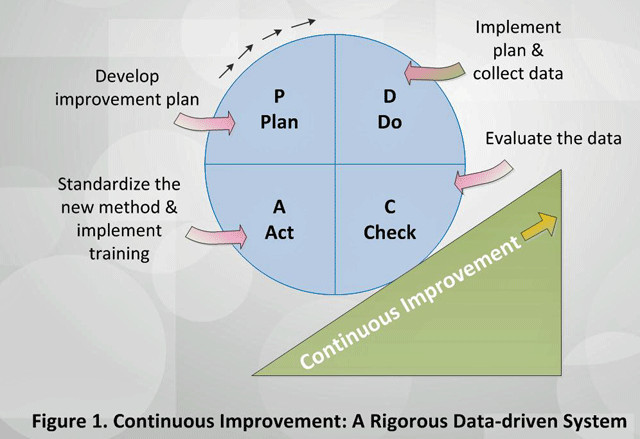
So, what small step can you take to improve your product, your process, your life, your health, your wealth, your relationships, your ….? Kaizen applies both within work, organisations and personally in life. Coupled with Lean, however, Kaizen employs the same tools as for problem-solving, like the 7 quality tools, PDCA, 5-whys, 5-Ss (visual management), A3-thinking and Horenso (bottom up communication) etc. In larger organisations dedicated Kaizen teams are there to support the implementation of Kaizen ideas (to build little jigs etc.). But the most fundamental tool is the daily discipline, like exercising daily for 5 minutes, of simply asking the question what little steps can you take to improve the work – and this is encouraged by both superiors and peers.
“Progress is impossible without the ability to admit mistakes.” Masaaki Imai
Masaaki Imai / Kaizen Inst. India
Because Kaizen ideas are small steps, they can be tried out, experimented with and further improved – and if in the end they don’t work as expected they can be dropped, all done in a playful tone. Experimentation is important: mistakes are not only allowed and unpunished, they are actively encouraged in a spirit of trying things out. Even where more experienced staff can see juniors, for instance, making errors, their job is not to stop them – on the contrary people only learn from their mistakes, so it’s important to let them ‘fail’, in the spirit of learning. Their only job is to contain the scale of the error, to avert major harm. In the Kaizen spirit of keeping things small, this is simple.
Little steps are easy to enact and they eliminate fear (which is the enemy of creativity). Kaizen is well aligned to the plasticity of the brain, with multiple cells each doing a bit: neurologists call it mind sculpture. Asking the simple question of ‘what one small thing can I do to improve the work?’ trains the cortex in looking for solutions rather than blame. This promotes collaboration, team spirit, and a positive attitude. Consider the difference between ‘what little step can you think of to improve your workplace’ with ‘what major contribution can you make to improve the bottom line of company’ – the latter being fear inducing.
“Confront the difficult while it is still easy. Accomplish the great tasks by a series of small acts” (Tao Tai Ching)
Hurdles to Kaizen
So why is Kaizen so difficult to implement in the West? Kaizen requires self-esteem (to overcome the urge to want to achieve mega-results by yesterday), optimism (belief that it will contribute to something larger at some point) and a common vision or purpose for Kaizen take you to. You cannot control the size of the result by controlling the size of the step – yet that is precisely what many managers try to do. Kaizen is possibly not suited to a command and control culture or a top-down business improvement culture; however, times are changing, and as leadership evolves and becomes increasingly distributed, so Kaizen will find a more natural home here too.
Source: Art Of Work blog
Kaizen has often failed in the past, because:
a) it was seen as a short term project, rather than a long-term platform, and thus dropped before it bore fruit,
b) targets and KPIs were overemphasised, reflecting fear-inducing short-termism which stifled the longer-term benefits, and
c) management only paid lip service to Kaizen, thus starving its potential.
Kaizen needs to be supported at all level to succeed. Kaizen is a mind-set, and a mind-set cannot be imposed or mandated. But it can and should be encouraged and nurtured, and given the freedom to flourish.
Kaizen and innovation, while different, are not exclusive – on the contrary they should work hand in glove. Everyone does small steps regularly, ideas build up on ideas with a compound interest effect, and innovation grows exponentially. Some ideas may grow large, but one cannot predict which idea might lead to a major breakthrough. Many big innovations actually did not come about by a ‘mega-aha’ in one leap; more often A has idea, this sparks a new idea in B, which in turn sparks idea in C, and all of sudden the accumulative effect becomes mega – even if the original idea A that set the chain off wasn’t all that good – nevertheless if A had not been allowed to linger, the subsequent mega idea might never have come about. So all Kaizen ideas initially should be treated equivalently.
“Kaizen… is the key to Japanese competitive success.” Masaaki Imai
When to apply Kaizen?
So, when should Kaizen be applied? All the time of course. By everyone, everywhere. But Kaizen is also particularly useful after a failed innovation (to break out of ‘failure’ mode, back to basics), as well as after a successful innovation or transformation (to sustain its momentum and make further improvements on it – and to prevent stagnation or hubris). This is why Caterfly proposes applying Kaizen as the third phase of an implementation or change program (agile, sociocracy, EMS/SMS), making innovation strategy.
Although Kaizen was formulated in Lean, as a philosophy it can be applied to life, family, healthcare etc., in all kinds of contexts. This is why I prefer to treat Kaizen separately from Lean, as a pan-organisational attitude of small ongoing innovations. Yes, Lean needs Kaizen, but Kaizen does not need Lean. I would argue that a Kaizen culture, however counter-intuitive Kaizen itself may appear for managers to implement, may be a better way to achieve change, engagement or innovation in an organisation, than many other interventions aimed directly at ‘change’, ‘engagement’ or ‘innovation’.
Kaizen opens up communication, and enables an organisation to become more responsive and adaptable to a changing world. Kaizen is a platform for continuous change and improvement, change towards a better emergent future. It is a platform for engagement, putting the organisation in the right mind-set to swim swiftly in the natural flow of change.
Copyright (C) Martin Grimshaw, Francois Knuchel & Daniel Mezick (author of Prime/OS™) 2014-15
Shared under a ‘Free Culture’ ‘Attribution-Share Alike’ Creative Commons Licence CC BY-SA 4.0 :
You may use this work as you like, including creating derivatives and commercial use, but you MUST provide proper attribution and share your work on the same basis, using the same licensing. This is our gift to the ‘intellectual commons’, and this license ensures that it remains open for all to benefit from, always. Full details at http://caterfly.co.uk/what-we-do/intellectual-commons/
This work is based on Prime/OS™, published as an Open Source, Free Cultural Work via the CC-BY-SA license from Creative Commons. Prime/OS is also referred to as OSA when used in Agile Adoptions. Download the Prime/OS™ Definition Here: http://www.prime-os.com/download-prime/
OST is a process implementation methodology that introduces transformation gently into a client organisation. OST implements a ‘passage‐rite’ structure that is framed by two organisation‐wide Open Space events. OST comprises and leverages the following core elements:
Game Mechanics (goals, rules, progress mapping, opt-in presence)
Invitation (including framing right questions)
Leadership Storytelling (and behaviour)
Principles of engagement, participative facilitation and respect
Cultural Anthropology (Passage Rites, “Master of Ceremonies”)
OST applies these various elements across a timeline spanning several months. OST implements a passage-rite-like transformation, which has a clear beginning, middle and end. It is important to note and understand that OST is an organisation‐level transformation process rather than an individual-level one. The organisation is best viewed as a single entity (a single social system, rather than a collection of individuals) when implementing OST.
By ‘SMART’ we mean Smarter ways of working. These can be state-of-the-art systems, methods or organisational mind-sets which aim to enable a business or organisation to be more efficient, more responsive, leaner, more agile, more conscientious or more sustainable. We use the term Smarter Working as shorthand for a variety of more human, healthier, more responsible, whole system, self-organisation or self-management approaches to working together, including but not limited to: Agile, Lean, Responsive, Conscious Business, Sociocracy, Kaizen, Environmental or Sustainability Management Systems (EMS or SMS), Holacracy, Management 3.0 and more.
The big picture of OST consists of 3 distinct “Phases”:
Phase 1:Introduction and Implementation. The start and successful completion of the (first chapter of the) adoption process bound by time and two distinct beginning/ending Open Space iterations
Phase 2:Development and Consolidation. Consolidating adoption through follow-up Open Space iterations, and/or Chapters 2, 3 … of adoption process following same Open Space events as in Phase 1 (where implementation is staged into more than one chapter)
Phase 3:Competence and Continuous Learning. Successful completion of Phase 2, as evidenced by several “Chapters” spanning at least two chapters. Shift to learning organisation mode
OST in more DETAIL: Core Elements
1. OST Phase 1: Introduction and Implementation. Experiencing engagement via opt‐in participation and Open Space. This is the first level, the level of “introduction” to the basic SMART concepts being implemented, and facilities of the OSTmethod: openness, invitation and opt‐in participation.
Opening Consulting with Leadership by Coach/Consultant, including planning for Open Space iterations
Invitation as the primary opt‐in mechanism
Open Space 1 (initial Open Space iteration, which marks the start of the transformation process, incorporating game mechanics: goals, rules, progress scoring and opt-in)
2-3-day Open Space (minimum 1 day) – opening Open Space iteration
Minimum of 90 days of experiments and playing with practices (Beta-Lab cocoon mode), between the scheduled Open Space iterations
Output is learning and some deliveries
Leadership Signalling with Storytelling (and other highly symbolic behaviours, respect)
Open Space 2 (second Open Space meeting, which terminates “Chapter 1” of the process adoption and opens “Chapter 2” of the organisational “story” of adoption) – closing Open Space iteration
FOLLOW UP. Closing consulting with leadership
Processing of Proceedings
Respectful Leadership Signalling with Storytelling (and other highly symbolic behaviours)
Coaching consultant delivers specific coaching on what to (possibly) consider next
Depending on circumstances, coaching consultant vacates the organisation and does not communicate with it for at least 1 month, to trigger self‐sustaining independence self-organising behaviours on the part of the organisation
Open Space 3 if needed (all the steps above repeated)
2. OST Phase 2: Development and Consolidation. Minimum 1 year: recurring Open Space iterations about 6 months apart. This is the stage of “consolidation towards competence”.
Evidence must be present first that the organisation has processed and completed Phase 1.
Several “Chapters” of learning, bound by two Open Space iterationss, may be needed for some organizations to reach this stage. Where the adoption program has been staged into more than one chapter, the subsequent chapter(s) would be introduced and implemented in the same manner as Phase 1, with two beginning/ending Open Space events
Repeat OST’s Open Space iterationss approximately every six months until a true learning organisation culture has been reached, with “all openness, all the time.”
Gradual introduction of Kaizen practices
3. OST Phase 3: Competence and Continuous Improvement – Kaizen & Innovation. No more scheduled Open Space iterations, due to a maturing of the organisation’s ability to sense, learn and respond, so Open Space on an as needed basis. Integration of Kaizen and Innovation practices for ongoing self-organised learning
Evidence must be present first, that the organisation has reached Phase 2, such as:
The scheduled Open Space iterations become less interesting, because the organisation now has an open culture that “is” open space in spirit and content
The organisation can consistently demonstrate a “safe-space” open culture.
Substantial changes to HR policies with intent to support an OST Phase 3 culture of responsiveness and participatory improvements
Establishment of norms for dealing with the ongoing conflict that is a natural consequence of independent thinkers working together in a volatile, high-change business environment
Pan-organisational program of Kaizen (continuous improvement) and Innovation practices to ensure the organisation is performing at peak, without stagnating, will full participation of all its people
Further follow-up Open Space and other events in the following years as required to guarantee continued self-organised learning. Major issues arising from new working practices, including the Kaizen and Innovation programs, can then be reviewed
While we don’t claim any originality to our use of the term, we have coined the term Smarter Working in this context to help us define the kind of systems, tools and processes that we work with, or which align with them. Smarter systems of working are modern approaches to work which might emphasise participation, collaboration, integrity, sustainability, self-organising or self-managing teams, and a wiser, 21st Century approach to leadership and hierarchy. Smarter systems of working do not conflict with the needs of society and planet. They are in alignment with life, rather than exploiting it. They promote personal, organisational and planetary wellbeing, with ethics at their centre.
Smarter Working includes, but is not limited to: Responsive, Lean, Agile, participatory Environmental or Sustainability Management Systems (EMS or SMS), Sociocracy, Management 3.0, Conscious Business, Holacracy, Kaizen, and so on.
Smarter Working means re-imagining what it means to be at work, as if were something we wanted to do, that was genuinely useful, to be enjoyed, a source of pride and contentment, and a place for learning and growth. Smarter Working means re-imagining working relationships and working together with common purpose in a way that is more enjoyable, healthier and happier, while taking a sustainability-first or even restorative attitude to our relationship to Earth.
 Do you want a way to rapidly launch new projects, bring participation, engagement, equality and inclusion to your organisation or event? To harness collective ingenuity for problem solving? To lead transformation that is real and lasting? To drive innovation?
 Martin and Francois also use the Open Smart Transformation model at Caterfly to bring about deep and lasting transformation or problem solving in organisations with Open Space.