Caterfly presents: a 1 day participant-led ‘Open Space’ event exploring the need for transforming the way we work together, the move toward more collaborative, responsive workplaces, for businesses that place the customer at the centre, with respect for people and planet, the reality, complexity and barriers to change, and ways to move forward.
Share. Learn. Connect: Building alliances for collective impact
Just as the combined efforts of the powers-that-be in the 16th and 17th Centuries were unable to halt the progress of Copernicus’ Revolution in astronomy, so also today’s big hierarchical bureaucracies, though seemingly all-powerful, will ultimately succumb to the power of a better idea for running organizations—better for customers, better for employees, better for managers, better for society, and better for the organizations and their investors.
Steve Denning, Forbes: The Copernican Revolution In Management
It has been my contention for a long time that one of the reasons change mandates experience a 60%-80% failure rate (depending on definition, metrics etc) is not because there is anything wrong with the new system or working practice an organisation is implementing, nor because of poor communication or persuasion skills of the executives or consultants charged with the intervention, but rather very simply because the employees affected are often not asked nor consulted in the matter. They are simply informed of the changes as a fait accompli, they are not invited to co-create the future of the organisation. This in turns leads to disengagement, disenchantment or even cynicism, which can create a block in the change being implemented.
Resistance to Change?
This block is often expressed as “resistance” to change, and most change management programs are often about “managing” this alleged “resistance”. Actually, however, in most cases it is not change itself people are resisting, but rather the imposition of a system or practice in which they had no involvement in creating, and is thus alien. Margaret Wheatley put it this way:
[People don’t] … accept imposed solutions, pre-determined designs, or well-articulated plans that have been generated somewhere else. Too often, we interpret their refusal as resistance. We say that people innately resist change. But the resistance we experience from others is not to change itself. It is to the particular process of change that believes in imposition rather than creation. It is the resistance of a living system to being treated as a non-living thing.”
Or as Peter Senge says: “People don’t resist change, they resist being changed.”
In other words the problem with change and the alleged resistance to change is not change itself, but rather the imposition or mandation of change from above. Japanese organisations have no problem with change, it is part of their culture. This is outwardly reflected in the agility of their buildings to adapt to changing environmental circumstances (typhoons, earthquakes), in traditional shrines being ‘rebuilt’ periodically, and in the fluidity between inner and outer space. In my experience Japanese organisations are continuously re-organising themselves according to changing circumstances, and this is done by all employees, down to the shop-floor, who are taught how to solve problems and how to adapt nimbly. Management consultancies hardly exist in Japan (yes, the McKinseys have plush show offices in Tokyo, but their clients are largely expatriate companies) – you do not need expensive change consultants when you can self-organise and change yourself. Change in Japan is not something thought out at the top, but rather everyone in the organisation is engaged in co-creating the changes.
The problem with Western organisational change, as I see it, is having too rigid organisational structures in the first place (inflexibility by design), imposing change from above without asking those doing the work first, and not giving the workforce the tools and authority to solve their own problems, and hence to co-create change when and as it is required.
The Zappos Case
Recently Zappos, the unique online shoe retailer based in Nevada, has been in the news about a memo from its CEO, Tony Hsieh, to its employees in which he offers all of them severance pay if they wish to leave the company because they are not comfortable in its new management environment. In the last 18 months the 1,500 strong company has been embarking on a massive change program, converting from a ‘command and control’ management structure, to one without formal managers, giving all employees equivalent decision-making powers to elect people to specific needs-based tasks or roles in a self-managed manner. The approach is known as ‘holacracy’, a derivative of the Dutch Quaker creation ‘sociocracy’ (find out more here). This full scale adoption of holacracy is the largest of its kind to date, hence many are following the story with keen interest.
The implementation requires a “roll-out” of a substantial amount of training (running meetings, consent decision-making, circle formations), and the program is now running to a first completion stage. It is clear that it has faced certain difficulties, both successes as well departures by disenchanted staff. Here are a few links to recent reports:
The Zappos story is actually a more interesting case, in my view, than most change programs: in a manner of speaking management here is mandating to abolish itself. The self-organising aspect of holacracy is, in my view, somewhat similar to Japanese management styles. True Japanese firms have managers in a hierarchy, but managers are more like mentors who attribute authority to solutions their staff have come up with and consented to. Moreover the fundamental information flow is horizontal working towards satisfying customers, rather than vertically serving shareholders. Prof Kichiro Hayashi (Tokyo Aoyama University) has referred to Japanese (and Oriental in general) management as organic. This organic style is very flexible and agile at adapting to changing circumstances, yet rather inefficient and seemingly disorganised in a static world; whereas Western ‘mechanical’ management is super-efficient in a stable world, but lacks the capacity to self-organise and self-change.
Ordering no more Orders
The Zappos story is thus to me an interesting Western attempt to address this, and in light of the perceived need to transform our capitalism it is being observed by many with keen interest. You might expect employees to embrace the opportunity to take on more responsibility, without having to be accountable to the eccentricities of a boss. Many do. But as Erich Fromm has shown, many also fear freedom. For some, in a world where they have been used to receiving orders, operating without them is scary and may create in them profound disorientation.
Nevertheless with support and coaching most people could easily get used to the new approach, though the bigger the organisation the more difficult it is to do. At the same time, however, there is a felt contradiction in the CEO being required to order that there would be no orders from hence on. To be fair to holacracy, its website says this about this apparent paradox of the CEO needing power to adopt holacracy: “Holacracy is a fundamental shift of authority: it changes the seat of power from the CEO to the Holacracy Constitution, which then distributes that power through specific processes. You cannot shift the seat of power without the CEO’s approval (and shouldn’t be able to). …, you need a formal agreement from that CEO to vest her/his power into something else — in this case the Holacracy Constitution. Without this formal agreement, you would just be “pretending” to work differently”
So what is it, then, that is causing the CEO to posit such an ultimatum “self-organize or leave the company”? Why is this change program evoking such drastic measures? True, the severance package is very generous, yet the dictum feels a little like a dictator forcing subjects to participate, initiate (with their own views) and be engaged. I cannot speak for holacracy, but that would defeat the purpose of its parent methodology, sociocracy, which envisions “people working together as different, unique persons on the basis of mutual equivalence in decision-making” – yet seemingly no differences are allowed at Zappos. This contravenes the desirability for diversity in order to create richness in decision-making. Unintentionally I suspect, it does look like Zappos want clones of each other. Yet can you really offer severance packages to family members?
So why resistance?
So why is there resistance, what is it some staff are riling against? The issue I believe is that holacracy was mandated or imposed. Staff were never asked or consulted whether they wanted holacracy, nor were they invited to co-develop the holacracy transformation. It was simply imposed on them. Somewhat paradoxically, but imposed nevertheless. What people are really rejecting is not holacracy itself, but being forced to change without consultation. This comes back to what I said initially, it is not the system or new behaviour that people are resisting, but the way it is being mandated and imposed. Holacracy may be a great idea, but mandating it doesn’t work. In the case of Zappos, this was already predicted a year ago in March 2014 in the blog “The Mandate of Holacracy at Zappos” by Daniel Mezick, author of Culture Games and agile coach, who was investigating why it was that 80% of agile adoptions were considered unsuccessful.
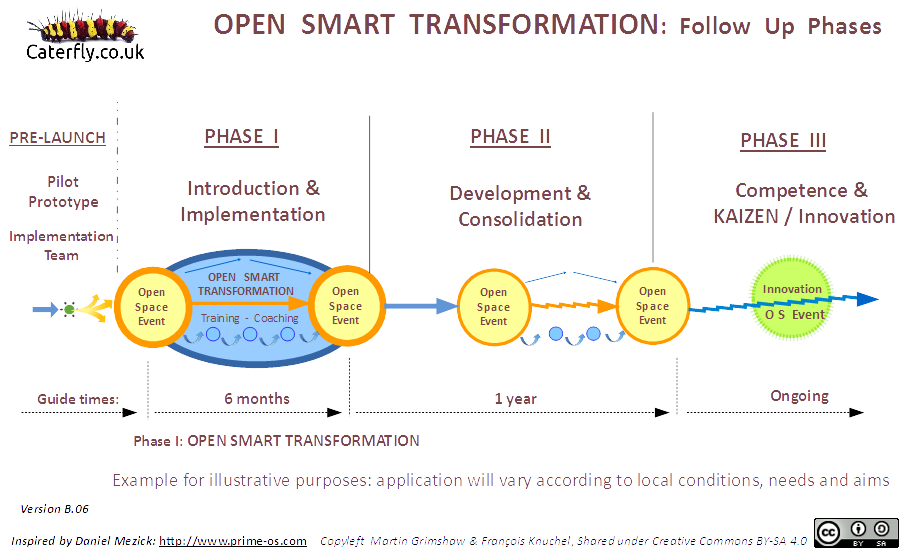
In short it is mandation which is the problem, not holacracy nor resistance to change in general. This is what we at Caterfly are trying to address with the Open Smart Transformation model, involving a special framework of two Open Space Technology events, where all affected personnel are invited to hold deep dialogues about the change. The two events also demark a period of 3 – 6 months, a cocoon of iterations, in which all employees are trained and coached in the new approach, are asked to suspend judgement and instead apply the new way on a trial and error basis, learning and prototyping, enabling all affected to be involved and engaged in the transformation process. This open ended playful period ends with a second Open Space event where everyone can work on sorting out what worked, what needs adapting and what to reject. In other words the new approach thereby becomes customised to the particular organisation, rather than being something off the shelf, and this work is all done collaboratively by the staff. Consequently they own the change, it is no longer an alien system, they all co-created the transformation together.
This process was initially developed and applied with great success fo agile adoptions where typically 70 – 80% failed. We realised that the fundamental principles of the new approach are true beyond just agile. They apply to adopting lean, responsive, management 3.0, conscious capitalism, environmental management, and holacracy/sociocracy too, and indeed of any new systems implementation or organisational transformation / change management. While what Tony Hsieh is trying to do is not only extremely noble and brave, and is being done with a great deal of generosity and candidness, it is a great pity it had been mandated initially. I am sure he could have avoided this “accept holacracy or get out” dilemma, if Zappos had invited the staff to co-create the change rather than imposing it on them. However generous the severance package offer may be, it now puts Tony Hsieh in a difficult position – some staff may see him, in trepidation, as the ultimate arbiter of who is to stay and who is to go.
Change Platform
In short, mandation or imposition does not work well! This is also summarised in Gary Hammel’s McKinsey article late 2014 “Build a Change Platform, not a Change Program”. Caterfly’s iterative cocoon-forming double open-space framework and follow up is such a platform, we believe, or at the very least helps establish one. Fundamentally we need to change change itself from a mandation mind-set to one of invitation: inviting all affected persons to co-create the new order of things, and thereby co-own it. Open Space Technology, doubled to form an iterative cocoon platform, is the only offline synchronous platform I am aware of that enables this to scale with large numbers of people, effectively, rapidly and sustainably.
Come join us at Shift: Why Aren’t Organisations Shifting? 21 July 2015, London
Details www.caterfly.co.uk/events
Further reading:
Why telling people what to do doesn’t work – click The problem with change management – click
Caterfly’s Open Smart Transformation model is based upon Daniel Mezick’s Open Agile Adoption / OpenSpace Agility™ model, and is a derivative of Prime/OS™. The following describe testimonials of Open Agile Adoption, which is itself based upon Open Space Technology, commonly Open Space.
The series of video testimonials here, taken from Daniel’s website, are of Open Agile Adoptions in the form of interviews with managers from client companies by Daniel Mezick.
1) Interview with a Senior Director of Product Development after their IT department had undergone a complete Open Agile Adoption. In it the director describes the transformation that both he and his staff experienced as a result of the OAA process. The interview describes in detail the process and how this enabled the department to implement major changes. It is also an excellent description of Open Space as experienced by a manager.
The interview is in 3 parts of 15 minutes each. Here are the links to the three YouTube videos.
Part 1:
Part 2:
Part 3:
2) Daniel Mezick also filmed interviews he did after an Open Space event at an Agile conference in 2014, with employees at an organisation in which he introduced Agile working using his Open Agile Adoption method. The interviews can be viewed here:
Caterfly helps the process of adopting Smarter Working systems and tools, including Agile management, and the process discussed in these interviews is fundamental to Caterfly’s work.
It is important to note, however, that all credit goes to Daniel Mezick and PrimeOS™ – the testimonials are of his Open Agile Adoption / OpenSpace Agility™ process, from which our Open Smart Transformation is derived. They reflect his good work, not ours. The purpose of including links to the videos here is to demonstrate the basic process works.
The course is heralding a new style of education, which I would call ‘the internet of learning‘, and which happens to also align well with our approach here at Caterfly. As it turns out, though not by design, the education style applies many of the principles of SOLE (Self Organised Learning Environments – that I have previously written about here) and Open Space Technology (which is a pillar of our work at Caterfly and our Open Smart Transformation model) to achieve something that so far has largely been lacking in most MOOCs: interactivity, intensive group work and peer learning.
Here is the course description for U.Lab: Transforming Business, Society, and Self:
Learn how to create profound innovation in a time of disruptive change by leading from the emerging future. This highly experiential course is based on Theory U, a framework, method, and way of connecting to the more authentic aspects of our self. It introduces the variable of consciousness into management and the social sciences, and proposes that the quality of the results that we create in any kind of social system is a function of the quality of awareness, attention or consciousness that the participants in the system operate from.
The course has operated as an experience on three levels:
1) Why isn’t fundamental change happening?
It addressed the issues of societal and business change and transformation currently in the Zeitgeist, exploring why it is that there is a sense of great changes in the air, yet in practice actually very little is changing. It explored the deeper source levels of disconnects, which could lead to catastrophic outcomes if not dealt with, and how these could be resolved in a more collaborative and harmonious manner. The fundamental premise is that all transformation has to start with the self.
2) Going round the curve: Theory U and mindful emergence
The course examined the U-Theory process itself. Theory U, as espoused by Otto Scharmer and colleagues, is a process of many steps that allows one and teams to build towards emerging futures through listening to deeper levels of inner wisdom and through co-sensing a new future trying to be born, while co-creating prototypes adaptable and responsive to the future that emerges. At first the 25 or so steps to achieve this appeared to me to be highly convoluted; however, this is why I joined the course, to learn more about this famous U-process without prejudice, and I must admit what I found was quite enlightening and encouraging (many of the steps are actually just refinements of five main processes), if only listening to one’s and others’ hearts with open mind and will.
3) Collaborative, self-organised, peer-learning
The third level was the learning process itself, the SOLE+Open Space-like aspect already alluded to above. The structure followed a similar MOOCs type of sequence commonly found in EdX, Coursera and Udacity courses, with video presentations, readings, assignments and a forum where one could engage in written posts, comments, questions etc, all in itself an interesting way of presenting new academic material. At the same time, however, the ULAB course had a unique interactive component which was developed at the authors’ own website at the Presencing Institute. This allowed the 15,000 participants (or at least those actively following the course) to form into local hubs which would meet, either in person or online, to discuss certain aspects of the course, and moreover to form ‘Coaching Circles’ about which I’ll talk more further on.
There were also three live presentations of 1.5 hours each with the whole ULAB team present and many of the 15,000 participants doing some journalling and deep listening exercises together at the same time. In many cases the hubs met in different cities around the world to view the live presentations together and to discuss the content afterwards, although because people were operating on different 24 hour time zones in many cases the hubs met at other times. There was also a real commitment and energy from the Ulab team. This was demonstrated in the second live broadcast which happened to be exactly on the day when Boston (where MIT is based) experienced one of the worst snow storms it has ever experienced, with all transportation and schools being closed; the team had to get special permission to stay overnight in the closed university to be able to run the live global broadcast the following morning.
The hubs and coaching circles were completely self-organised (with the assistance of the Presencing Institute website platform which enabled this) in terms of who joined which hub or circle, when and where they met, how they communicated and what they did. The Ulab team had provided some guidelines as to how the hubs might form and facilitate their meetings, but it was essentially completely self-initiated and self-organised.
I actually took part in several hubs, one for London which met several times, one for the UK which also met centrally in Leamington Spa, one for Europe, which was more informal, and I was also part of an international hub, which we called the Cloud Hub, which met online only. This Cloud Hub was the most active (of the four), had about 30 participants, from India, Finland, Holland, Spain, UK, Canada, USA, Brasil, Chile and Argentina. We communicated by email, WhatsApp chat, Skype, Google Hangouts, Facebook (we created a Facebook page) and Google Drive for sharing documents, and the Presencing Institute site itself has some communication tools which were useful for sharing things with the whole ULab community.
The ULab team had set an appropriate online environment and conditions for the hubs and coaching circles to form by themselves, and most of the learning happened from peer learning. The deepest learning occurred in the coaching circles. The coaching circles consisted of maximum 5 people who met weekly for 90 minutes, to go through one of our member’s ‘case’. This was a highly structured process which was self-managed using an instruction sheet and a time-keeper. Unlike traditional coaching, the emphasis in these peer-coaching exercises was on supporting the case-giver by holding back from reactions and advice, instead allowing deeper levels of understanding, empathy and wisdom to emerge for collective learning. The exercise engendered a deep form of listening and conversing, both individually and collectively, which enabled far richer conversations to occur than is normally the case. The coaching circles formed some deep conversations which I have otherwise only come across naturally in Open Space events.
Other group tasks included paying attention to the different levels of listening we operate at, journalling, empathy walks, collective mindfulness and later prototyping. The latter is really about going beyond the deep listening and collective wisdom towards co-creating or birthing a new world, by a process of trial and error or build, test out and reform. This process allows the collective to be responsive to changing circumstances. This is a very different type of transformation approach from the planned (based on the past) and enforced or rolled out change interventions usually applied by change makers, and which often cascade top-down through hierarchies. In the past the typical mode has been about making change (following a pre-planned blueprint), often without asking (with the ensuing natural resistance), rather than letting change happen (with a vision of the desired future) and constantly adapting this to the actually emergent future through a prototyping mind-set.
The key learnings I got from this course are: It demonstrated a prototype of a new kind of learning using online digital tools, which relies on and works on the principle of online SOLE – Self-Organised Learning Environments, with a particular focus on peer learning. Fundamentally the same principles are at work as in Open Space meetings – and indeed one of the key words Professor Otto Scharmer kept on referring to was, as change-makers, to “hold the space” to allow the deeper conversations to happen, without which any real organisational transformation is not possible – just as you cannot force people and organisations to learn, so you cannot coerce them to change!
I am not sure how easy it would be to scale the U-lab approach to whole organisations (businesses, government agencies, educational institutions) who are undergoing a transformation, but the one thing I am even more convinced of now is that it is absolutely paramount that the employees and affected personnel in any transformation must be involved in very deep conversations about the desired change at its initiation, in order to co-sense it and co-create it. Change is absolutely not something that can be imposed or mandated up or down as has traditionally been practiced in the past. Indeed change management itself needs to change. And the key to these deep conversations is enabling an environment, holding the space, so people can listen empathetically, mindfully and constructively to each other to co-create the change. The Open Space event format enables this space to be held, and is thus the easiest and most efficient way to invite large numbers of people into the process in the same space simultaneously, so that they can create the transformation together.
As a coach I have always steered away from ‘change management’, even though it is a huge industry and I would probably have done quite well in it. Intuitively change management has always struck me as unfair or oppressive, even when it was well-intentioned and perfectly rational. It has appeared to me one-sided, often with senior management wanting to enforce a new system or a new way of working, yet were themselves unwilling to change their own habits or behaviours. I even felt this sense of unease when I was a ‘senior manager’ myself! ‘Change management’ renders an air of blame, injecting fear, and when things are not working it’s ‘because the staff are incompetent, or lazy, or otherwise doing things wrong – they need to change’. It is not a genuinely collaborative effort.
Change has often seemed to me to be imposed. Moreover it is rarely ever on a level playing field, and seldom a two-way process. I have observed so many situations in companies, for instance, where improvements have been suggested by more junior staff which have then simply been brushed off as ‘get on with your work’, ‘that’s not your job’ or ‘we know what we are doing’. The voices of staff are often ignored, even though they are the ones actually doing the work and would be in a better position to know. The Stafford hospital scandal is a typical case where staff were not listened to – after all “what do nurses know about management?” I personally experienced the inner sarcasm felt by the Heathrow T5 staff before the new terminal opened, who knew exactly where all the problems were long before the opening, but were simply ignored – the ensuing fiasco could well have been avoided, if they had been listened to.
Even where there is a recognition that some form of consultation needs to take place, more often than not this is done only after the major decisions have already been taken, and there is little influence staff can have. Instead senior executives are advised by consultants that they need to brush up their communication skills, the reason change is not working is because staff have not been informed well enough about the purpose of the change, what it will look like and who is responsible for what. Malfunctioning change programs are often blamed on poor communication, as if better persuasive skills would make the change work.
“People don’t resist change, they resist being changed.” Peter Senge
Overall I agree with Ron Ashkenas in his Harvard Business Review blog Change Management Needs to Change that the poor success rate of change management initiatives lies less in the content or strategy of change, but in the poor preparation and skills of the senior executives in implementing the change. Implementation is often delegated down to an army of ‘consultants’ and ‘champions’. For every 100 business books on strategy, 98 are on strategy development and only 2 on implementation. We are sorely lacking in implementation skills and the way implementation itself will and should inform strategy. Not surprisingly this gives rise to the deep disconnect between managers and the managed, between politicians and the electorate, between “the system” and its participants.
The same fundamental problem exists in day to day operations, never mind change management, in ordinary decisions. Decisions are taken without consulting the affected staff; these are then poorly executed or sometimes even simply sabotaged by the staff – fundamentally because they were never asked. It never ceases to amaze me how corporate decisions are made without even asking, never mind eliciting suggestions from, the staff affected, those who actually do the work. Executives expect the decisions to somehow be carried out, as if mechanically, and are then surprised when things do not get done, blaming the reticence of staff. Executives spurt out strategies and wonderful soundbites left right galore, but when it comes to implementation they are rather thin on the ground.
“Separating knowledge and decision making authority leads to bad decisions.” Mark Seuffert
The basic problem is simple: people are not asked. Strategies and change programs are developed by executives behind closed doors, and then mandated. What should be happening is that those affected need to be invited into the process, invited to co-author the new story. This is often viewed as time-consuming and unnecessary, despite statistical evidence to the contrary, even though there exist good processes or practices (like Open Space Technology) which can make this very effective. Adoptions need to involve the whole workforce, and not a few elite making the decisions and ‘rolling’ them out. All staff need to be invited, to explore what, how and why change or improvement could be executed, how we can all work on it together, and most importantly to truly listen to all the suggestions, ideas and different perspectives from the workforce.
You cannot impose (command) participation or engagement, it’s a contradiction of terms – yet this is precisely what many change management programs still try to do. Words like ‘buy-in’ send a cringe down my spine – it implies being sold to, being had or manipulated, without a real equivalent discussion. ‘Empowerment’ implies that someone has power and passes some of it on – what an insult! Even change programs which are supposed to distribute decision-making among the work force, like agile or holacracy, have been mandated, often with resulting unexpected high staff turnover. As a lean-kaizen and sociocratic coach I also need to be very careful not to impose these brilliant systems on others, but rather to invite all into the process. It is not the quality of the new system which is in question, but the quality of the collaboration, implementation and initial consent. Invitation is the key – inviting all affected to co-create the change. The simplest, yet most difficult, thing to do is simply to ask.
Wouldn’t you like to be invited and consulted every time those around you change something?
Find out more about how we use the power of invitation and collaborative transformation at Caterfly.
Further reading:
More on the Stafford hospital crisis and simple shifts for more effective working and inclusion – click
Why telling people what to do doesn’t work – click
What is Open Space? – click
Self Organising Learning Environments… and what it means for the future workplace
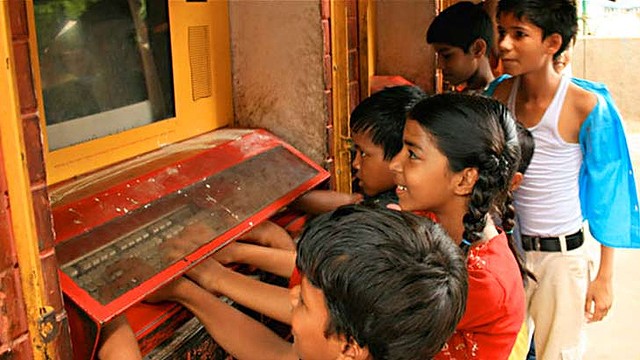
Anyone who has come across TED prize winner Sugata Mitra’s Hole In The Wall computer experiment in India (see videos below) will realise that organisational management is not the only human activity facing a crisis nowadays, but so is education and schooling in its traditional forms. Both management and teaching suffer from the innate habit of its professionals wanting to micro-manage everything, wanting to command and control, indeed trying to control outcomes, rather than letting them emerge. Sugata Mitra calls for creating Self-Organising Learning Environments (SOLE), and his experiments have shown some surprising results.
In SOLE “teachers” should not supply answers, but raise questions instead. It is not about making learning happen, but letting it happen. Too often the urge is for us to interfere. As Eton former headmaster Tony Little has said, not enough attention is paid to learning from peers; contending that what makes a school great is not good teachers, but creating an environment where learning can happen among peers. Peer learning is so much more powerful than is assumed, as the hole in wall experiments have shown; the problem is that this is also worrysome for managers and teachers alike: in SOLE they cannot control it, the learning happens by itself. Managers and teachers alike find it hard to let go.
A similar self-organising principle takes place in Open Space Technology (commonly Open Space) meetings. Open Space is all about letting conversations happen, rather the making them happen through a controlled or moderated program. There is a marketplace of ideas, people group and regroup in a completely self-organised way and move around freely, thus maximising peer learning, peer problem-solving or peer co-creativity. Open Space merely sets the environment or the right conditions for deep passionate conversations to happen. Those who try to “improve” this seemingly unmanaged process, actually interfere and disrupt the natural self-organising, and all too often poor micro-management and controlling patterns set back in. The biggest challenge in SOLE, Open Space or other self-organising systems is preventing managers, teachers or moderators from interfering – getting them to just let go.
“You cannot teach a man anything. You can only help him discover it within himself.” Galileo Galilei
That self-organised peer learning works I can attest through personal experience. In the 1980’s I was working as language project manager / director of studies at Suzuki Motors HQ in Japan for the massive ‘technology transfer’ project, transferring Suzuki’s manufacturing and management skills (what was later termed Lean Manufacturing, Lean Management, or Lean by others) from its plants to partner Canadian company, CAMI Automotive in Ontario. The essence of Lean is that it is not just about the system employed, but just as importantly about the high level of responsibility delegated and trust accorded to those actually doing the work, the ‘workers’ on the shop floor. Our task was to train over 200 shop-floor team leaders in basic English communication skills and training skills, so that they could train 2,000 Canadian workers in those Lean skills (at that time practically no-one in the West knew what Lean was or how it worked). Toyota were also undertaking similar joint-venture projects at the time (e.g. Nummi, Derby) but took a different approach, sending hundreds of their managers across as expatriates to manage the plants. Suzuki did not have the resources to do that, moreover it had undertaken to operate the CAMI plant as a collaborative venture with the Canadian Automotive Union employing local managers right from the start of production, so it was paramount that the transition and training run smoothly.
The problem was that the Japanese team leaders were highly skilled in the work, but had absolutely no foreign language skills (indeed they had never been abroad) and had essentially been school drop outs, with a clear distaste for formal schooling. The idea that they, at 40 or 50 years old, should suddenly go ‘back to school’ to learn a new language was utterly repulsive to them, and many had threatened to leave the company – they had already ‘given up’ before even starting. It was clear that any more conventional form of language and cross-cultural training program was out of the question. That is precisely why we, our company, were brought in at the time, as we had already had plenty of experience successfully running training programs for ‘blue-collar’ workers, particularly at Kobelco.
“If you want to build a ship, don’t drum up people to collect wood and don’t assign them tasks and work, but rather teach them to long for the endless immensity of the sea.” Antoine de Saint-Exupery
Our approach was unconventional. Instead of spoon-feeding elements piece by piece, we created a total physical context or environment and relied completely on the power of self-organised peer learning, using approaches like ‘Total Physical Response’, ‘Suggestopedia’ and ‘Structuro Global Audio Visual’ learning. These are all holistic and context driven in nature (which is how babies learn!), much like the computer in the wall. Without going into detail here, it was not what the team leaders had feared, and not only did they have great fun with the approach, they learned so much and quickly from the peer activities, that their attitudes and enthusiasm changed completely, to everyone’s delight.
The second half of the 6 months program was devoted to developing the supervisors’ technical training skills, in English. Most conventional technical English courses would start by teaching an array of technical expressions and role-playing simulated situations step by step. We did none of that! Our program, called SPEC and developed by David Vale, consisted of an empty room, with walls prepared so that notices, posters, kanban etc could be stuck on them, a corner with a rich resource of source material (technical books, magazines etc, nowadays we would put computers, but they weren’t around in those days and neither was the internet!), and a marketplace of projects. Their job was to prepare their workplace training material in English and practice teaching it (practicing with each other). The only thing we gave them were a few guidelines and framework expressions for doing a presentation or running a training session (they had already learned training meta-language from previous TPR). They had 8 weeks with 4 hours each day together in the same room to get ready.
Each day we started in a circle (everything we did always started and finished in a circle), and they would start by deciding what areas they each wanted to work on, and posted their information on the marketplace board. They then naturally grouped together according to their needs, they moved around to other groups as they needed to, and they prepared, organised and practiced with and from each other. We instructors did not interfere at all in this self-organising process, nor in the material they were actually working on. It was all entirely driven by them and our only role was as a resource person, answering questions and giving specific cultural feedback when it was requested. It worked beautifully. At the end they achieved their mission. I cannot emphasise enough how powerful self-organised peer learning can be, if the learning is allowed to emerge, rather than coerced (most teaching or training is trainer-led ‘push’ imposition rather than ‘pull’ emergence).
At the time I had not heard of Open Space Technology (there was no internet), but when I later discovered Open Space I immediately recognized that it was exactly what we had been doing, but instead of in a meeting or conference context, ours was in a classroom learning setting. Instead of 2-3 full days of Open Space, it was 40 half days of SPEC, but fundamentally following the same self-organising peer-driven process. It is also the same self-organising peer-learning principle which plays in SOLE. The biggest challenge for me as the manager at the Suzuki project at the time had not been the initially very reticent learners – once they realised that self-organised peer learning could be fun and rewarding they were absolutely fine. Ironically the biggest challenge was some of the instructors on our own team – we had had to hire highly qualified instructors for image reasons (the clients wanted good bios and qualifications), yet I then had to ‘unteach’ them almost everything they had learned to do as instructors. Some took it up quickly, but others found it very hard indeed to let go and let be.
I should add the project was highly successful. The subsequent training of the Canadians was so effective that most of the Japanese supervisors were able to return to Japan after just one year instead of the planned two years – the cost savings to Suzuki was enormous compared to the initial training costs. This new ‘bilingual’ team of trainers were then available for new assignments – they were subsequently sent on 2-3 year stints to Hungary, India, Malaysia, Thailand and eventually China, from which we see some of the huge changes from shabby box vehicles to modern cars in the new Skodas, Tatas and Protons. I would like to think that our Open Space / SOLE type of training contributed to the economic rise of Eastern European and Asian economies as a support mechanism, though l think that would probably be stretching it a little bit too far; after all they were all joint efforts. Equally I’m pretty certain it is fair to say that it would be wrong to assume that Open Space or SOLE had no role to play at all.
The SOLE principle is also the one we are applying to Caterfly. For a transformation program or implementation of new systems to succeed it is imperative that all affected people are invited in to co-decide, co-learn and co-create the change together. This has to be free of manipulation and needs to be seen to be free of vested interest. The self-organising peer-learning nature of Open Space is ideal to start the leaning process, and let emergence work its wonders. Cocooning the coaching period between beginning and end Open Space events sets protective boundaries within which things can be tried out, played with and people can learn from each other. Caterfly is built on the idea of inviting people into the change process, rather than coercing them, and on the self-organising peer learning that emerges. You cannot control the outcome, the only thing you can do is give it some direction by the questions you ask.
As the brilliant former Wharton Business School professor Russell Ackoff has said (BBC Interview with Peter Day): “Anyone who’s ever taught a course is aware of the fact that the one who learns the most is the teacher. So schools are upside down. The students ought to be teaching. You cannot teach unless you learn. The faculty ought to be learning, that’s what it knows how to do, it doesn’t know how to teach. The old fashioned Roman school house was a room in which student taught student – the teacher was simply a resource to ask for help, not someone who spoke at them, spurning out knowledge. We need to remake schools to be built around learning, instead of around teaching, and that’s a fundamental revision.”
And so too it should be with management and leadership, I would say. Let’s apply the Open Space of learning and the SOLE of meetings to new leadership and its transformation!
Image: Annette Zera: The Law Of Two Feet / Butterflies
What is ‘Open Space’?
Open Space Technology, commonly Open Space, is a social technology, a tool for helping people to rally around a shared challenge, with minimum obstacles and maximum efficiency. It is used to organise large meetings, gatherings, conferences, problem solving and summits in which everyone has the opportunity to participate on their own terms.
Open Space is nothing new. The process was developed by Harrison Owen in the 1980’s and it has been applied countless thousands of times, in at least 135 countries, in a variety of ways, with groups of just a few people to several thousands, from hours to several days, and longer. However, the basic process and principles perhaps reach back into ancient human history.
Open Space offers a clear framework for allowing us to achieve remarkable things. Open Space embraces complexity and chaos, yet it remains confoundingly simple while enabling creativity and productivity to flourish.
The results can not only be dramatic, but its effect on participants used to the confines of careful planning, hierarchy, telling others what to do and being told what to do, can be transformative and enriching.
“Everything the Power of the World does, is done in a circle.”
Black Elk, in Black Elk Speaks
Who is it for? What does it do?
Open space events have many applications. The most obvious one is as an alternative form of a conference – a conference without speakers, where the participants’ heart-felt issues are at the centre of discussion. This form can be applied in a multitude of settings, wherever there is an issue people have a common passion about, in
communities
political gatherings
peace talks
neighbourhoods
research or
specialist areas.
Open Space is a completely opt-in event, so invitations go out to many people and those passionate about the theme turn up.
Within organisations Open Space can also be applied for more specific purposes. Open Space can be used for:
product design and development (synchronisation)
strategy development, bringing in whole workforce
supply-chain issues, coordinating suppliers
redesigning the organisation, bottom up
innovation and prototyping, including customers
complexity problem solving using diverse perspectives
collective intelligence letting future emerge
inviting an organisational transformation process
It is this latter application, inviting the relevant workforce to co-create an implementation or a transformation that our Caterfly Open Smart Transformation is concerned with.
In all case Open Space is a way of inviting a larger number the workforce into the process, thus opening the space for a larger view of things, rather than leaving it to a few select people to manage. This is particularly important where there are big issues at stake which ignite the passions of many people. The self-organising aspect of Open Space enables any number of people to be involved efficiently and constructively.
Open Space Events can be from 1/2 day to several days. It should be noted, however, they are far more effective and powerful when run over 2 or 3 days. This is because the first day tends to focus on current and past issues, and after a night’s sleep new ideas and energies are created which means the second and third (action planning) days are far more creative, and make use of the synergies of the minds present.
How does it work?
The basic process is counter intuitively straightforward:
* Clearly define the challenge, and express it in a few words. This is what you are inviting participants to get enthused about.
Photo: Stanley Park / World Open Space on Open Space 2009
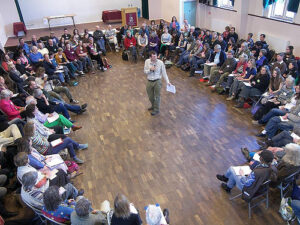
* Everyone sits in a big circle. A facilitator gives some basic instructions, then lets them get on with it.
* There is no prepared agenda, just a big blank board with available time slots and areas to use. Participants are invited to articulate what they really want to know, share, discuss or work on, and co-create the agenda with whatever sub topics they want.
* People then work out what seems most important, urgent or interesting to them, and go there. Some people will likely end up either flitting about from discussion to discussion, or getting a cup of tea and serendipitously having just the brain wave or interaction they need right there.
* Through the event people share what they’ve done, thus building a kind of ‘collective consciousness’ of the whole shebang.
* Toward the end of the event, everyone comes back together in a big circle and shares what they did, learnt, or what they want to happen next.
* Usually all participants get an anthology of the summaries of each session, perhaps with a plan of action, or key outcomes.
* Go home and let go, until the time comes to do something again.
Turn up if you want to, do what feels important, let others do what they feel is important, let go and allow it to happen in whatever way participants conspire to make happen.
The reason it seems to work
Leaders and facilitators allow people to work it out for themselves and get out of the way. No one is coerced, and no one has to be there. Opt-in participation devolves responsibility to individuals to choose to follow their passion.
There are some basic principles to help people let go of trying to be in control, and embrace what is actually happening. A metaphor would be a surfer, who rather than trying to direct the waves, finds the right place to catch one and ride it.
There is just one firm rule, known as The Law Of Two Feet, although it is more of a playful hint than strict instruction. The Law says that ‘if you are neither learning nor contributing, it is your duty to find another place to be.’ Rather than choosing a session and being stuck in it or feeling obliged, participants are encouraged to move around, increasing impact and efficiency for the individual, for each sub group, and for the whole.
Rather than try to solve a problem with just one brain, perhaps the boss or a management team, or trying to engage numerous individuals over a long period of time, Open Space harnesses the creativity and skills of everyone, all at once. What might take a dedicated team many months, gets accelerated over a very short burst, and results in more brilliant solutions that no one could have predicted.
Organising people is hard work and inefficient. Helping people to organise themselves is surprisingly easy, effective and energising. Meanwhile, it becomes easier for people to really engage, and those voices can be heard which often aren’t. Open Space works particularly well where there is no known outcome, with very complex issues and where any form of pre-planning is futile as letting the future emerge rather than trying to control is essential.
A part of how Open Space came to be discovered, was Harrison Owen’s experience while co-organising a conference. It took a lot of effort. People showed up, and sat passively in rows of chairs listening to experts. But when the coffee breaks came, the event came alive, buzzing with spontaneous conversation. The coffee break was the best bit. Open Space is an attempt to turn the entire experience into something like the coffee break. Some people started thinking of it as the opposite of a conference, and now the term unConference has become more common.
Lastly, Open Space events can also be significantly greener, utilising human resources more than material. I often refer to them as ‘compostable conferences.’
And that’s it.
“There is no order without chaos.” Harrison Owen at TEDx, Dancing with Shiva: Are we working too hard?
A large collection of video samples in Evocative Open Space Videos, especially the following 3 short videos give a good overview of what Open Space is and what it looks like in action:
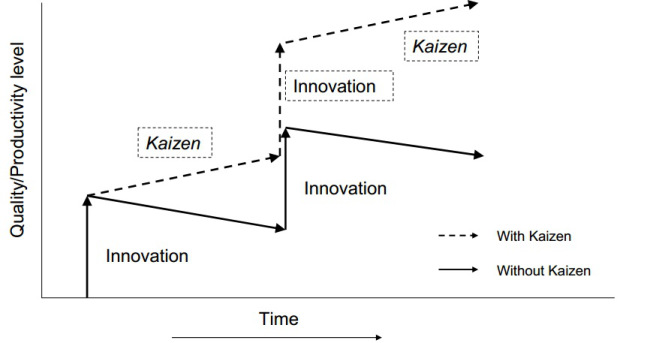
The follow up Phase III of our Open Smart Transformation (OST) process is referred to as “Competence and Innovation / Kaizen”. Competence relates to the successful mastery of the adopted approach to a degree that it is practically second nature to the organisation and does not require a lot of attention beyond maintenance. Innovation / Kaizen refers to the integration of a Kaizen culture continuously seeking small improvements as described in ‘What is Kaizen’, integrated with an occasional intensive burst of Innovation activity, using an Open Space event.
Masaaki Imai / Ofi Sofyan Gumelar
Kaizen is often contrasted to Innovation – the latter representing big steps, big leaps, mega ideas. Innovation is more dramatic and produces spectacular improvements which, however, are not necessarily sustainable. Big innovation and small Kaizen can be compared to the hare and the tortoise, the hare being innovation running fast in big leaps, the tortoise in little steps one step at a time. Both approaches are required. In a Kaizen culture one must be careful to avoid a Kaizen-only approach – that is an organisation extremely adept at finely improving and perfecting methods or products, which are, however, completely out of date (e.g. the fax machine). It is therefore important for a kaizen organisation to sometimes break out of its Kaizen mode and do some substantial out-of-the-box radical thinking.
“Kaizen is like a hotbed that nurtures small and ongoing changes, while innovation is like magma that appears in abrupt eruptions from time to time.” Masaaki Imai
We believe this is best achieved using Open Space Technology. Since disruptive out-of-the-box thinking cannot be pre-planned, it has to be done in a platform which is totally open and self-organised, both in terms of content as well as of participation. Pre-planning and organisation by definition defeat innovation. Serendipity and collective sensing are paramount. Open Space is based on self-organisation, opt-in participation and a market-place of ideas where people are free to follow their curiosity and passion through various clusters of interest. In the third phase, therefore, we recommend an ongoing platform or culture of Kaizen continuous improvement, interspersed once or twice a year, or as needed, with a mega-burst of radical innovation activity through an Open Space Innovation event to which the whole relevant workforce is invited.
Caterfly’s introduction of Open Space Technology to combine Kaizen and innovation is our unique contribution, which we hope will be taken up by others.
“If I have seen further it is by standing on the shoulders of giants.” Isaac Newton
The buzz about invitation – what inspired us
Caterfly’s Open Smart Transformation model is a derivative of Prime/OS™. A good part of Caterfly’s approach and Open Smart Transformation model was initially inspired by Open Agile Adoption (OAA) developed by Daniel Mezick. Open Agile Adoption itself applies the work of Harrison Owen in Open Space Technology, commonly Open Space. Daniel Mezick identified some unique properties of Open Space Technology related to game theory, especially its characteristic (‘pull’) opt-in invitation approach (Law of 2 Feet) rather than by imposition (‘push’). What is unique about OAA in Daniel’s use of Open Space Technology, however, is his re-framing and application of Open Space for a specific purpose, specifically in applying two Open Space events to frame a transformation process. From this he developed OAA (Open Agile Adoption) for ‘pull’-style agile implementations.
This work is based on Prime/OS™, published as an Open Source, Free Cultural Work via the CC-BY-SA license from Creative Commons.
Download the Prime/OS™ Definition Here: http://www.prime-os.com/download-prime/
Creative Commons, Free Culture licensing details here
We have always maintained that the people affected by any form of system implementation or transformation must first and foremost be consulted and invited into the process and the decision-making, so we immediately recognised the relevance of Daniel’s work beyond its Agile application. In fact we are not Agile coaches and to that degree OAA is not directly relevant to us. However we recognised that the principle Daniel was propagating is relevant way beyond pure Agile adoption, indeed it is applicable to the adoption of any system, like lean, systems thinking, responsive org, sociocracy or sustainability management, or indeed to any form of organisational transformation.
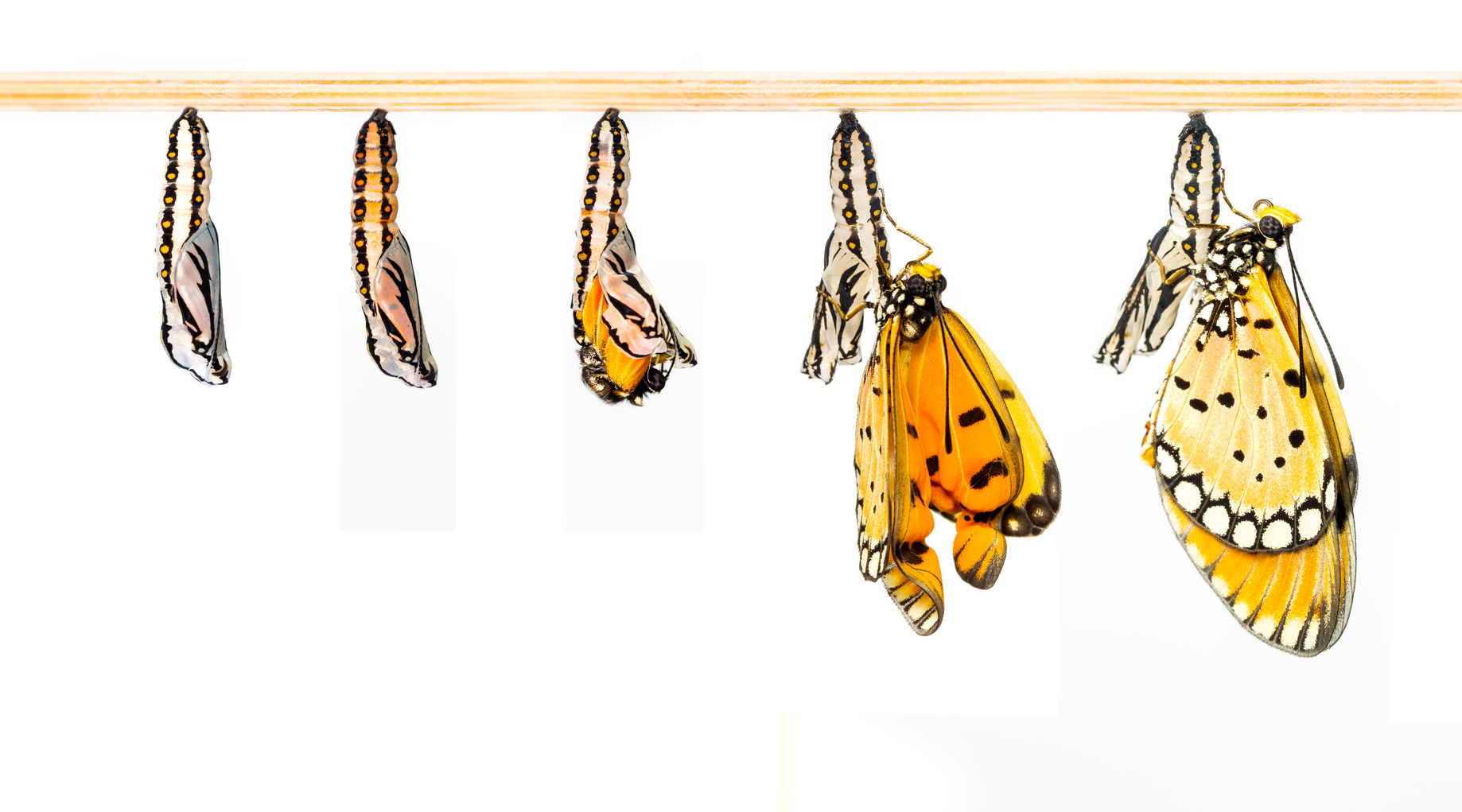
From this we developed the concept of the Caterfly, denoting the metamorphosis from caterpillar to butterfly, starting with the building of a protective cocoon and ending with the breaking out of it, with a long period of gestation in between; or in Caterfly a beginning and an end Open Space event each with various coaching iterations in between. The ‘cocoon’ is marked time-wise by the two Open Space events. The metamorphosis can represent any adoption, cultural change or transformation process an organisation seeks to undergo – and it does so not by mandating or imposing, but by inviting all affected to co-write the change or adoption story.
Daniel Mezick had independently come to a similar conclusion and had renamed his extended application as Prime/OS™. Consequently we have agreed to regard our Open Smart Transformation as a derivative of Prime/OS™, under a Creative Commons license, which enables us to follow those before us in gifting our work to the Intellectual Commons. The approaches are similar at this point, although this may change with experience. The only modificaton we have made so far is in the follow up phase III where we introduce Kaizen. We believe a process of learning should continue beyond adoption, and Kaizen creates an excellent platform for this continous renewal, responsiveness and innovation.
We are pleased to be connected with Daniel Mezick on this very important contribution to organisational transformation. We enjoy Daniel’s double-open space cocoon framework because it offers an excellent platform to invite the people affected by the change into the decision and planning process, and to co-create the change.
As Open Space facilitators we would also like to acknowledge and appreciate the work of Harrision Owen and the hundreds of Open Space facilitators around the world who have run many thousands of Open Space events over more than 20 years and have proven that Open Space is one of the most effective transformation preparatory tools around.
Caterfly’s predominant role is to support and enhance coaches and trainers running a transformation programme with Open Space events. We facilitate the framing Open Space events and leave the coaches and consultants to run their programme as usual.
Further reading * Daniel Mezick’s site is a great repository for further information and writing around the subject.
* Find out more about Open Space at our ‘What is Open Space?’ page, where there are also links to further resources including Harrison Owen’s work.
* Full description of the Open Smart Transformation model
“The three-out-of-seven success rate is an average view from many different research findings. Some studies reported success as low as 10%, others as high as 50%. The research span across many industries and countries and the nature of the change initiative studied varied widely—customer relationship ,management , enterprise resource planning , shared services endeavors, supply chain projects, mergers and acquisitions, cost reduction initiatives, restructuring/reorganization efforts, customer experience initiatives, etc. Any way you examine the findings, there is ample evidence that the change initiatives are far more likely to fall short of their stated objectives than to reach their promised outcomes.”
“Too many change efforts start with all the managers getting together behind closed doors and deciding what should be done. They never think of telling their people what is going to happen and why, let alone canvassing their opinions, ideas or suggestions because they are the people closest to the front line and who just might be able to see what ultimate impact the change could have on the customer.”
Ken Blanchard, ‘Mastering the art of change’ [Training Journal, January 2010]
Blanchard lists 6 stages of concern which are often not met:
* Need for information, not a slick sales talk (trying to get ‘buy in’)
* Need for personal relevance (what will this mean for me?)
* Implementation: what do I need to do and when?
* Impact: Is this making a difference, Is it worth it?
* Collaboration: how can I share learning and wins
* Refinement: How can we continually improve the change?
Caterfly has been strongly influenced by a call to arms by Daniel Mezick, who developed the Open Agile Adoption system for implementing Agile working in organisations. Caterfly’s Open Smart Transformation model is a derivative of Prime/OS™ developed by Daniel Mezick.
Open Agile Adoption – implementing Agile working patterns in organisations using Open Space
 Caterfly presents: a 1 day participant-led ‘Open Space’ event exploring the need for transforming the way we work together, the move toward more collaborative, responsive workplaces, for businesses that place the customer at the centre, with respect for people and planet, the reality, complexity and barriers to change, and ways to move forward.





 product design and development (synchronisation)