Tag: participation

  • Ask, Then Invite to Co-create Change

    Ask, Then Invite to Co-create Change

    Scaled System Transformations in Organisations

    Have you ever been in an organisation where you were good at your job, efficient and productive, satisfied by what you achieved, hopeful about future prospects, respected in your expertise, and really feeling part of a good team? ……. and then all of a sudden, one day, out of the blue, you are told that some changes were going to happen; ……. and that a that a team of consultants were coming in to bring about these changes and introduce a new system (SAP, agile, lean………). This team then devotes time and energy explaining the purpose of the change, the why and how, and it all makes perfect logical sense, indeed the proposed changes are not dissimilar to changes you had proposed to your manager in the past. And yet, despite not disagreeing with the reasons for the change, your heart feels crushed, you somehow feel totally betrayed, utterly let down, completely undermined, leaving you shattered and dispirited.
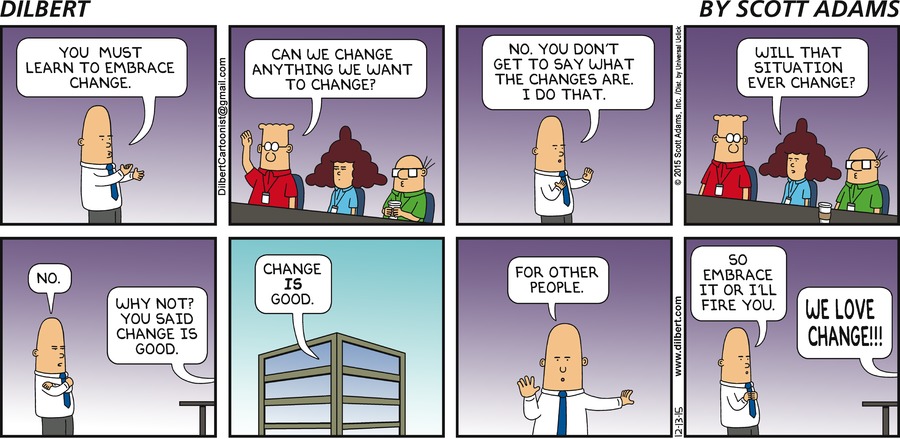
    Dilbert embrace change

    Why? Because nobody in the organisation, none of your superiors, ever bothered to ask you. The changes touch on the essence of your work, and still you were not even consulted. Instead someone at the top decided this was a good idea, let’s bring in some change experts in to implement it, and the team of consultants, who know nothing about the operational side of the work you do, are brought in to tell you what to do. Why aren’t you, as a long-time loyal employee, dedicated to achieving the aims of the organisation, being at least asked about the matter, never mind consulted? Obviously you feel disrespected and undermined, but also angry – your self-esteem is under attack. Suddenly this new system seems alien to you.

    While on reflection you would have been quite an enthusiastic proponent of the changes being proposed, because they were brought on over your head without your consent and without your views being heard, suddenly you feel estranged, and this new system appears alien. You lose motivation, you don’t want to be part of it, and you start silently resisting the change. Not because you disagree fundamentally or logically, but because of the manner this was done over your head. You were never given a say in the matter, nor a choice to opt in or out. You no longer feel respected and esteemed, you become cynical, and you, perhaps unconsciously, resist passively.

    Consequently you are now branded a change resister, and it is deemed you need to be “managed” with care. You are singled out as a laggard and for now ignored. It becomes a double blow, not only do you feel betrayed and undermined by the initial imposition, now you start losing confidence, your professional competence is called into question, you no longer feel part of the team, indeed resentment becomes stronger and stronger, you no longer want to listen, and a vicious cycle builds up. Suddenly you are a serious resister, an enemy of change, you are no longer for us but against “them”. While the consultants work on the more amenable employees, you become “the” problem, and your survival in the organisation becomes questionable, gradually instigating fear and a destructive atmosphere.

    And all because, initially, you were never asked. You were not invited to contribute to the new way forward, it was simply imposed on you from above. You feel alienated, because you were not invited to co-create the organisation’s future, and you no longer feel part of the team.

    Not consulting, not listening to, and not inviting those who do the work, those closest to the products/services and the users, and those most connected to the processes that create value, not bringing them in into the change process, not inviting them to co-create the change, are all prescriptions for failure. They reflect distrust and disrespect of an organisation’s own people. And yet this scenario happens again and again, person after person, time after time, organisation after organisation. What a waste of good resources! What a waste of energy! What a waste of great talent!

    The solution ‘should be’ fairly straight-forward, do exactly what’s missing: ASK! Invite the affected employees to co-create the change and thereby make it their own. Why don’t so many organisations follow this most basic of human leadership principles? Possibly a legacy of the command and control management attitudes of the last century? Possibly due to an inherent unconscious management distrust (and disrespect) of employees. Possibly due to lack of awareness of the inhumaneness of mandation, an unintended consequence of classical intervention. Possibly due to worries about having to “manage” large numbers of employees invited to co-create the change. And possibly simply, it has to be said, due to a lack of know-how – managers may know that engaging the workforce might be important, but they just don’t know how to go about it. The challenge is how to do it at scale.

    This is exactly the issue and the know-how a new book just silently published recently seeks to address. It is called The Open Space Agility Handbook. It is written and conceived by Daniel Mezick, respected senior agile coach in the Boston area, author of Culture Games, together with a team of experts, Mark Sheffield, Deborah Pontes, Louise Kold-Taylor, Harold Shinsato and OpenSpace Technology founder, Harrison Owen. ‘Agile’, for those of you not from the IT or software development world, is a working practice applied by software engineers, derived from ‘Lean’, which enables software development teams to be much closer to customers and to respond to their needs nimbly, thus being agile. The practice is anchored in the Agile Manifesto.

    openspaceagility_big_picture
    This diagram is copied directly from the Open Space Agility website. and represents an overview road map of OSA used in the book.
    1. Graphic (c) 2015 www.OpenSpaceAgility.com (OSA),
    2. All rights reserved; provided by permission of OSA.

    While this new book focusses on ‘Agile’, it is really about organisational transformation. The title, The Open Space Agility Handbook, sounds pretty technical and unobtrusive. And in one sense that’s all it is, as the title says, it’s a handbook on how to adopt agile practices, using a double Open Space Technology frame. What the book’s title doesn’t betray, however, is the transformative power of its approach. On one hand the book is simply a step by step guide on implementing agile. On the other hand it presents a revolutionary approach to agile adoptions, and beyond, in fact it tackles head-on one of the key challenges of organisational interventions and change management itself. As innocuous as the book may seem, don’t be fooled by its simplicity. It describes a simple solution to one of the most difficult challenges of management, that of scaled organisational change.

    While the handbook concentrates on agile only, the principles and philosophy behind the invitation approach is applicable beyond agile – you can replace “agile” with “lean”, “conscious” or “responsive”. The approach could just as easily apply to lean, teal, responsive, peer-to-peer learning, distributed leadership, conscious business, environmental sustainability, beyond budgeting, sociocracy and indeed any other form of organisational transformation. Thus whether you like agile or not, if you are involved in adoptions, implementations or transformations, this book is for you. Instead of mandating change from above, which leads to resistance or internal sabotage, the approach urges organisations to ask and invite the relevant work-force to co-create the change together, as a collaborative iterative effort, rather than imposing from above.

    The approach is based asking those doing the work about proposed adoptions or change and inviting them to co-create transformation together, using a combination of Open Space Technology and standard coaching iterative methods, ….. and thereby avoiding the tremendous waste of talent and resources arising from the imposition of change. As the concepts of INVITATION (as opposed to directed or imposed), PEER-BASED SELF-ORGANISED LEARNING (SOLE) and CHANGE CO-CREATION become increasingly understood and appreciated in organisations, so this simple how-to book will find a growing audience in and beyond agile. The approach is completely in line with what the Stanford and London Business School guru Gary Hamel has termed the ‘change platform’.

    _______________________________

    More details of the approach can be found here.

    This blog was first published in Medium on 21 December 2016
  • The problem with change management

    The problem with change management

    The Problem with Change Management

    As a coach I have always steered away from ‘change management’, even though it is a huge industry and I would probably have done quite well in it. Intuitively change management has always struck me as unfair or oppressive, even when it was well-intentioned and perfectly rational. It has appeared to me one-sided, often with senior management wanting to enforce a new system or a new way of working, yet were themselves unwilling to change their own habits or behaviours. I even felt this sense of unease when I was a ‘senior manager’ myself!  ‘Change management’ renders an air of blame, injecting fear, and when things are not working it’s ‘because the staff are incompetent, or lazy, or otherwise doing things wrong – they need to change’. It is not a genuinely collaborative effort.

    Change has often seemed to me to be imposed. Moreover it is rarely ever on a level playing field, and seldom a two-way process. I have observed so many situations in companies, for instance, where improvements have been suggested by more junior staff which have then simply been brushed off as ‘get on with your work’, ‘that’s not your job’ or ‘we know what we are doing’. The voices of staff are often ignored, even though they are the ones actually doing the work and would be in a better position to know. The Stafford hospital scandal is a typical case where staff were not listened to – after all “what do nurses know about management?” I personally experienced the inner sarcasm felt by the Heathrow T5 staff before the new terminal opened, who knew exactly where all the problems were long before the opening, but were simply ignored – the ensuing fiasco could well have been avoided, if they had been listened to.

    Even where there is a recognition that some form of consultation needs to take place, more often than not this is done only after the major decisions have already been taken, and there is little influence staff can have. Instead senior executives are advised by consultants that they need to brush up their communication skills, the reason change is not working is because staff have not been informed well enough about the purpose of the change, what it will look like and who is responsible for what. Malfunctioning change programs are often blamed on poor communication, as if better persuasive skills would make the change work.

    “People don’t resist change, they resist being changed.” Peter Senge

    Overall I agree with Ron Ashkenas in his Harvard Business Review blog Change Management Needs to Change that the poor success rate of change management initiatives lies less in the content or strategy of change, but in the poor preparation and skills of the senior executives in implementing the change. Implementation is often delegated down to an army of ‘consultants’ and ‘champions’. For every 100 business books on strategy, 98 are on strategy development and only 2 on implementation. We are sorely lacking in implementation skills and the way implementation itself will and should inform strategy. Not surprisingly this gives rise to the deep disconnect between managers and the managed, between politicians and the electorate, between “the system” and its participants.

    The same fundamental problem exists in day to day operations, never mind change management, in ordinary decisions. Decisions are taken without consulting the affected staff; these are then poorly executed or sometimes even simply sabotaged by the staff – fundamentally because they were never asked. It never ceases to amaze me how corporate decisions are made without even asking, never mind eliciting suggestions from, the staff affected, those who actually do the work. Executives expect the decisions to somehow be carried out, as if mechanically, and are then surprised when things do not get done, blaming the reticence of staff. Executives spurt out strategies and wonderful soundbites left right galore, but when it comes to implementation they are rather thin on the ground.

    “Separating knowledge and decision making authority leads to bad decisions.” Mark Seuffert

    The basic problem is simple: people are not asked. Strategies and change programs are developed by executives behind closed doors, and then mandated. What should be happening is that those affected need to be invited into the process, invited to co-author the new story. This is often viewed as time-consuming and unnecessary, despite statistical evidence to the contrary, even though there exist good processes or practices (like Open Space Technology) which can make this very effective. Adoptions need to involve the whole workforce, and not a few elite making the decisions and ‘rolling’ them out. All staff need to be invited, to explore what, how and why change or improvement could be executed, how we can all work on it together, and most importantly to truly listen to all the suggestions, ideas and different perspectives from the workforce.

    You cannot impose (command) participation or engagement, it’s a contradiction of terms – yet this is precisely what many change management programs still try to do. Words like ‘buy-in’ send a cringe down my spine – it implies being sold to, being had or manipulated, without a real equivalent discussion. ‘Empowerment’ implies that someone has power and passes some of it on – what an insult! Even change programs which are supposed to distribute decision-making among the work force, like agile or holacracy, have been mandated, often with resulting unexpected high staff turnover. As a lean-kaizen and sociocratic coach I also need to be very careful not to impose these brilliant systems on others, but rather to invite all into the process. It is not the quality of the new system which is in question, but the quality of the collaboration, implementation and initial consent. Invitation is the key – inviting all affected to co-create the change.  The simplest, yet most difficult, thing to do is simply to ask.

    Wouldn’t you like to be invited and consulted every time those around you change something?

    Find out more about how we use the power of invitation and collaborative transformation at Caterfly.

    Further reading:
    More on the Stafford hospital crisis and simple shifts for more effective working and inclusion – click
    Why telling people what to do doesn’t work – click
    What is Open Space? – click

  • What is Open Space?

    What is Open Space?

    Image: Annette Zera: The Law Of Two Feet / Butterflies

    What is ‘Open Space’?

    Open Space Technology, commonly Open Space, is a social technology, a tool for helping people to rally around a shared challenge, with minimum obstacles and maximum efficiency. It is used to organise large meetings, gatherings, conferences, problem solving and summits in which everyone has the opportunity to participate on their own terms.

    Open Space is nothing new. The process was developed by Harrison Owen in the 1980’s and it has been applied countless thousands of times, in at least 135 countries, in a variety of ways, with groups of just a few people to several thousands, from hours to several days, and longer. However, the basic process and principles perhaps reach back into ancient human history.

    Open Space offers a clear framework for allowing us to achieve remarkable things. Open Space embraces complexity and chaos, yet it remains confoundingly simple while enabling creativity and productivity to flourish.

    The results can not only be dramatic, but its effect on participants used to the confines of careful planning, hierarchy, telling others what to do and being told what to do, can be transformative and enriching.

    “Everything the Power of the World does, is done in a circle.”
    Black Elk, in Black Elk Speaks

    Who is it for? What does it do?

    Open space events have many applications. The most obvious one is as an alternative form of a conference – a conference without speakers, where the participants’ heart-felt issues are at the centre of discussion. This form can be applied in a multitude of settings, wherever there is an issue people have a common passion about, in

    • communities
    • political gatherings
    • peace talks
    • neighbourhoods
    • research or
    • specialist areas.

    Open Space is a completely opt-in event, so invitations go out to many people and those passionate about the theme turn up.

    Within organisations Open Space can also be applied for more specific purposes.  Open Space can be used for:

    • product design and development (synchronisation)
    • strategy development, bringing in whole workforce
    • supply-chain issues, coordinating suppliers
    • redesigning the organisation, bottom up
    • innovation and prototyping, including customers
    • complexity problem solving using diverse perspectives
    • collective intelligence letting future emerge
    • inviting an organisational transformation process

    It is this latter application, inviting the relevant workforce to co-create an implementation or a transformation that our Caterfly Open Smart Transformation is concerned with.

    In all case Open Space is a way of inviting a larger number the workforce into the process, thus opening the space for a larger view of things, rather than leaving it to a few select people to manage.  This is particularly important where there are big issues at stake which ignite the passions of many people.  The self-organising aspect of Open Space enables any number of people to be involved efficiently and constructively.

    Open Space Events can be from 1/2 day to several days.  It should be noted, however, they are far more effective and powerful when run over 2 or 3 days.  This is because the first day tends to focus on current and past issues, and after a night’s sleep new ideas and energies are created which means the second and third (action planning) days are far more creative, and make use of the synergies of the minds present.

    How does it work?

    The basic process is counter intuitively straightforward:

    * Clearly define the challenge, and express it in a few words. This is what you are inviting participants to get enthused about.

    Photo: Stanley Park / World Open Space on Open Space 2009
    Photo: Stanley Park / World Open Space on Open Space 2009

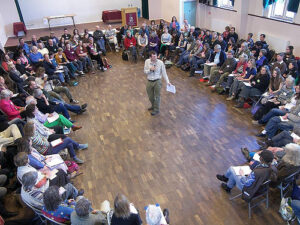
    * Everyone sits in a big circle. A facilitator gives some basic instructions, then lets them get on with it.

    * There is no prepared agenda, just a big blank board with available time slots and areas to use. Participants are invited to articulate what they really want to know, share, discuss or work on, and co-create the agenda with whatever sub topics they want.

    * People then work out what seems most important, urgent or interesting to them, and go there. Some people will likely end up either flitting about from discussion to discussion, or getting a cup of tea and serendipitously having just the brain wave or interaction they need right there.

    * Through the event people share what they’ve done, thus building a kind of ‘collective consciousness’ of the whole shebang.

    * Toward the end of the event, everyone comes back together in a big circle and shares what they did, learnt, or what they want to happen next.

    * Usually all participants get an anthology of the summaries of each session, perhaps with a plan of action, or key outcomes.

    * Go home and let go, until the time comes to do something again.

    Turn up if you want to, do what feels important, let others do what they feel is important, let go and allow it to happen in whatever way participants conspire to make happen. 

    The reason it seems to work

    Leaders and facilitators allow people to work it out for themselves and get out of the way. No one is coerced, and no one has to be there. Opt-in participation devolves responsibility to individuals to choose to follow their passion.

    light bulbs sketched on chalkboard Many small ideas make a big oneThere are some basic principles to help people let go of trying to be in control, and embrace what is actually happening. A metaphor would be a surfer, who rather than trying to direct the waves, finds the right place to catch one and ride it.

    There is just one firm rule, known as The Law Of Two Feet, although it is more of a playful hint than strict instruction. The Law says that ‘if you are neither learning nor contributing, it is your duty to find another place to be.’ Rather than choosing a session and being stuck in it or feeling obliged, participants are encouraged to move around, increasing impact and efficiency for the individual, for each sub group, and for the whole.

    Rather than try to solve a problem with just one brain, perhaps the boss or a management team, or trying to engage numerous individuals over a long period of time, Open Space harnesses the creativity and skills of everyone, all at once. What might take a dedicated team many months, gets accelerated over a very short burst, and results in more brilliant solutions that no one could have predicted.

    Organising people is hard work and inefficient. Helping people to organise themselves is surprisingly easy, effective and energising. Meanwhile, it becomes easier for people to really engage, and those voices can be heard which often aren’t.  Open Space works particularly well where there is no known outcome, with very complex issues and where any form of pre-planning is futile as letting the future emerge rather than trying to control is essential.

    Relax nothing is under controlA part of how Open Space came to be discovered, was Harrison Owen’s experience while co-organising a conference. It took a lot of effort. People showed up, and sat passively in rows of chairs listening to experts. But when the coffee breaks came, the event came alive, buzzing with spontaneous conversation. The coffee break was the best bit. Open Space is an attempt to turn the entire experience into something like the coffee break. Some people started thinking of it as the opposite of a conference, and now the term unConference has become more common.

    Lastly, Open Space events can also be significantly greener, utilising human resources more than material. I often refer to them as ‘compostable conferences.’

    And that’s it.

    “There is no order without chaos.”
    Harrison Owen at TEDx, Dancing with Shiva: Are we working too hard? 

    Further reading and Videos:

    Wikipedia: Open Space Technology

    Harrison Owen’s Brief History of Open Space

    Open Space World resources

    How Caterfly is pioneering Open Space for Innovation and Kaizen or using it in organisations to invite cultural transformation

    Caterfly’s model is based on Daniel Mezick’s innovative Prime/OS™ model, using Open Space to adopt Agile working and more

    Chris Corrigan article, on using Open Space to solve complex problems

    Huffington Post Business article, Opening The Space For Innovation

    Martin Grimshaw’s Open Space Facilitator’s Checklist

    Open Space Facilitators around the world: Open Space World Map

    A large collection of video samples in Evocative Open Space Videos, especially the following 3 short videos give a good overview of what Open Space is and what it looks like in action:

  • Why coercion doesn’t work

    Why coercion doesn’t work

    Tuesday 21 July 15, Victoria, London: Shift, a participant-led Open Space event
    Why aren’t organisations shifting? www.events.caterfly.co.uk

    “People don’t resist change, they resist being changed.” Peter Senge

    As any parent knows, as soon as a child starts to develop a sense of identity, they start to assert their boundaries and free will by saying No.

    Human nature being what it is, we have an innate hardwired resistance to change and to being told what to do, that starts as children and generally lingers from thereon. Attempts to creatively and positively work with this phenomenon can be seen in alternative education, where teaching at pupils is replaced by self-led learning, encouraging autonomy and curiosity.

    Achieving Buy-in

    In the workplace getting others to do what is wanted of them, and getting them to engage, care and want it, is known as ‘achieving buy-in.’ It is the classic and everyday challenge faced by leadership and management trying to get staff to do stuff, and at its worst it feels like coercion. Attempts to lead organisational change are often met with cultural inertia.

    Throwing Unconscious Spanners

    I remember sitting in a team meeting many years ago and witnessing something that led to a profound insight that has stayed with me ever since. A member of staff, arms crossed and a look of consternation on her face, responded to the manager with something like, ‘Well, I never did really agree with that strategy we initiated fours ago.’

    That strategy was the manager’s, introduced upon staff who all nodded along and set about it with varying degrees of compliance, enthusiasm, disgruntlement or sabotage depending on how much they quietly thought it was a good or bad idea. That strategy probably worked to some extent without really catching fire, despite staff being paid to do what they are told and annual performance appraisals.

    I have seen this pattern repeated over and over. In the workplace, we commonly consciously or unconsciously throw spanners in the works of someone else’s well laid plan.

    Or as a friend told me recently, “I got an F in GCSE electronics because my project was made entirely of wood.” Which neatly illustrates to me the fallacy and depressing failings of coercive education.

    Consent is sexy, as they say

    “The ultimate weapon has always existed. Every man, every woman, and every child owns it. It’s the ability to say No and take the consequences.” It is what distinguishes us from robots.
    Hagbard Celine, The Illuminatus! Triology, Robert Shea and Robert Anton Wilson. 

    Rather than attempting to ‘achieve buy-in’, why not allow people to solve problems and draw up their own action plans? People tend to find solutions that they have helped to co-create more exciting, and once genuine or even enthusiastic consent has been reached, tend to set about the task with gusto. Participation doesn’t just work, it is more effective in the long run, and if harnessed well then multiple view points can lead to smarter decisions. Allowing people to set their own pace and write their own story, helps to dissolve change fatigue so common in organisations, where staff might be under a constant barrage of brilliant new ideas, at the mercy of merry-go-round leadership and consultants.

    Barriers and the Bottom-up Manifesto

    There are barriers too. We are habituated into patterns of behaviour that were often set early in life and reinforced in school and work for all but the more maverick and rebellious of us. We’re used to being told what to do. Working stuff out for ourselves can feel daunting and unusual. We tend not to be brilliant at collaborative decision making, and too often remain stuck in the competitive need to win, rather than seek the win-win. Tools that encourage self-organisation and ownership bring out the better in us, but also bring out the rest in us. Over time behaviour shifts, but habits are notoriously persistent.

    Self-propelled learning and problem solving also means that managers need to learn to let go of control, which can also be discomforting and even threatening. Positive results and an enthused workforce, however, soon illustrate the benefits of new approaches. Rather than well-intentioned directives cascading down the hierarchy to be met with indifference or the feigned relish of the easily replaced, how about asking staff to collaborate with leaders to find pathways that finally utilise their long ignored insight? Why not try introducing some bottom-up alongside the old top-down?

    Leaders and managers might just discover that the expertise they seek was hiding under their noses all along.


    See also: The Problem With Change Management

    Beyond unConferencing: New Uses of Open Space

  • Smarter working

    Smarter Working

    Caterfly uses Open Smart Transformation to help organisations implement smarter ways of working.

    What do we mean by Smart?

    While we don’t claim any originality to our use of the term, we have coined the term Smarter Working in this context to help us define the kind of systems, tools and processes that we work with, or which align with them. Smarter systems of working are modern approaches to work which might emphasise participation, collaboration, integrity, sustainability, self-organising or self-managing teams, and a wiser, 21st Century approach to leadership and hierarchy. Smarter systems of working do not conflict with the needs of society and planet. They are in alignment with life, rather than exploiting it. They promote personal, organisational and planetary wellbeing, with ethics at their centre.

    Smarter Working includes, but is not limited to: Responsive, Lean, Agile,  participatory Environmental or Sustainability Management Systems (EMS or SMS), Sociocracy, Management 3.0, Conscious Business, Holacracy, Kaizen, and so on.

    Smarter Working means re-imagining what it means to be at work, as if were something we wanted to do, that was genuinely useful, to be enjoyed, a source of pride and contentment, and a place for learning and growth. Smarter Working means re-imagining working relationships and working together with common purpose in a way that is more enjoyable, healthier and happier, while taking a sustainability-first or even restorative attitude to our relationship to Earth.

    Smarter Working is work as it should be.