Tag: sole

  • Beyond ‘UnConferencing’: Fresh Uses of Open Space

    Tuesday 21 July 15, Victoria, London: Shift, a participant-led Open Space event
    Why aren’t organisations shifting? www.events.caterfly.co.uk

    Applications of Open Space Technology in 21st Century
    self-organising network organisations

    Open Space Technology (OST) has been around for almost 30 years, has been applied in 150 countries, with 300,000+ groups or events, involving millions of people having unique experiences through OST.  OST (Open Space Technology) has been used:

    • as a participant-led alternative to conferences (hence “unconference”)
    • for conflict resolution (in large scale peace deliberations)
    • for stakeholder dialogues in a variety of contexts and disciplines

    … and many situations involving deep discussions, where there is a burning issue, high levels of passion and no preconceived outcome.  OST works beautifully because it fulfils some of the conditions for participant engagement, such as connection, communication and meaning.  OST has also been used extensively for various intra-organisational purposes within organisations with huge success.

    Despite the successes, ZenLarge however, OST has rarely become mainstream practice within organisations.  This may be because it does not sit well with the planned, budgeted, command & control management style of most organisations.  Moreover OST does not create legacies, i.e. it does not lend itself to anyone taking credit for successful outcomes, because success is collective.  So  as Steve Denning of Forbes laments in his Drucker Forum 2015 blog “… despite almost a century of fine management writing …. about the humanist strand of management thinking that celebrates team and collaboration through respect for customers and workers as human beings  ……. , the ugly truth is that its lasting impact on general management has been limited.”  … so it is with OST, too.

    Nevertheless, over the last few years, as the nature of organisations has gradually been changing, or is being forced to shift through the internet and social technologies, so the demand for OST is on the increase.  As we see from some of the thriving pioneering new organisations (as described for instance in Frederic Laloux’s Reinventing Organisations), the definition and purpose of organisations are changing from linear, mechanical, predictability-based, controlled and top-down structures to fluid, organic, emergent, distributed and self-organising networks.

    These new organisations thrive on continuous reconfiguration, plasticity, responsive innovation, synchronicity, eco-centricity, co-creativity and mindful empathy.  They are self-organising (and continuously self-re-organising) iterative learning network cultures that are ‘wirearchical’, locally attuned and able to adapt to the prevailing fast changing, diverse and highly complex conditions.  All of which is not possible unless “led” bottom-up with all employees or members fully engaged and empowered, and with ‘teams of teams’ exploring and cross-communicating.

    teamsofteams

    It is in these new kinds of organisations that OST could become more common, especially where cross-functional alignment and coordination is sought. OST thrives on unpredictability, fluidity and complexity, where the more conventional interventions of “managing” all of the factors do not work. Assigning people to solve highly complex problems can be self-defeating, for instance, because the very selection predetermines certain outcomes which often turn out to be counterproductive.  OST on the other hand provides a platform for self-selection (opt-in),  cross border serendipity and self-organisation.  In particular OST is superb at enabling what MIT’s Human Dynamics Lab research has found to be one of the necessary ingredients for high perfoming teams: regularly exploring information outside one’s team and usual circle of colleagues. OST excels at holistic cross-functional interactions.

    As OST within organisations expands, so will the need grow for more skilled OST facilitators who are able to “hold space” without disrupting the interaction flow, and create “containers” within which authentic cross-fertilising exchanges and deep dialogue can occur.  They will also need to be able to create peer-based self-organising learning environments, which will form the source of an organisation’s client- or user-connectivity, iterations and innovations.

    OST is the face to face synchronous counterpart to digital networks and social technologies (as used in intra-organisational online networks).  While online asynchronous connectivity plays an expanding role in these organisations, people still need direct human contact and serendipitous interaction, and OST excels at this.  Indeed recent research at MIT’s Media Lab has shown that face to face communication far exceeds video-conferencing or email in enhancing team performance, so direct interaction will increasingly neeed to supplement digitalisation.  It is for these more organisation types or modes of operation that new applications for OST will emerge, all involving larger numbers of people from across different parts of the organisation coming together and communicating across borders.  Let me list just a few fresh applications of OST:

    • As a tool for bottom-up culture change, exploring new ways of working and interacting, establishing collective values and practices through experimentation and co-creativity
    • For strategy development, adjustment and alignment across the whole organisation (somewhat akin to Hoshin Kanri), with a stronger emphasis on implementation.
    • For R & D product/service design and development, periodic consolidation and synchronisation (possibly combined with ‘big room’ Obeya)
    • As a complex problem-solving tool, involving multiple stakeholders with diverse perspectives and no predictable solutions (a more self-organised version of S. Beer’s cybernetic Syntegrity)
    • As a way for organic organisational reconfiguration (bottom-up re-organisation) to respond to changing circumstances (rewiring team networks)
    • To enable cross-party collaboration, e.g. prototyping with designers/ developers, customers/users and producers/suppliers (horizontal feedback)
    • To create learning organisations through pan-organisational peer-based learning environments which are self-managed and self-regenerating

    Crowd wisdom accuracy james surowieckiFor many, if not most organisations today, a lot of the above may seem obscure, abstract and remote, far from the current reality.  In fact most organisations today are still run in a predict, command and control fashion.  At the same time, however, there is an understanding amongst leaders this needs to change.  Even though little has changed so far, some leaders are talking of an organisational paradigm shift.   Yet many of them have little clue how to go about this.  This may partly be because their leadership style stands in the way of culture change: as Einstein said, “you cannot solve problems with the same solutions that created them”.  Awaiting a generation change is probably not an option.

    My take:  Do not even try!  You cannot plan, command and micro-manage this shift.  Instead let the workers, employees and members of the organisation configure the change through emergence.  Give the organisation a platform for letting this happen.  Stand back, let go and let it happen.  This is exactly where OST can work its wonders.  Whatever emerges is the right thing to emerge.  Leaders should not try to be heroes and do it themselves, rather let the whole workforce authentically engage, experiment and co-create the shift together.  Let Open Space Technology do what it does best.  This is probably the most important application of OST currently needed – as a tool for organisational transformation and paradigm shift.  Let transformation happen. Let open space begin.


    See also What is Open Space?

    The Problem With Change Management
    Innovation and Kaizen

    Open Agile Testimonials


  • SOLE – self organising learning environments

    SOLE – self organising learning environments

    Self Organising Learning Environments… and what it means for the future workplace

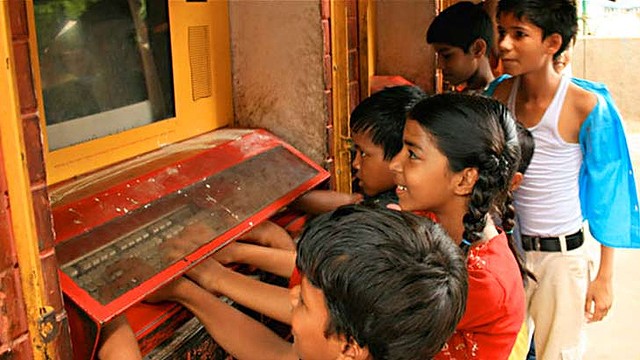
    Anyone who has come across TED prize winner Sugata Mitra’s Hole In The Wall computer experiment in India (see videos below) will realise that organisational management is not the only human activity facing a crisis nowadays, but so is education and schooling in its traditional forms. Both management and teaching suffer from the innate habit of its professionals wanting to micro-manage everything, wanting to command and control, indeed trying to control outcomes, rather than letting them emerge. Sugata Mitra calls for creating Self-Organising Learning Environments (SOLE), and his experiments have shown some surprising results.

    In SOLE “teachers” should not supply answers, but raise questions instead. It is not about making learning happen, but letting it happen. Too often the urge is for us to interfere. As Eton former headmaster Tony Little has said, not enough attention is paid to learning from peers; contending that what makes a school great is not good teachers, but creating an environment where learning can happen among peers. Peer learning is so much more powerful than is assumed, as the hole in wall experiments have shown; the problem is that this is also worrysome for managers and teachers alike: in SOLE they cannot control it, the learning happens by itself. Managers and teachers alike find it hard to let go.

    A similar self-organising principle takes place in Open Space Technology (commonly Open Space) meetings. Open Space is all about letting conversations happen, rather the making them happen through a controlled or moderated program. There is a marketplace of ideas, people group and regroup in a completely self-organised way and move around freely, thus maximising peer learning, peer problem-solving or peer co-creativity. Open Space merely sets the environment or the right conditions for deep passionate conversations to happen. Those who try to “improve” this seemingly unmanaged process, actually interfere and disrupt the natural self-organising, and all too often poor micro-management and controlling patterns set back in. The biggest challenge in SOLE, Open Space or other self-organising systems is preventing managers, teachers or moderators from interfering – getting them to just let go.

    “You cannot teach a man anything. You can only help him discover it within himself.” Galileo Galilei

    That self-organised peer learning works I can attest through personal experience. In the 1980’s I was working as language project manager / director of studies at Suzuki Motors HQ in Japan for the massive ‘technology transfer’ project, transferring Suzuki’s manufacturing and management skills (what was later termed Lean Manufacturing, Lean Management, or Lean by others) from its plants to partner Canadian company, CAMI Automotive in Ontario. The essence of Lean is that it is not just about the system employed, but just as importantly about the high level of responsibility delegated and trust accorded to those actually doing the work, the ‘workers’ on the shop floor. Our task was to train over 200 shop-floor team leaders in basic English communication skills and training skills, so that they could train 2,000 Canadian workers in those Lean skills (at that time practically no-one in the West knew what Lean was or how it worked). Toyota were also undertaking similar joint-venture projects at the time (e.g. Nummi, Derby) but took a different approach, sending hundreds of their managers across as expatriates to manage the plants. Suzuki did not have the resources to do that, moreover it had undertaken to operate the CAMI plant as a collaborative venture with the Canadian Automotive Union employing local managers right from the start of production, so it was paramount that the transition and training run smoothly.

    The problem was that the Japanese team leaders were highly skilled in the work, but had absolutely no foreign language skills (indeed they had never been abroad) and had essentially been school drop outs, with a clear distaste for formal schooling. The idea that they, at 40 or 50 years old, should suddenly go ‘back to school’ to learn a new language was utterly repulsive to them, and many had threatened to leave the company – they had already ‘given up’ before even starting.  It was clear that any more conventional form of language and cross-cultural training program was out of the question.  That is precisely why we, our company, were brought in at the time, as we had already had plenty of experience successfully running training programs for ‘blue-collar’ workers, particularly at Kobelco.

    “If you want to build a ship, don’t drum up people to collect wood and don’t assign them tasks and work, but rather teach them to long for the endless immensity of the sea.” Antoine de Saint-Exupery

    Our approach was unconventional. Instead of spoon-feeding elements piece by piece, we created a total physical context or environment and relied completely on the power of self-organised peer learning, using approaches like ‘Total Physical Response’, ‘Suggestopedia’ and ‘Structuro Global Audio Visual’ learning. These are all holistic and context driven in nature (which is how babies learn!), much like the computer in the wall. Without going into detail here, it was not what the team leaders had feared, and not only did they have great fun with the approach, they learned so much and quickly from the peer activities, that their attitudes and enthusiasm changed completely, to everyone’s delight.

    The second half of the 6 months program was devoted to developing the supervisors’ technical training skills, in English. Most conventional technical English courses would start by teaching an array of technical expressions and role-playing simulated situations step by step. We did none of that! Our program, called SPEC and developed by David Vale, consisted of an empty room, with walls prepared so that notices, posters, kanban etc could be stuck on them, a corner with a rich resource of source material (technical books, magazines etc, nowadays we would put computers, but they weren’t around in those days and neither was the internet!), and a marketplace of projects. Their job was to prepare their workplace training material in English and practice teaching it (practicing with each other). The only thing we gave them were a few guidelines and framework expressions for doing a presentation or running a training session (they had already learned training meta-language from previous TPR). They had 8 weeks with 4 hours each day together in the same room to get ready.

    Jigsaw puzzle handsEach day we started in a circle (everything we did always started and finished in a circle), and they would start by deciding what areas they each wanted to work on, and posted their information on the marketplace board. They then naturally grouped together according to their needs, they moved around to other groups as they needed to, and they prepared, organised and practiced with and from each other. We instructors did not interfere at all in this self-organising process, nor in the material they were actually working on. It was all entirely driven by them and our only role was as a resource person, answering questions and giving specific cultural feedback when it was requested. It worked beautifully. At the end they achieved their mission. I cannot emphasise enough how powerful self-organised peer learning can be, if the learning is allowed to emerge, rather than coerced (most teaching or training is trainer-led ‘push’ imposition rather than ‘pull’ emergence).

    At the time I had not heard of Open Space Technology (there was no internet), but when I later discovered Open Space I immediately recognized that it was exactly what we had been doing, but instead of in a meeting or conference context, ours was in a classroom learning setting. Instead of 2-3 full days of Open Space, it was 40 half days of SPEC, but fundamentally following the same self-organising peer-driven process. It is also the same self-organising peer-learning principle which plays in SOLE. The biggest challenge for me as the manager at the Suzuki project at the time had not been the initially very reticent learners – once they realised that self-organised peer learning could be fun and rewarding they were absolutely fine. Ironically the biggest challenge was some of the instructors on our own team – we had had to hire highly qualified instructors for image reasons (the clients wanted good bios and qualifications), yet I then had to ‘unteach’ them almost everything they had learned to do as instructors. Some took it up quickly, but others found it very hard indeed to let go and let be.

    I should add the project was highly successful. The subsequent training of the Canadians was so effective that most of the Japanese supervisors were able to return to Japan after just one year instead of the planned two years – the cost savings to Suzuki was enormous compared to the initial training costs. This new ‘bilingual’ team of trainers were then available for new assignments – they were subsequently sent on 2-3 year stints to Hungary, India, Malaysia, Thailand and eventually China, from which we see some of the huge changes from shabby box vehicles to modern cars in the new Skodas, Tatas and Protons. I would like to think that our Open Space / SOLE type of training contributed to the economic rise of Eastern European and Asian economies as a support mechanism, though l think that would probably be stretching it a little bit too far; after all they were all joint efforts. Equally I’m pretty certain it is fair to say that it would be wrong to assume that Open Space or SOLE had no role to play at all.

    The SOLE principle is also the one we are applying to Caterfly. For a transformation program or implementation of new systems to succeed it is imperative that all affected people are invited in to co-decide, co-learn and co-create the change together. This has to be free of manipulation and needs to be seen to be free of vested interest. The self-organising peer-learning nature of Open Space is ideal to start the leaning process, and let emergence work its wonders. Cocooning the coaching period between beginning and end Open Space events sets protective boundaries within which things can be tried out, played with and people can learn from each other. Caterfly is built on the idea of inviting people into the change process, rather than coercing them, and on the self-organising peer learning that emerges. You cannot control the outcome, the only thing you can do is give it some direction by the questions you ask.

    As the brilliant former Wharton Business School professor Russell Ackoff has said (BBC Interview with Peter Day): “Anyone who’s ever taught a course is aware of the fact that the one who learns the most is the teacher. So schools are upside down. The students ought to be teaching. You cannot teach unless you learn. The faculty ought to be learning, that’s what it knows how to do, it doesn’t know how to teach. The old fashioned Roman school house was a room in which student taught student – the teacher was simply a resource to ask for help, not someone who spoke at them, spurning out knowledge. We need to remake schools to be built around learning, instead of around teaching, and that’s a fundamental revision.”

    And so too it should be with management and leadership, I would say. Let’s apply the Open Space of learning and the SOLE of meetings to new leadership and its transformation!


    Sugata Mitra SOLE illustration
    Click to enlarge

    Further reading:

    Why coercion doesn’t work

    What is Open Space?

    Experience: Massive collaborative self-organised learning with Theory U