Tag: unConference

  • Why do Organisations need more trained Facilitators?

    Why do Organisations need more trained Facilitators?

    What trained Open Space Technology Facilitators could do for Organisations

    Many companies suffer from a lack of cohesion and connectedness. Managers and staff alike generally lack a holistic view of their organisation in terms of its internal flow of energy and value creation. Most people in organisations do not have a full view of what goes on across the organisation, and the executives at the top may have an overview of the various departments, but generally have little understanding of what the issues are at the shop floor level.

    This lack of a multi-disciplinary and holistic view of their own organisation is manifest in the way departments and teams often work in very entrenched silo mentalities. Silos produce poor cross-departmental collaboration and pan-organisational coherence. The situation is particularly acute in Western companies where people typically specialise in one area of work and then stay in their field – if they do move on, they tend to go on to similar work elsewhere, changing company rather than changing type of work.

    This contrasts to Asian firms, in particular Japanese, where people are routinely rotated to different departments, irrespective of their specialities, typically in 2-5 year cycles, so that as they become more senior, irrespective of position, they gain a good understanding of how the company works and in particular are sympathetic to the various perspectives as seen from different parts of the organisation – in short they also become generalists with a holistic view of the organisation and its place in society, they are the bridges and glue of the whole.

    In the West we tend to put resources in tools like process improvements, particularly at a team level. Agile implementations and moves towards business agility are examples of current day efforts to improve team effectiveness, and thus the ability to add value for customers in a speedy, flexible and iterative way. Which is all great, but this happens at a team or section level, with ‘high performing’ teams often rewarded irrespective of whether their high performance is actually beneficial to the smooth operation of the whole organisation as a whole. This is like putting a high performing Rolls Royce engine in a Volkswagen Beetle chassis – this would prove untenable, the Beetle was never designed to cope with the power of the RR engine, the whole would crumble in the long run. Likewise interventions are usually isolated and do not tackle the challenge of getting the organisation to operate more effectively and coherently as one whole.

    Moreover, an organisation is only as effective as its weakest link, so concentrating resources on some priority teams while largely ignoring others, or while not considering how this might effect the whole, can actually dampen the overall organisational effectiveness. Even with balanced high performing teams there is often no engagement model in place that guarantees that all teams are operating in tandem towards the same purpose. One often finds teams competing with each other internally, or unknowingly duplicating efforts.

    So how could we get more pan-organisational collaboration, cohesion and innovation across the organisation, without switching to an Asian style rotation system, (which would take a full generation before its benefits became apparent, so hardly feasible)? What could we do to enable more pan-organisational coherence and collaboration, and for everyone to start thinking about their organisation more holistically? Why aren’t organisations putting more resources into developing such pan-organisational cohesion?

    There may be several reasons:

    • a general lack of awareness of the need for it (it is not on people’s minds first and foremost)
    • organisations having no experience in trying to achieve coherence
    • no knowledge or expertise within the organisation on how to do it
    • nobody knowing how to “plan” the thousands of conversations that would need to happen to enable pan-organisational exchange
    • likewise nobody in the organisation knowing, for instance, how to run large-scale participatory meetings, instead only relying speaker-centered conferences or motivational talks (which by nature are non-participatory)
    • No understanding for ‘unplanning’ conversations to engender serendipitous or emergent conversations
    • in a mechanistic view of the organisation open-ended chaordic interventions seen as a waste of time, with the bureaucratic command and control approach asserting itself
    • similarly innovation viewed as something best left to the ‘innovation specialists’ – unfortunately many a bright idea from staff, coming from a place of understanding the customer, gets sidelined with this attitude.

    Clearly we need pan-organisational models of engagement. These do exist. They can be found in practices such as Presencing Theatre, World Cafe, Appreciative Enquiry, Circle Ways, The Art of Hosting and many other participatory approaches also collated in Liberating Structures. The most open-ended and engaging approach of them all, however, which really allows genuine pan-organisational conversations that matter to emerge, is Open Space Technology (commonly Open Space), the structure used in ‘Unconference’, ‘Hackathon‘ and ‘BarCamp’ events. While there are many ways to run concurrent conversations, Open Space Technology does this particularly well at scale, and is ideal in larger organisations needing cross-departmental exchange at all levels simultaneously.

    Open Space Technology, commonly Open Space, is a method for hosting highly participatory, large group, whole-system collaboration based on self-organisation in which participants themselves co-create the agenda, experience and outcomes that matter to them. Click here to see our article What is Open Space Technology?

    The components of Open Space graphic

    Open Space Technology is described in more detail elsewhere. My purpose here is to encourage larger organisations to use Open Space Technology much more frequently and for them to hire or train a few internal facilitators who can actually run Open Space Tech events within their organisation. There is no reason why an Open Space Tech event should be a one-off occasion. If organisations want genuine agility in their organisations, then running Open Space events should be a regular occurrence.

    Open Space Technology has many benefits (see Beyond unConferences) but in the context of pan-organisational collaboration, innovation and coherence Open Space Technology enables cross-fertilisation of ideas and cross-collaboration across departments in a highly interactive environment at once on a massive scale. An Open Space event can lead collectively to a holistic re-energising of the whole organisation, creating conditions for the organisation to thrive organically. Moreover it can be a massive and long-lasting boost to staff engagement and morale, largely because deep conversations that matter to them can take place. These vital conversations are rarely had in organisations, and yet are hugely necessary for people within the organisation to flourish.

    The benefits of using pan-organisational Open Space Tech for organisations are:

    • it helps bridge departments, and thus breaks down silos, encouraging collaboration rather than internal competition
    • it stimulates over time a systems view of the organisation amongst all staff, thus facilitating constructive dialogue between different parts of the organisation
    • it shifts everyone into an ‘innovation mode‘ and elevates the creativity of the whole organisation; this enables complex problem-solving and disruptive innovation
    • it is a brilliant basis for invitation-based culture change
    • it represents a highly effective model of engagement, rejuvenating staff co-creativity
    • it enables expanded stakeholder dialogues to take place involving the wider organisation
    • it enables conversations to emerge which could never have been planned
    • it encourages the emergence of new ideas and concepts otherwise inconceivable
    • Its self-organising, autonomous and peer-learning format forms the basis for creating a learning organisation.

    Ultimately Open Space Tech enables thousands of meaningful conversations to happen serendipitously at scale and across the organisation that otherwise would never have happened and would have been impossible to plan, all within a limited time scale (1-2 days)

    So given Open Space Technology has so many advantages, why is it not used more frequently in organisations? What are the stumbling blocks? Some have already been mentioned earlier, but here are few as more:

    • it can be logistically demanding, the larger the number of invitees, the better, but also the more demanding it is to organise; Open Space Tech has no limit to size (other than the capacity of venue)
    • a general lack of awareness, or a perceived weirdness of the process
    • poor quality of facilitators (wanting to ‘manage’ the process, combine it or trying to ‘improve’ it)
    • unpredictable outcome can be scary
    • perceived costs (in fact Open Space Tech is a lot cheaper, but like a plane crash it sounds big when it happens)
    • for most managers not having a clear agenda feels rather frightening.

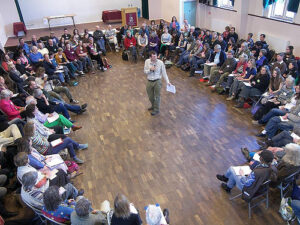
    Facilitator introduces an Open Space event. Martin GrimshawThis lack of a clear agenda (the agenda is created by the participants on the spot at the start of an Open Space Event) is probably the biggest stumbling block within commercial organisations, as managers and sponsors are often expected to state clearly what the anticipated outcomes of such a meeting should be (in order to justify the funding for it, for instance). Yet that is precisely the catch 22. Open Space Technology relies on emergence, serendipity and new creative solutions to whatever challenges brought the people together to the Open Space event in the first place. Agendas pre-define solutions, they pre-determine outcomes and as such they stifle emergence. The whole point of Open Space Technology without pre-set agendas is to enable issues to emerge which would otherwise never have arisen.

    Agendas kill emergence and thereby also stifle innovation and motivation. People feel caged in by (other people’s) agendas. Yet for managers coming from a mechanical view of business, “agendalessness” is most difficult to fathom. Managers will almost always want to interfere and include some agenda. It is ironic that in our times when leaders are crying for more staff engagement, collaboration, participation, accountability and innovation, they are also imposing more agendas, the very thing that kills all those virtues. Agendas create precisely those conditions which disengage people. The only agenda that works is one created by ALL those participating there and then, in the here and now, in a free market-place where people can opt in and out of the authentic conversations.

    To be blunt: As a manager you can either have engagement and innovation, or you can have agendas and outcomes, but you cannot have both – they cancel each other out. So if agendas and outcomes are what you want, fine, don’t use Open Space Technology, but don’t expect engagement and innovation either. If engagement and innovation are what you want, however, then you have to be willing to let go of any agenda, or rather let the staff and workers determine and deliberate their own issues.
    The Law Of Two Feet as butterfly wings and rainbow colours
    Annette Zera: The Law of Two Feet

    For this reason, it is important that some people in the organisation know how to run Open Space Technology events. In particular they need to fully understand the issues around invitations, agendas, co-creation and emergence. It needs people who can resist what many managers want, such as adding items to an agenda in advance. Because Open Space Tech meetings operate on the basis of opt-in invitation, people will only feel inspired to join a meeting, if it is about an issue that concerns them, is burning for them, and is not laden with pre-conceived solutions which do not address their perspective. Open Space Tech facilitators need to have a thorough understanding of the role of invitation (versus imposition) and the effect of agendas on the matter.

    There is a general need for organisations to have more facilitators and facilitative leaders, if organisations are to thrive (through innovation and collaboration). But they should also have an Open Space Tech facilitator or two at hand. While more general facilitators or organisational development practitioners are in a good position to introduce people-centric participatory next stage ways of organising and working to the organisation, there should ideally be someone who is specifically able to bring about a pan-organisational, cross-functional and holistic understanding of, and engagement in, the organisation through Open Space Technology. What is needed are facilitators who can bring about internal flexibility and agility by calling Open Space events at short notice, while also understanding the importance of creating a safe and transparent environment for emergence to happen, opening and holding the space.

    In the long run Open Space Technology can set some foundations for the organisation to shift from a mechanical command-and-control perspective to a more living, organic and responsive one, one able tocontinuously adapt and learn. Larger organisations should therefore have one or two internal Open Space Tech facilitators. Ideally organisations should be operating in a permanent Open Space Tech mode or mindset all the time, and having an Open Space Tech facilitator on board who can keep that spirit alive would be nothing but beneficial.


  • Brexit & Shift: How can we transform the workplace together? Thurs 14 July, London

    Brexit & Shift: How can we transform the workplace together? Thurs 14 July, London

    After Brexit: How can we transform the workplace together?
    Shift : 14 July 16 : London UK
    http://events.caterfly.co.uk/
    #OrgShift
    Facebook
    Please help us spread the word


    In response to the shock, division and disaray unleashed by the Brexit referendum, we feel it is essential to make space for people to come together. This is a participant-led ‘Open Space’ event, so the experience and discussions you have is up to you. But with many people distracted from fancy notions of reinventing work by very real and immediate worry, fear, anger, despondency this is your time to let off steam, ask big questions, get support and support others, or get constructive.

    One thing seems certain: If it is true that many people have reacted to feeling ignored, impoverished and powerless, then making the workplace work for everyone, of making sure that everyone has a voice and can participate is more important than ever.

    How can we respond? How we drive this movement forward? How can we help make work better for everyone? What can you contribute?

    Thanks. In despair, in hope, and with determination…. see you there?


  • Shifting Organisations – What’s the Problem? 14 July London

    Shifting Organisations – What’s the Problem? 14 July London

    Open Space Event, Thurs 14 July ’16, London

    Caterfly Logo slogan url


    Caterfly presents: a 1 day event exploring the need for transforming the way we work together, the move toward more collaborative, responsive workplaces, for businesses that place the customer at the centre, with respect for people and planet, the reality, complexity and barriers to change, and ways to move forward.

    #OrgShift

    Share. Learn. Connect: Building alliances for collective impact

     http://events.caterfly.co.uk


    Just as the combined efforts of the powers-that-be in the 16th and 17th Centuries were unable to halt the progress of Copernicus’ Revolution in astronomy, so also today’s big hierarchical bureaucracies, though seemingly all-powerful, will ultimately succumb to the power of a better idea for running organizations—better for customers, better for employees, better for managers, better for society, and better for the organizations and their investors.

    Steve Denning, Forbes: The Copernican Revolution In Management


    What is Open Space?


    Eventbrite - Why aren't Organisations Shifting?

  • Thurs 29 – Fri 30 October ’15: Deep shift and radical innovation with Open Space

    The art of hosting participant-led unConferences, solving complex problems, accelerating action, leading change in organisations, and hosting conversations that matter.

    An experiential 2 day co-learning workshop: Brighton, with Martin Grimshaw and Francois Knuchel

    #OpenSpaceTech

    Book-Now-button-orange-0304-lg

    PageLines- Collectiveintelligencegroupinnovationlightbulb.jpgWhy?
    Do you want a way to rapidly launch new projects, bring participation, engagement, equality and inclusion to your organisation or event? To harness collective ingenuity for problem solving? To lead transformation that is real and lasting? To drive innovation?

    What?
    Learn how to organise and facilitate gatherings using Open Space Technology, a method by which a large group of people can organise themselves into a conference, complete with agenda, break-out sessions, action planning and reports, with almost no preparation before-hand. Open Space allows each participant to do what they came to do, and can be a very effective way of launching large-scale change or responding to a looming crisis.
    Book-Now-button-orange-0304-lg Who?
    This workshop invites those who are new to using Open Space and those who already have some or even extensive experience of using it, to co-learn together, deepen our practice, and share our experiences of using it. In this 2 day workshop we will have the opportunity to experience Open Space as attendees commonly do, with space to reflect and to go deeper into designing an event as part of a broader programme.

    How?
    This workshop will be run as an Open Space so that participants can learn experientially, while learning how to design, prepare and facilitate an Open Space event, including tips and tricks, likely issues that may be encountered, follow up and incorporating an event within a wider context or strategy.

    What is Open Space?
    Open Space Technology is a format for organising compostable conferences, unconferences, meetings, stakeholder engagement, BarCamps and CityCamps, with maximum efficiency and minimum time and resources. It is a form of ‘crowd sourcing’ which can be used to bring together a company or any group or organisation to focus on a specific problem or question. Open Space allows for participants to co-create experience, learning and solutions in a way that unlocks creativity.

    Open Space is used by large companies, local government, community activists, and forward thinking organisations everywhere, from gatherings of 5 to several thousand people, from a couple of hours to several days.Book-Now-button-orange-0304-lg

    Please contact us if you would like to hire us as facilitators, consultants or trainers. Martin and Francois also use the Open Smart Transformation model at Caterfly to bring about deep and lasting transformation or problem solving in organisations with Open Space.

    Find out more about Open Space here – What is Open Space?

    More workshops and events:
    See Martin’s site for coming Sociocracy and Mindfulness workshops: http://2bwow.org.uk/workshops/
    November (tbc): Shift2 – an unConference. Following the success of Shift, we’re hosting another.

    Please click on subscribe for low volume updates and new articles, and click on events for schedule.

    Red_Butterfly_86x80Workshop hosted by There’s Better Ways Of Working, a trading name of Thriving Planet CIC, in partnership with Caterfly.

  • Thurs 20 – Fri 21 August ’15: Deep shift and radical innovation with Open Space

    The art of hosting participant-led unConferences, solving complex problems, accelerating action, leading change in organisations, and hosting conversations that matter.

    An experiential 2 day co-learning workshop: Brighton, with Martin Grimshaw and Francois Knuchel

    * We regret that this date has been postponed – we are currently arranging a new date in October ’15 – please contact us to request a preference and early bird discount *

     A very limited number of ‘pay-what-you-want’ tickets are available on application. You just need to tell us a dazzling (but short) story of why you think the world will be a better place for you being on the course.

    Also: Fri 12 June 1 day, London, Unleash The People With Open Space
    Tue 21 July, unConference: Shift – Why aren’t organisations shifting?

    Eventbrite - Deep shift and radical innovation with Open Space

     #OpenSpaceTech

    Why?

    PageLines- Collectiveintelligencegroupinnovationlightbulb.jpgDo you want a way to rapidly launch new projects, bring participation, engagement, equality and inclusion to your organisation or event? To harness collective ingenuity for problem solving? To lead transformation that is real and lasting? To drive innovation?

    What?
    Learn how to organise and facilitate gatherings using Open Space Technology, a method by which a large group of people can organise themselves into a conference, complete with agenda, break-out sessions, action planning and reports, with almost no preparation before-hand. Open Space allows each participant to do what they came to do, and can be a very effective way of launching large-scale change or responding to a looming crisis.

    Eventbrite - Deep shift and radical innovation with Open Space
    Who?

    This workshop invites those who are new to using Open Space and those who already have some or even extensive experience of using it, to co-learn together, deepen our practice, and share our experiences of using it. In this 2 day workshop we will have the opportunity to experience Open Space as attendees commonly do, with space to reflect and to go deeper into designing an event as part of a broader programme.

    How?
    This workshop will be run as an Open Space so that participants can learn experientially, while learning how to design, prepare and facilitate an Open Space event, including tips and tricks, likely issues that may be encountered, follow up and incorporating an event within a wider context or strategy.


    What is Open Space?
    Open Space Technology is a format for organising compostable conferences, unconferences, meetings, stakeholder engagement, BarCamps and CityCamps, with maximum efficiency and minimum time and resources. It is a form of ‘crowd sourcing’ which can be used to bring together a company or any group or organisation to focus on a specific problem or question. Open Space allows for participants to co-create experience, learning and solutions in a way that unlocks creativity.

    Open Space is used by large companies, local government, community activists, and forward thinking organisations everywhere, from gatherings of 5 to several thousand people, from a couple of hours to several days.

    Eventbrite - Deep shift and radical innovation with Open Space

    Please contact us if you would like to hire us as facilitators, consultants or trainers.

    Caterfly Logo slogan urlMartin and Francois also use the Open Smart Transformation model at Caterfly to bring about deep and lasting transformation or problem solving in organisations with Open Space.

    Find out more about Open Space here – What is Open Space?

    Please click on subscribe for low volume training and new articles, and click on events for schedule.

  • 12 June, London: Unleash the people with Open Space

    Caterfly in partnership with There’s Better Ways Of Working present:

    The art of hosting participant-led unConferences, solving complex problems, accelerating action, leading change in organisations, and hosting conversations that matter.

    #OpenSpaceTech

    An experiential co-learning workshop: London, one day, with Martin Grimshaw and Francois Knuchel

    Also: Thurs 20 – Friday 21 August, Brighton, Deep Shift And Radical Innovation with Open Space
    Tue 21 July, unConference: Shift – Why aren’t organisations shifting?
    facebook_32

    Eventbrite - Unleash the people with Open Space

    Why?
    Jigsaw puzzle handsDo you want a way to rapidly launch new projects, bring participation, engagement, equality and inclusion to your organisation or event? To harness collective ingenuity for problem solving? To lead transformation that is real and lasting? To drive innovation?

    What?
    Learn how to design and facilitate gatherings using Open Space Technology, a method by which a large group of people can organise themselves into a conference, complete with agenda, break-out sessions, action planning and reports, with almost no preparation before-hand. Open Space allows each participant to do what they need to do, and can be a very effective way of launching large-scale change or responding to a looming crisis.

    Who?
    This workshop invites those who are new to using Open Space and those who already have some or even extensive experience of using it, to co-learn together, deepen our practice, and share our experiences of using it.

    How?
    This workshop will be run as an Open Space so that participants can learn experientially, while learning how to design, prepare and facilitate an Open Space event, including tips and tricks, likely issues that may be encountered, follow up and incorporating an event within a wider context or strategy.

    Eventbrite - Unleash the people with Open Space

    What is Open Space?
    Open Space Technology is a format for organising compostable conferences, unconferences, meetings, stakeholder engagement, BarCamps and CityCamps, with maximum efficiency and minimum time and resources. It is a form of ‘crowd sourcing’ which can be used to bring together a company or any group or organisation to focus on a specific problem or question. Open Space allows for participants to co-create experience, learning and solutions in a way that unlocks creativity.

    Open Space is used by large companies, local government, community activists, and forward thinking organisations everywhere, from gatherings of 5 to several thousand people, from a couple of hours to several days, even with little notice or preparation.

     * A very limited number of ‘pay-what-you-want’ tickets are available on application. You just need to tell us a dazzling (but short) story of why you think the world will be a better place for you being on the course.


    Please contact us if you would like to hire us as facilitators, consultants or trainers.

    Caterfly Logo slogan urlMartin and Francois also use the Open Smart Transformation model at Caterfly to bring about deep and lasting transformation or problem solving in organisations with Open Space.

    Find out more about Open Space here – What is Open Space?

    More workshops and events: Going Deeper with Open Space (August, 2 days), Shift: Why Aren’t Organisations Shifting? (21 July). Click on events for details.

    Please click on subscribe for low volume training updates and new blogs

  • 21 July, London: Shift – Why aren’t organisations shifting?

    Caterfly Logo Url 313x148Caterfly presents: a 1 day participant-led ‘Open Space’ event exploring the need for transforming the way we work together, the move toward more collaborative, responsive workplaces, for businesses that place the customer at the centre, with respect for people and planet, the reality, complexity and barriers to change, and ways to move forward.

    Share. Learn. Connect: Building alliances for collective impact

    Full details: http://events.caterfly.co.uk

    #OrgShift

    Eventbrite - Why aren't Organisations Shifting?

    facebook_32

    Just as the combined efforts of the powers-that-be in the 16th and 17th Centuries were unable to halt the progress of Copernicus’ Revolution in astronomy, so also today’s big hierarchical bureaucracies, though seemingly all-powerful, will ultimately succumb to the power of a better idea for running organizations—better for customers, better for employees, better for managers, better for society, and better for the organizations and their investors.

    Steve Denning, Forbes: The Copernican Revolution In Management


    Butterflies Shift 26024690_ml

  • What is Open Space?

    What is Open Space?

    Image: Annette Zera: The Law Of Two Feet / Butterflies

    What is ‘Open Space’?

    Open Space Technology, commonly Open Space, is a social technology, a tool for helping people to rally around a shared challenge, with minimum obstacles and maximum efficiency. It is used to organise large meetings, gatherings, conferences, problem solving and summits in which everyone has the opportunity to participate on their own terms.

    Open Space is nothing new. The process was developed by Harrison Owen in the 1980’s and it has been applied countless thousands of times, in at least 135 countries, in a variety of ways, with groups of just a few people to several thousands, from hours to several days, and longer. However, the basic process and principles perhaps reach back into ancient human history.

    Open Space offers a clear framework for allowing us to achieve remarkable things. Open Space embraces complexity and chaos, yet it remains confoundingly simple while enabling creativity and productivity to flourish.

    The results can not only be dramatic, but its effect on participants used to the confines of careful planning, hierarchy, telling others what to do and being told what to do, can be transformative and enriching.

    “Everything the Power of the World does, is done in a circle.”
    Black Elk, in Black Elk Speaks

    Who is it for? What does it do?

    Open space events have many applications. The most obvious one is as an alternative form of a conference – a conference without speakers, where the participants’ heart-felt issues are at the centre of discussion. This form can be applied in a multitude of settings, wherever there is an issue people have a common passion about, in

    • communities
    • political gatherings
    • peace talks
    • neighbourhoods
    • research or
    • specialist areas.

    Open Space is a completely opt-in event, so invitations go out to many people and those passionate about the theme turn up.

    Within organisations Open Space can also be applied for more specific purposes.  Open Space can be used for:

    • product design and development (synchronisation)
    • strategy development, bringing in whole workforce
    • supply-chain issues, coordinating suppliers
    • redesigning the organisation, bottom up
    • innovation and prototyping, including customers
    • complexity problem solving using diverse perspectives
    • collective intelligence letting future emerge
    • inviting an organisational transformation process

    It is this latter application, inviting the relevant workforce to co-create an implementation or a transformation that our Caterfly Open Smart Transformation is concerned with.

    In all case Open Space is a way of inviting a larger number the workforce into the process, thus opening the space for a larger view of things, rather than leaving it to a few select people to manage.  This is particularly important where there are big issues at stake which ignite the passions of many people.  The self-organising aspect of Open Space enables any number of people to be involved efficiently and constructively.

    Open Space Events can be from 1/2 day to several days.  It should be noted, however, they are far more effective and powerful when run over 2 or 3 days.  This is because the first day tends to focus on current and past issues, and after a night’s sleep new ideas and energies are created which means the second and third (action planning) days are far more creative, and make use of the synergies of the minds present.

    How does it work?

    The basic process is counter intuitively straightforward:

    * Clearly define the challenge, and express it in a few words. This is what you are inviting participants to get enthused about.

    Photo: Stanley Park / World Open Space on Open Space 2009
    Photo: Stanley Park / World Open Space on Open Space 2009

    * Everyone sits in a big circle. A facilitator gives some basic instructions, then lets them get on with it.

    * There is no prepared agenda, just a big blank board with available time slots and areas to use. Participants are invited to articulate what they really want to know, share, discuss or work on, and co-create the agenda with whatever sub topics they want.

    * People then work out what seems most important, urgent or interesting to them, and go there. Some people will likely end up either flitting about from discussion to discussion, or getting a cup of tea and serendipitously having just the brain wave or interaction they need right there.

    * Through the event people share what they’ve done, thus building a kind of ‘collective consciousness’ of the whole shebang.

    * Toward the end of the event, everyone comes back together in a big circle and shares what they did, learnt, or what they want to happen next.

    * Usually all participants get an anthology of the summaries of each session, perhaps with a plan of action, or key outcomes.

    * Go home and let go, until the time comes to do something again.

    Turn up if you want to, do what feels important, let others do what they feel is important, let go and allow it to happen in whatever way participants conspire to make happen. 

    The reason it seems to work

    Leaders and facilitators allow people to work it out for themselves and get out of the way. No one is coerced, and no one has to be there. Opt-in participation devolves responsibility to individuals to choose to follow their passion.

    light bulbs sketched on chalkboard Many small ideas make a big oneThere are some basic principles to help people let go of trying to be in control, and embrace what is actually happening. A metaphor would be a surfer, who rather than trying to direct the waves, finds the right place to catch one and ride it.

    There is just one firm rule, known as The Law Of Two Feet, although it is more of a playful hint than strict instruction. The Law says that ‘if you are neither learning nor contributing, it is your duty to find another place to be.’ Rather than choosing a session and being stuck in it or feeling obliged, participants are encouraged to move around, increasing impact and efficiency for the individual, for each sub group, and for the whole.

    Rather than try to solve a problem with just one brain, perhaps the boss or a management team, or trying to engage numerous individuals over a long period of time, Open Space harnesses the creativity and skills of everyone, all at once. What might take a dedicated team many months, gets accelerated over a very short burst, and results in more brilliant solutions that no one could have predicted.

    Organising people is hard work and inefficient. Helping people to organise themselves is surprisingly easy, effective and energising. Meanwhile, it becomes easier for people to really engage, and those voices can be heard which often aren’t.  Open Space works particularly well where there is no known outcome, with very complex issues and where any form of pre-planning is futile as letting the future emerge rather than trying to control is essential.

    Relax nothing is under controlA part of how Open Space came to be discovered, was Harrison Owen’s experience while co-organising a conference. It took a lot of effort. People showed up, and sat passively in rows of chairs listening to experts. But when the coffee breaks came, the event came alive, buzzing with spontaneous conversation. The coffee break was the best bit. Open Space is an attempt to turn the entire experience into something like the coffee break. Some people started thinking of it as the opposite of a conference, and now the term unConference has become more common.

    Lastly, Open Space events can also be significantly greener, utilising human resources more than material. I often refer to them as ‘compostable conferences.’

    And that’s it.

    “There is no order without chaos.”
    Harrison Owen at TEDx, Dancing with Shiva: Are we working too hard? 

    Further reading and Videos:

    Wikipedia: Open Space Technology

    Harrison Owen’s Brief History of Open Space

    Open Space World resources

    How Caterfly is pioneering Open Space for Innovation and Kaizen or using it in organisations to invite cultural transformation

    Caterfly’s model is based on Daniel Mezick’s innovative Prime/OS™ model, using Open Space to adopt Agile working and more

    Chris Corrigan article, on using Open Space to solve complex problems

    Huffington Post Business article, Opening The Space For Innovation

    Martin Grimshaw’s Open Space Facilitator’s Checklist

    Open Space Facilitators around the world: Open Space World Map

    A large collection of video samples in Evocative Open Space Videos, especially the following 3 short videos give a good overview of what Open Space is and what it looks like in action: