Tag: co-creation

  • Why do Organisations need more trained Facilitators?

    Why do Organisations need more trained Facilitators?

    What trained Open Space Technology Facilitators could do for Organisations

    Many companies suffer from a lack of cohesion and connectedness. Managers and staff alike generally lack a holistic view of their organisation in terms of its internal flow of energy and value creation. Most people in organisations do not have a full view of what goes on across the organisation, and the executives at the top may have an overview of the various departments, but generally have little understanding of what the issues are at the shop floor level.

    This lack of a multi-disciplinary and holistic view of their own organisation is manifest in the way departments and teams often work in very entrenched silo mentalities. Silos produce poor cross-departmental collaboration and pan-organisational coherence. The situation is particularly acute in Western companies where people typically specialise in one area of work and then stay in their field – if they do move on, they tend to go on to similar work elsewhere, changing company rather than changing type of work.

    This contrasts to Asian firms, in particular Japanese, where people are routinely rotated to different departments, irrespective of their specialities, typically in 2-5 year cycles, so that as they become more senior, irrespective of position, they gain a good understanding of how the company works and in particular are sympathetic to the various perspectives as seen from different parts of the organisation – in short they also become generalists with a holistic view of the organisation and its place in society, they are the bridges and glue of the whole.

    In the West we tend to put resources in tools like process improvements, particularly at a team level. Agile implementations and moves towards business agility are examples of current day efforts to improve team effectiveness, and thus the ability to add value for customers in a speedy, flexible and iterative way. Which is all great, but this happens at a team or section level, with ‘high performing’ teams often rewarded irrespective of whether their high performance is actually beneficial to the smooth operation of the whole organisation as a whole. This is like putting a high performing Rolls Royce engine in a Volkswagen Beetle chassis – this would prove untenable, the Beetle was never designed to cope with the power of the RR engine, the whole would crumble in the long run. Likewise interventions are usually isolated and do not tackle the challenge of getting the organisation to operate more effectively and coherently as one whole.

    Moreover, an organisation is only as effective as its weakest link, so concentrating resources on some priority teams while largely ignoring others, or while not considering how this might effect the whole, can actually dampen the overall organisational effectiveness. Even with balanced high performing teams there is often no engagement model in place that guarantees that all teams are operating in tandem towards the same purpose. One often finds teams competing with each other internally, or unknowingly duplicating efforts.

    So how could we get more pan-organisational collaboration, cohesion and innovation across the organisation, without switching to an Asian style rotation system, (which would take a full generation before its benefits became apparent, so hardly feasible)? What could we do to enable more pan-organisational coherence and collaboration, and for everyone to start thinking about their organisation more holistically? Why aren’t organisations putting more resources into developing such pan-organisational cohesion?

    There may be several reasons:

    • a general lack of awareness of the need for it (it is not on people’s minds first and foremost)
    • organisations having no experience in trying to achieve coherence
    • no knowledge or expertise within the organisation on how to do it
    • nobody knowing how to “plan” the thousands of conversations that would need to happen to enable pan-organisational exchange
    • likewise nobody in the organisation knowing, for instance, how to run large-scale participatory meetings, instead only relying speaker-centered conferences or motivational talks (which by nature are non-participatory)
    • No understanding for ‘unplanning’ conversations to engender serendipitous or emergent conversations
    • in a mechanistic view of the organisation open-ended chaordic interventions seen as a waste of time, with the bureaucratic command and control approach asserting itself
    • similarly innovation viewed as something best left to the ‘innovation specialists’ – unfortunately many a bright idea from staff, coming from a place of understanding the customer, gets sidelined with this attitude.

    Clearly we need pan-organisational models of engagement. These do exist. They can be found in practices such as Presencing Theatre, World Cafe, Appreciative Enquiry, Circle Ways, The Art of Hosting and many other participatory approaches also collated in Liberating Structures. The most open-ended and engaging approach of them all, however, which really allows genuine pan-organisational conversations that matter to emerge, is Open Space Technology (commonly Open Space), the structure used in ‘Unconference’, ‘Hackathon‘ and ‘BarCamp’ events. While there are many ways to run concurrent conversations, Open Space Technology does this particularly well at scale, and is ideal in larger organisations needing cross-departmental exchange at all levels simultaneously.

    Open Space Technology, commonly Open Space, is a method for hosting highly participatory, large group, whole-system collaboration based on self-organisation in which participants themselves co-create the agenda, experience and outcomes that matter to them. Click here to see our article What is Open Space Technology?

    The components of Open Space graphic

    Open Space Technology is described in more detail elsewhere. My purpose here is to encourage larger organisations to use Open Space Technology much more frequently and for them to hire or train a few internal facilitators who can actually run Open Space Tech events within their organisation. There is no reason why an Open Space Tech event should be a one-off occasion. If organisations want genuine agility in their organisations, then running Open Space events should be a regular occurrence.

    Open Space Technology has many benefits (see Beyond unConferences) but in the context of pan-organisational collaboration, innovation and coherence Open Space Technology enables cross-fertilisation of ideas and cross-collaboration across departments in a highly interactive environment at once on a massive scale. An Open Space event can lead collectively to a holistic re-energising of the whole organisation, creating conditions for the organisation to thrive organically. Moreover it can be a massive and long-lasting boost to staff engagement and morale, largely because deep conversations that matter to them can take place. These vital conversations are rarely had in organisations, and yet are hugely necessary for people within the organisation to flourish.

    The benefits of using pan-organisational Open Space Tech for organisations are:

    • it helps bridge departments, and thus breaks down silos, encouraging collaboration rather than internal competition
    • it stimulates over time a systems view of the organisation amongst all staff, thus facilitating constructive dialogue between different parts of the organisation
    • it shifts everyone into an ‘innovation mode‘ and elevates the creativity of the whole organisation; this enables complex problem-solving and disruptive innovation
    • it is a brilliant basis for invitation-based culture change
    • it represents a highly effective model of engagement, rejuvenating staff co-creativity
    • it enables expanded stakeholder dialogues to take place involving the wider organisation
    • it enables conversations to emerge which could never have been planned
    • it encourages the emergence of new ideas and concepts otherwise inconceivable
    • Its self-organising, autonomous and peer-learning format forms the basis for creating a learning organisation.

    Ultimately Open Space Tech enables thousands of meaningful conversations to happen serendipitously at scale and across the organisation that otherwise would never have happened and would have been impossible to plan, all within a limited time scale (1-2 days)

    So given Open Space Technology has so many advantages, why is it not used more frequently in organisations? What are the stumbling blocks? Some have already been mentioned earlier, but here are few as more:

    • it can be logistically demanding, the larger the number of invitees, the better, but also the more demanding it is to organise; Open Space Tech has no limit to size (other than the capacity of venue)
    • a general lack of awareness, or a perceived weirdness of the process
    • poor quality of facilitators (wanting to ‘manage’ the process, combine it or trying to ‘improve’ it)
    • unpredictable outcome can be scary
    • perceived costs (in fact Open Space Tech is a lot cheaper, but like a plane crash it sounds big when it happens)
    • for most managers not having a clear agenda feels rather frightening.

    Facilitator introduces an Open Space event. Martin GrimshawThis lack of a clear agenda (the agenda is created by the participants on the spot at the start of an Open Space Event) is probably the biggest stumbling block within commercial organisations, as managers and sponsors are often expected to state clearly what the anticipated outcomes of such a meeting should be (in order to justify the funding for it, for instance). Yet that is precisely the catch 22. Open Space Technology relies on emergence, serendipity and new creative solutions to whatever challenges brought the people together to the Open Space event in the first place. Agendas pre-define solutions, they pre-determine outcomes and as such they stifle emergence. The whole point of Open Space Technology without pre-set agendas is to enable issues to emerge which would otherwise never have arisen.

    Agendas kill emergence and thereby also stifle innovation and motivation. People feel caged in by (other people’s) agendas. Yet for managers coming from a mechanical view of business, “agendalessness” is most difficult to fathom. Managers will almost always want to interfere and include some agenda. It is ironic that in our times when leaders are crying for more staff engagement, collaboration, participation, accountability and innovation, they are also imposing more agendas, the very thing that kills all those virtues. Agendas create precisely those conditions which disengage people. The only agenda that works is one created by ALL those participating there and then, in the here and now, in a free market-place where people can opt in and out of the authentic conversations.

    To be blunt: As a manager you can either have engagement and innovation, or you can have agendas and outcomes, but you cannot have both – they cancel each other out. So if agendas and outcomes are what you want, fine, don’t use Open Space Technology, but don’t expect engagement and innovation either. If engagement and innovation are what you want, however, then you have to be willing to let go of any agenda, or rather let the staff and workers determine and deliberate their own issues.
    The Law Of Two Feet as butterfly wings and rainbow colours
    Annette Zera: The Law of Two Feet

    For this reason, it is important that some people in the organisation know how to run Open Space Technology events. In particular they need to fully understand the issues around invitations, agendas, co-creation and emergence. It needs people who can resist what many managers want, such as adding items to an agenda in advance. Because Open Space Tech meetings operate on the basis of opt-in invitation, people will only feel inspired to join a meeting, if it is about an issue that concerns them, is burning for them, and is not laden with pre-conceived solutions which do not address their perspective. Open Space Tech facilitators need to have a thorough understanding of the role of invitation (versus imposition) and the effect of agendas on the matter.

    There is a general need for organisations to have more facilitators and facilitative leaders, if organisations are to thrive (through innovation and collaboration). But they should also have an Open Space Tech facilitator or two at hand. While more general facilitators or organisational development practitioners are in a good position to introduce people-centric participatory next stage ways of organising and working to the organisation, there should ideally be someone who is specifically able to bring about a pan-organisational, cross-functional and holistic understanding of, and engagement in, the organisation through Open Space Technology. What is needed are facilitators who can bring about internal flexibility and agility by calling Open Space events at short notice, while also understanding the importance of creating a safe and transparent environment for emergence to happen, opening and holding the space.

    In the long run Open Space Technology can set some foundations for the organisation to shift from a mechanical command-and-control perspective to a more living, organic and responsive one, one able tocontinuously adapt and learn. Larger organisations should therefore have one or two internal Open Space Tech facilitators. Ideally organisations should be operating in a permanent Open Space Tech mode or mindset all the time, and having an Open Space Tech facilitator on board who can keep that spirit alive would be nothing but beneficial.


  • Coming soon: The Change Platform

    Coming soon: The Change Platform

    STOP PRESS: The Change Platform went live in October ’18. Subscribe below or click here to browse current and past editions.

    Click below to subscribe.

    Stories from the leading edge of highly functional and enjoyable workplaces – and making the transition effectively.

    Caterfly is shortly launching a free low-frequency e-hub, pulling together helpful and insightful articles and practical support for anyone engaged in change in organisations, or wanting to transform the way their company works together.

    Sharing what works – making work better.

    Subscribe to The Change Platform by low frequency email

    [pl_accordion name=”accordion”]
    [pl_accordioncontent name=”accordion” number=”1″ heading=”subscribe” open=”no”]
    [yikes-mailchimp form=”1″]
    [/pl_accordioncontent]

    The Change Platform will focus on modern, smart approaches to introducing and maintaining major shifts in the workplace that are effective and manageable, both in the short and long term, as well as highlighting stories from those working in businesses that are already working brilliantly, or from those on the journey.

    We showcase what lies beyond ‘Dilbert-esque’ workplaces, that are fulfilling, efficient, human and collaborative – and how to get there. 

    You can register now with a couple of quick clicks below, to receive it by email. The first edition will be published in coming weeks, and perhaps every month or so thereafter. If you’re already subscribed to receive our blog or occasional updates, please click on subscribe below to update your preferences and make sure you receive the Change Platform in your inbox.

    Please share using the links below and hashtag #ChangePlatform and inviting others to join. If you’d like to send us submissions. such as your own articles, podcasts and videos or those you have found particularly useful or insightful, please send them to us at  letstalk AT caterfly.co.uk to be featured in ‘The People’s Podium’.

    If we’re not already connected there, click on the Twitter & Facebook links at the top of this page.

    Cheers –  Martin & François
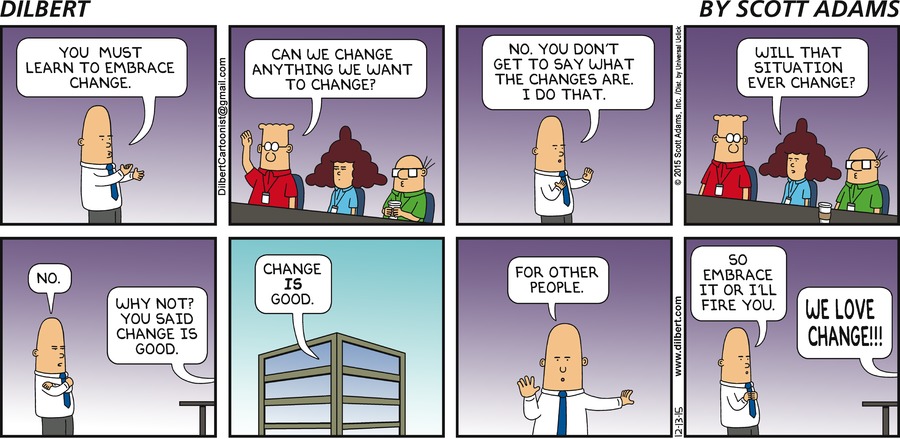
    Dilbert comic strip - enforcing change upon employees

  • Shifting Organisations – What’s the Problem? 14 July London

    Shifting Organisations – What’s the Problem? 14 July London

    Open Space Event, Thurs 14 July ’16, London

    Caterfly Logo slogan url


    Caterfly presents: a 1 day event exploring the need for transforming the way we work together, the move toward more collaborative, responsive workplaces, for businesses that place the customer at the centre, with respect for people and planet, the reality, complexity and barriers to change, and ways to move forward.

    #OrgShift

    Share. Learn. Connect: Building alliances for collective impact

     http://events.caterfly.co.uk


    Just as the combined efforts of the powers-that-be in the 16th and 17th Centuries were unable to halt the progress of Copernicus’ Revolution in astronomy, so also today’s big hierarchical bureaucracies, though seemingly all-powerful, will ultimately succumb to the power of a better idea for running organizations—better for customers, better for employees, better for managers, better for society, and better for the organizations and their investors.

    Steve Denning, Forbes: The Copernican Revolution In Management


    What is Open Space?


    Eventbrite - Why aren't Organisations Shifting?

  • Ask, Then Invite to Co-create Change

    Ask, Then Invite to Co-create Change

    Scaled System Transformations in Organisations

    Have you ever been in an organisation where you were good at your job, efficient and productive, satisfied by what you achieved, hopeful about future prospects, respected in your expertise, and really feeling part of a good team? ……. and then all of a sudden, one day, out of the blue, you are told that some changes were going to happen; ……. and that a that a team of consultants were coming in to bring about these changes and introduce a new system (SAP, agile, lean………). This team then devotes time and energy explaining the purpose of the change, the why and how, and it all makes perfect logical sense, indeed the proposed changes are not dissimilar to changes you had proposed to your manager in the past. And yet, despite not disagreeing with the reasons for the change, your heart feels crushed, you somehow feel totally betrayed, utterly let down, completely undermined, leaving you shattered and dispirited.

    Dilbert embrace change

    Why? Because nobody in the organisation, none of your superiors, ever bothered to ask you. The changes touch on the essence of your work, and still you were not even consulted. Instead someone at the top decided this was a good idea, let’s bring in some change experts in to implement it, and the team of consultants, who know nothing about the operational side of the work you do, are brought in to tell you what to do. Why aren’t you, as a long-time loyal employee, dedicated to achieving the aims of the organisation, being at least asked about the matter, never mind consulted? Obviously you feel disrespected and undermined, but also angry – your self-esteem is under attack. Suddenly this new system seems alien to you.

    While on reflection you would have been quite an enthusiastic proponent of the changes being proposed, because they were brought on over your head without your consent and without your views being heard, suddenly you feel estranged, and this new system appears alien. You lose motivation, you don’t want to be part of it, and you start silently resisting the change. Not because you disagree fundamentally or logically, but because of the manner this was done over your head. You were never given a say in the matter, nor a choice to opt in or out. You no longer feel respected and esteemed, you become cynical, and you, perhaps unconsciously, resist passively.

    Consequently you are now branded a change resister, and it is deemed you need to be “managed” with care. You are singled out as a laggard and for now ignored. It becomes a double blow, not only do you feel betrayed and undermined by the initial imposition, now you start losing confidence, your professional competence is called into question, you no longer feel part of the team, indeed resentment becomes stronger and stronger, you no longer want to listen, and a vicious cycle builds up. Suddenly you are a serious resister, an enemy of change, you are no longer for us but against “them”. While the consultants work on the more amenable employees, you become “the” problem, and your survival in the organisation becomes questionable, gradually instigating fear and a destructive atmosphere.

    And all because, initially, you were never asked. You were not invited to contribute to the new way forward, it was simply imposed on you from above. You feel alienated, because you were not invited to co-create the organisation’s future, and you no longer feel part of the team.

    Not consulting, not listening to, and not inviting those who do the work, those closest to the products/services and the users, and those most connected to the processes that create value, not bringing them in into the change process, not inviting them to co-create the change, are all prescriptions for failure. They reflect distrust and disrespect of an organisation’s own people. And yet this scenario happens again and again, person after person, time after time, organisation after organisation. What a waste of good resources! What a waste of energy! What a waste of great talent!

    The solution ‘should be’ fairly straight-forward, do exactly what’s missing: ASK! Invite the affected employees to co-create the change and thereby make it their own. Why don’t so many organisations follow this most basic of human leadership principles? Possibly a legacy of the command and control management attitudes of the last century? Possibly due to an inherent unconscious management distrust (and disrespect) of employees. Possibly due to lack of awareness of the inhumaneness of mandation, an unintended consequence of classical intervention. Possibly due to worries about having to “manage” large numbers of employees invited to co-create the change. And possibly simply, it has to be said, due to a lack of know-how – managers may know that engaging the workforce might be important, but they just don’t know how to go about it. The challenge is how to do it at scale.

    This is exactly the issue and the know-how a new book just silently published recently seeks to address. It is called The Open Space Agility Handbook. It is written and conceived by Daniel Mezick, respected senior agile coach in the Boston area, author of Culture Games, together with a team of experts, Mark Sheffield, Deborah Pontes, Louise Kold-Taylor, Harold Shinsato and OpenSpace Technology founder, Harrison Owen. ‘Agile’, for those of you not from the IT or software development world, is a working practice applied by software engineers, derived from ‘Lean’, which enables software development teams to be much closer to customers and to respond to their needs nimbly, thus being agile. The practice is anchored in the Agile Manifesto.

    openspaceagility_big_picture
    This diagram is copied directly from the Open Space Agility website. and represents an overview road map of OSA used in the book.
    1. Graphic (c) 2015 www.OpenSpaceAgility.com (OSA),
    2. All rights reserved; provided by permission of OSA.

    While this new book focusses on ‘Agile’, it is really about organisational transformation. The title, The Open Space Agility Handbook, sounds pretty technical and unobtrusive. And in one sense that’s all it is, as the title says, it’s a handbook on how to adopt agile practices, using a double Open Space Technology frame. What the book’s title doesn’t betray, however, is the transformative power of its approach. On one hand the book is simply a step by step guide on implementing agile. On the other hand it presents a revolutionary approach to agile adoptions, and beyond, in fact it tackles head-on one of the key challenges of organisational interventions and change management itself. As innocuous as the book may seem, don’t be fooled by its simplicity. It describes a simple solution to one of the most difficult challenges of management, that of scaled organisational change.

    While the handbook concentrates on agile only, the principles and philosophy behind the invitation approach is applicable beyond agile – you can replace “agile” with “lean”, “conscious” or “responsive”. The approach could just as easily apply to lean, teal, responsive, peer-to-peer learning, distributed leadership, conscious business, environmental sustainability, beyond budgeting, sociocracy and indeed any other form of organisational transformation. Thus whether you like agile or not, if you are involved in adoptions, implementations or transformations, this book is for you. Instead of mandating change from above, which leads to resistance or internal sabotage, the approach urges organisations to ask and invite the relevant work-force to co-create the change together, as a collaborative iterative effort, rather than imposing from above.

    The approach is based asking those doing the work about proposed adoptions or change and inviting them to co-create transformation together, using a combination of Open Space Technology and standard coaching iterative methods, ….. and thereby avoiding the tremendous waste of talent and resources arising from the imposition of change. As the concepts of INVITATION (as opposed to directed or imposed), PEER-BASED SELF-ORGANISED LEARNING (SOLE) and CHANGE CO-CREATION become increasingly understood and appreciated in organisations, so this simple how-to book will find a growing audience in and beyond agile. The approach is completely in line with what the Stanford and London Business School guru Gary Hamel has termed the ‘change platform’.

    _______________________________

    More details of the approach can be found here.

    This blog was first published in Medium on 21 December 2016
  • Thurs 29 – Fri 30 October ’15: Deep shift and radical innovation with Open Space

    The art of hosting participant-led unConferences, solving complex problems, accelerating action, leading change in organisations, and hosting conversations that matter.

    An experiential 2 day co-learning workshop: Brighton, with Martin Grimshaw and Francois Knuchel

    #OpenSpaceTech

    Book-Now-button-orange-0304-lg

    PageLines- Collectiveintelligencegroupinnovationlightbulb.jpgWhy?
    Do you want a way to rapidly launch new projects, bring participation, engagement, equality and inclusion to your organisation or event? To harness collective ingenuity for problem solving? To lead transformation that is real and lasting? To drive innovation?

    What?
    Learn how to organise and facilitate gatherings using Open Space Technology, a method by which a large group of people can organise themselves into a conference, complete with agenda, break-out sessions, action planning and reports, with almost no preparation before-hand. Open Space allows each participant to do what they came to do, and can be a very effective way of launching large-scale change or responding to a looming crisis.
    Book-Now-button-orange-0304-lg Who?
    This workshop invites those who are new to using Open Space and those who already have some or even extensive experience of using it, to co-learn together, deepen our practice, and share our experiences of using it. In this 2 day workshop we will have the opportunity to experience Open Space as attendees commonly do, with space to reflect and to go deeper into designing an event as part of a broader programme.

    How?
    This workshop will be run as an Open Space so that participants can learn experientially, while learning how to design, prepare and facilitate an Open Space event, including tips and tricks, likely issues that may be encountered, follow up and incorporating an event within a wider context or strategy.

    What is Open Space?
    Open Space Technology is a format for organising compostable conferences, unconferences, meetings, stakeholder engagement, BarCamps and CityCamps, with maximum efficiency and minimum time and resources. It is a form of ‘crowd sourcing’ which can be used to bring together a company or any group or organisation to focus on a specific problem or question. Open Space allows for participants to co-create experience, learning and solutions in a way that unlocks creativity.

    Open Space is used by large companies, local government, community activists, and forward thinking organisations everywhere, from gatherings of 5 to several thousand people, from a couple of hours to several days.Book-Now-button-orange-0304-lg

    Please contact us if you would like to hire us as facilitators, consultants or trainers. Martin and Francois also use the Open Smart Transformation model at Caterfly to bring about deep and lasting transformation or problem solving in organisations with Open Space.

    Find out more about Open Space here – What is Open Space?

    More workshops and events:
    See Martin’s site for coming Sociocracy and Mindfulness workshops: http://2bwow.org.uk/workshops/
    November (tbc): Shift2 – an unConference. Following the success of Shift, we’re hosting another.

    Please click on subscribe for low volume updates and new articles, and click on events for schedule.

    Red_Butterfly_86x80Workshop hosted by There’s Better Ways Of Working, a trading name of Thriving Planet CIC, in partnership with Caterfly.

  • Thurs 20 – Fri 21 August ’15: Deep shift and radical innovation with Open Space

    The art of hosting participant-led unConferences, solving complex problems, accelerating action, leading change in organisations, and hosting conversations that matter.

    An experiential 2 day co-learning workshop: Brighton, with Martin Grimshaw and Francois Knuchel

    * We regret that this date has been postponed – we are currently arranging a new date in October ’15 – please contact us to request a preference and early bird discount *

     A very limited number of ‘pay-what-you-want’ tickets are available on application. You just need to tell us a dazzling (but short) story of why you think the world will be a better place for you being on the course.

    Also: Fri 12 June 1 day, London, Unleash The People With Open Space
    Tue 21 July, unConference: Shift – Why aren’t organisations shifting?

    Eventbrite - Deep shift and radical innovation with Open Space

     #OpenSpaceTech

    Why?

    PageLines- Collectiveintelligencegroupinnovationlightbulb.jpgDo you want a way to rapidly launch new projects, bring participation, engagement, equality and inclusion to your organisation or event? To harness collective ingenuity for problem solving? To lead transformation that is real and lasting? To drive innovation?

    What?
    Learn how to organise and facilitate gatherings using Open Space Technology, a method by which a large group of people can organise themselves into a conference, complete with agenda, break-out sessions, action planning and reports, with almost no preparation before-hand. Open Space allows each participant to do what they came to do, and can be a very effective way of launching large-scale change or responding to a looming crisis.

    Eventbrite - Deep shift and radical innovation with Open Space
    Who?

    This workshop invites those who are new to using Open Space and those who already have some or even extensive experience of using it, to co-learn together, deepen our practice, and share our experiences of using it. In this 2 day workshop we will have the opportunity to experience Open Space as attendees commonly do, with space to reflect and to go deeper into designing an event as part of a broader programme.

    How?
    This workshop will be run as an Open Space so that participants can learn experientially, while learning how to design, prepare and facilitate an Open Space event, including tips and tricks, likely issues that may be encountered, follow up and incorporating an event within a wider context or strategy.


    What is Open Space?
    Open Space Technology is a format for organising compostable conferences, unconferences, meetings, stakeholder engagement, BarCamps and CityCamps, with maximum efficiency and minimum time and resources. It is a form of ‘crowd sourcing’ which can be used to bring together a company or any group or organisation to focus on a specific problem or question. Open Space allows for participants to co-create experience, learning and solutions in a way that unlocks creativity.

    Open Space is used by large companies, local government, community activists, and forward thinking organisations everywhere, from gatherings of 5 to several thousand people, from a couple of hours to several days.

    Eventbrite - Deep shift and radical innovation with Open Space

    Please contact us if you would like to hire us as facilitators, consultants or trainers.

    Caterfly Logo slogan urlMartin and Francois also use the Open Smart Transformation model at Caterfly to bring about deep and lasting transformation or problem solving in organisations with Open Space.

    Find out more about Open Space here – What is Open Space?

    Please click on subscribe for low volume training and new articles, and click on events for schedule.

  • 12 June, London: Unleash the people with Open Space

    Caterfly in partnership with There’s Better Ways Of Working present:

    The art of hosting participant-led unConferences, solving complex problems, accelerating action, leading change in organisations, and hosting conversations that matter.

    #OpenSpaceTech

    An experiential co-learning workshop: London, one day, with Martin Grimshaw and Francois Knuchel

    Also: Thurs 20 – Friday 21 August, Brighton, Deep Shift And Radical Innovation with Open Space
    Tue 21 July, unConference: Shift – Why aren’t organisations shifting?
    facebook_32

    Eventbrite - Unleash the people with Open Space

    Why?
    Jigsaw puzzle handsDo you want a way to rapidly launch new projects, bring participation, engagement, equality and inclusion to your organisation or event? To harness collective ingenuity for problem solving? To lead transformation that is real and lasting? To drive innovation?

    What?
    Learn how to design and facilitate gatherings using Open Space Technology, a method by which a large group of people can organise themselves into a conference, complete with agenda, break-out sessions, action planning and reports, with almost no preparation before-hand. Open Space allows each participant to do what they need to do, and can be a very effective way of launching large-scale change or responding to a looming crisis.

    Who?
    This workshop invites those who are new to using Open Space and those who already have some or even extensive experience of using it, to co-learn together, deepen our practice, and share our experiences of using it.

    How?
    This workshop will be run as an Open Space so that participants can learn experientially, while learning how to design, prepare and facilitate an Open Space event, including tips and tricks, likely issues that may be encountered, follow up and incorporating an event within a wider context or strategy.

    Eventbrite - Unleash the people with Open Space

    What is Open Space?
    Open Space Technology is a format for organising compostable conferences, unconferences, meetings, stakeholder engagement, BarCamps and CityCamps, with maximum efficiency and minimum time and resources. It is a form of ‘crowd sourcing’ which can be used to bring together a company or any group or organisation to focus on a specific problem or question. Open Space allows for participants to co-create experience, learning and solutions in a way that unlocks creativity.

    Open Space is used by large companies, local government, community activists, and forward thinking organisations everywhere, from gatherings of 5 to several thousand people, from a couple of hours to several days, even with little notice or preparation.

     * A very limited number of ‘pay-what-you-want’ tickets are available on application. You just need to tell us a dazzling (but short) story of why you think the world will be a better place for you being on the course.


    Please contact us if you would like to hire us as facilitators, consultants or trainers.

    Caterfly Logo slogan urlMartin and Francois also use the Open Smart Transformation model at Caterfly to bring about deep and lasting transformation or problem solving in organisations with Open Space.

    Find out more about Open Space here – What is Open Space?

    More workshops and events: Going Deeper with Open Space (August, 2 days), Shift: Why Aren’t Organisations Shifting? (21 July). Click on events for details.

    Please click on subscribe for low volume training updates and new blogs

  • 21 July, London: Shift – Why aren’t organisations shifting?

    Caterfly Logo Url 313x148Caterfly presents: a 1 day participant-led ‘Open Space’ event exploring the need for transforming the way we work together, the move toward more collaborative, responsive workplaces, for businesses that place the customer at the centre, with respect for people and planet, the reality, complexity and barriers to change, and ways to move forward.

    Share. Learn. Connect: Building alliances for collective impact

    Full details: http://events.caterfly.co.uk

    #OrgShift

    Eventbrite - Why aren't Organisations Shifting?

    facebook_32

    Just as the combined efforts of the powers-that-be in the 16th and 17th Centuries were unable to halt the progress of Copernicus’ Revolution in astronomy, so also today’s big hierarchical bureaucracies, though seemingly all-powerful, will ultimately succumb to the power of a better idea for running organizations—better for customers, better for employees, better for managers, better for society, and better for the organizations and their investors.

    Steve Denning, Forbes: The Copernican Revolution In Management


    Butterflies Shift 26024690_ml

  • Do change mandates work?

    Do change mandates work?

    Do Organisational Change Mandates Work?


    It has been my contention for a long time that one of the reasons change mandates experience a 60%-80% failure rate (depending on definition, metrics etc) is not because there is anything wrong with the new system or working practice an organisation is implementing, nor because of poor communication or persuasion skills of the executives or consultants charged with the intervention, but rather very simply because the employees affected are often not asked nor consulted in the matter. They are simply informed of the changes as a fait accompli, they are not invited to co-create the future of the organisation. This in turns leads to disengagement, disenchantment or even cynicism, which can create a block in the change being implemented.

    Resistance to Change?

    This block is often expressed as “resistance” to change, and most change management programs are often about “managing” this alleged “resistance”.  Actually, however, in most cases it is not change itself people are resisting, but rather the imposition of a system or practice in which they had no involvement in creating, and is thus alien. Margaret Wheatley put it this way:

    [People don’t] … accept imposed solutions, pre-determined designs, or well-articulated plans that have been generated somewhere else.  Too often, we interpret their refusal as resistance.  We say that people innately resist change.  But the resistance we experience from others is not to change itself. It is to the particular process of change that believes in imposition rather than creation.  It is the resistance of a living system to being treated as a non-living thing.

    Or as Peter Senge says: “People don’t resist change, they resist being changed.”

    In other words the problem with change and the alleged resistance to change is not change itself, but rather the imposition or mandation of change from above. Japanese organisations have no problem with change, it is part of their culture. This is outwardly reflected in the agility of their buildings to adapt to changing environmental circumstances (typhoons, earthquakes), in traditional shrines being ‘rebuilt’ periodically, and in the fluidity between inner and outer space. In my experience Japanese organisations are continuously re-organising themselves according to changing circumstances, and this is done by all employees, down to the shop-floor, who are taught how to solve problems and how to adapt nimbly. Management consultancies hardly exist in Japan (yes, the McKinseys have plush show offices in Tokyo, but their clients are largely expatriate companies) – you do not need expensive change consultants when you can self-organise and change yourself.  Change in Japan is not something thought out at the top, but rather everyone in the organisation is engaged in co-creating the changes.

    The problem with Western organisational change, as I see it, is having too rigid organisational structures in the first place (inflexibility by design), imposing change from above without asking those doing the work first, and not giving the workforce the tools and authority to solve their own problems, and hence to co-create change when and as it is required.

    The Zappos Case

    Recently Zappos, the unique online shoe retailer based in Nevada, has been in the news about a memo from its CEO, Tony Hsieh, to its employees in which he offers all of them severance pay if they wish to leave the company because they are not comfortable in its new management environment. In the last 18 months the 1,500 strong company has been embarking on a massive change program, converting from a ‘command and control’ management structure, to one without formal managers, giving all employees equivalent decision-making powers to elect people to specific needs-based tasks or roles in a self-managed manner. The approach is known as ‘holacracy’, a derivative of the Dutch Quaker creation ‘sociocracy’ (find out more here). This full scale adoption of holacracy is the largest of its kind to date, hence many are following the story with keen interest.

    The implementation requires a “roll-out” of a substantial amount of training (running meetings, consent decision-making, circle formations), and the program is now running to a first completion stage. It is clear that it has faced certain difficulties, both successes as well departures by disenchanted staff. Here are a few links to recent reports:

    The Zappos story is actually a more interesting case, in my view, than most change programs: in a manner of speaking management here is mandating to abolish itself.  The self-organising aspect of holacracy is, in my view, somewhat similar to Japanese management styles. True Japanese firms have managers in a hierarchy, but managers are more like mentors who attribute authority to solutions their staff have come up with and consented to.  Moreover the fundamental information flow is horizontal working towards satisfying customers, rather than vertically serving shareholders.  Prof Kichiro Hayashi (Tokyo Aoyama University) has referred to Japanese (and Oriental in general) management as organic.  This organic style is very flexible and agile at adapting to changing circumstances, yet rather inefficient and seemingly disorganised in a static world; whereas Western ‘mechanical’ management is super-efficient in a stable world, but lacks the capacity to self-organise and self-change.

    Ordering no more Orders

    The Zappos story is thus to me an interesting Western attempt to address this, and in light of the perceived need to transform our capitalism it is being observed by many with keen interest.  You might expect employees to embrace the opportunity to take on more responsibility, without having to be accountable to the eccentricities of a boss. Many do. But as Erich Fromm has shown, many also fear freedom. For some, in a world where they have been used to receiving orders, operating without them is scary and may create in them profound disorientation.

    Nevertheless with support and coaching most people could easily get used to the new approach, though the bigger the organisation the more difficult it is to do. At the same time, however, there is a felt contradiction in the CEO being required to order that there would be no orders from hence on. To be fair to holacracy, its website says this about this apparent paradox of the CEO needing power to adopt holacracy: “Holacracy is a fundamental shift of authority: it changes the seat of power from the CEO to the Holacracy Constitution, which then distributes that power through specific processes. You cannot shift the seat of power without the CEO’s approval (and shouldn’t be able to). …, you need a formal agreement from that CEO to vest her/his power into something else — in this case the Holacracy Constitution. Without this formal agreement, you would just be “pretending” to work differently

    So what is it, then, that is causing the CEO to posit such an ultimatum “self-organize or leave the company”? Why is this change program evoking such drastic measures? True, the severance package is very generous, yet the dictum feels a little like a dictator forcing subjects to participate, initiate (with their own views) and be engaged. I cannot speak for holacracy, but that would defeat the purpose of its parent methodology, sociocracy, which envisions “people working together as different, unique persons on the basis of mutual equivalence in decision-making” – yet seemingly no differences are allowed at Zappos.  This contravenes the desirability for diversity in order to create richness in decision-making. Unintentionally I suspect, it does look like Zappos want clones of each other. Yet can you really offer severance packages to family members?

    So why resistance?

    So why is there resistance, what is it some staff are riling against? The issue I believe is that holacracy was mandated or imposed. Staff were never asked or consulted whether they wanted holacracy, nor were they invited to co-develop the holacracy transformation. It was simply imposed on them. Somewhat paradoxically, but imposed nevertheless. What people are really rejecting is not holacracy itself, but being forced to change without consultation. This comes back to what I said initially, it is not the system or new behaviour that people are resisting, but the way it is being mandated and imposed. Holacracy may be a great idea, but mandating it doesn’t work. In the case of Zappos, this was already predicted a year ago in March 2014 in the blog “The Mandate of Holacracy at Zappos” by Daniel Mezick, author of Culture Games and agile coach, who was investigating why it was that 80% of agile adoptions were considered unsuccessful.

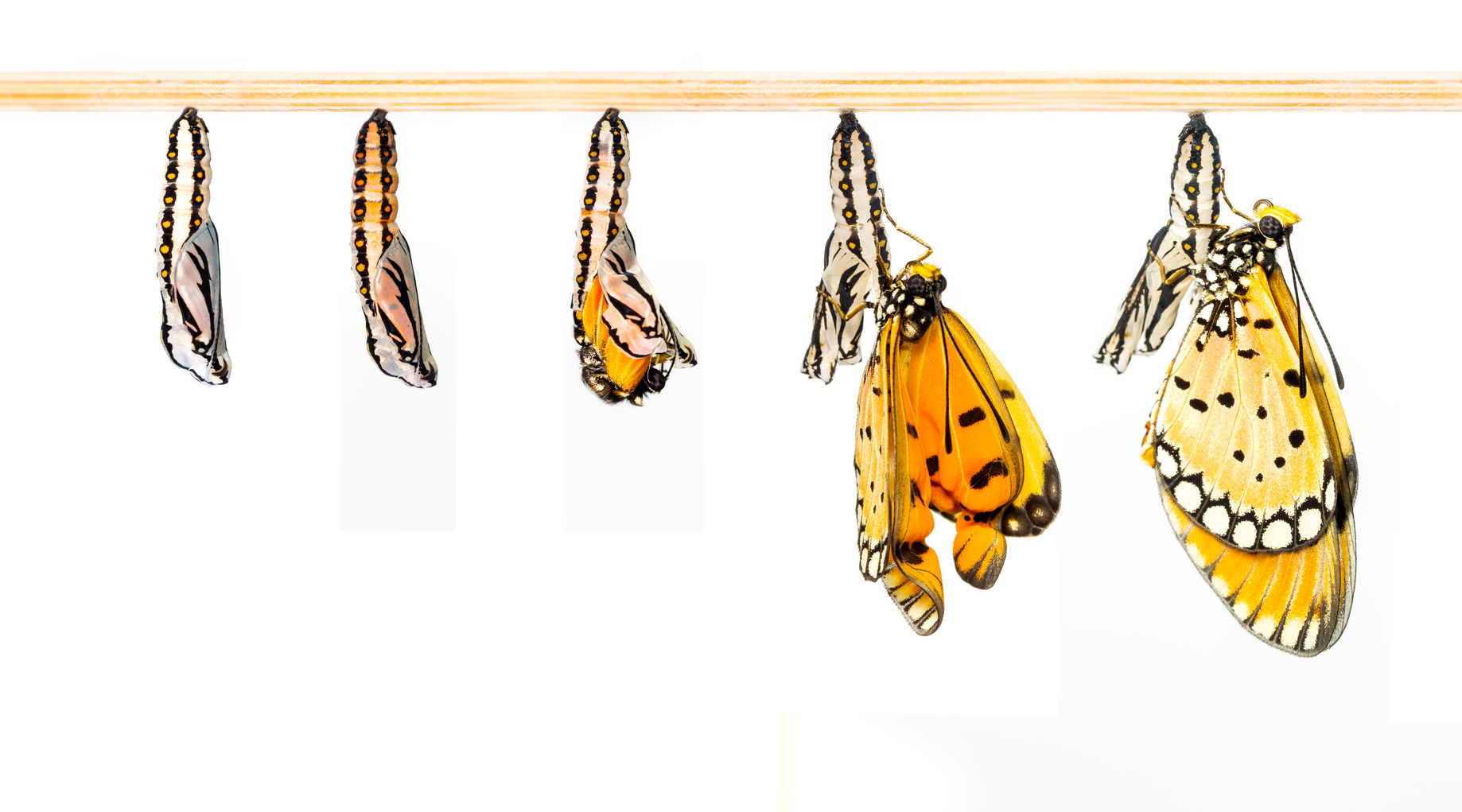
    In short it is mandation which is the problem, not holacracy nor resistance to change in general. This is what we at Caterfly are trying to address with the Open Smart Transformation model, involving a special framework of two Open Space Technology events, where all affected personnel are invited to hold deep dialogues about the change. The two events also demark a period of 3 – 6 months, a cocoon of iterations, in which all employees are trained and coached in the new approach, are asked to suspend judgement and instead apply the new way on a trial and error basis, learning and prototyping, enabling all affected to be involved and engaged in the transformation process. This open ended playful period ends with a second Open Space event where everyone can work on sorting out what worked, what needs adapting and what to reject. In other words the new approach thereby becomes customised to the particular organisation, rather than being something off the shelf, and this work is all done collaboratively by the staff.  Consequently they own the change, it is no longer an alien system, they all co-created the transformation together.

    This process was initially developed and applied with great success fo agile adoptions where typically 70 – 80% failed. We realised that the fundamental principles of the new approach are true beyond just agile. They apply to adopting lean, responsive, management 3.0, conscious capitalism, environmental management, and holacracy/sociocracy too, and indeed of any new systems implementation or organisational transformation / change management. While what Tony Hsieh is trying to do is not only extremely noble and brave, and is being done with a great deal of generosity and candidness, it is a great pity it had been mandated initially. I am sure he could have avoided this “accept holacracy or get out” dilemma, if Zappos had invited the staff to co-create the change rather than imposing it on them. However generous the severance package offer may be, it now puts Tony Hsieh in a difficult position – some staff may see him, in trepidation, as the ultimate arbiter of who is to stay and who is to go.

    Change Platform

    In short, mandation or imposition does not work well! This is also summarised in Gary Hammel’s McKinsey article late 2014 “Build a Change Platform, not a Change Program”. Caterfly’s iterative cocoon-forming double open-space framework and follow up is such a platform, we believe, or at the very least helps establish one. Fundamentally we need to change change itself from a mandation mind-set to one of invitation: inviting all affected persons to co-create the new order of things, and thereby co-own it.  Open Space Technology, doubled to form an iterative cocoon platform, is the only offline synchronous platform I am aware of that enables this to scale with large numbers of people, effectively, rapidly and sustainably.


    Come join us at Shift: Why Aren’t Organisations Shifting? 21 July 2015, London
    Details www.caterfly.co.uk/events

    Further reading:
    Why telling people what to do doesn’t work – click
    The problem with change management – click


  • Massive collaborative self-organised learning experience

    Experience: Massive Collaborative Self-organised Learning with Theory U

    From Ego to Eco: Transforming Business, Society, and Self

    Recently I was among 15,000+ ‘change makers’ from 180 countries who participated in a large MOOC (Massive Open Online Course) learning experiment initiated by MIT’s (Massachusetts Institute of Technology) Professor Otto Scharmer, author of ‘Theory U and ‘Leading from the Emergent Future, From Ego-System to Eco-System Economics‘.

    The course is heralding a new style of education, which I would call ‘the internet of learning‘, and which happens to also align well with our approach here at Caterfly. As it turns out, though not by design, the education style applies many of the principles of SOLE (Self Organised Learning Environments – that I have previously written about here) and Open Space Technology (which is a pillar of our work at Caterfly and our Open Smart Transformation model) to achieve something that so far has largely been lacking in most MOOCs: interactivity, intensive group work and peer learning.

    Here is the course description for U.Lab: Transforming Business, Society, and Self:

    Learn how to create profound innovation in a time of disruptive change by leading from the emerging future. This highly experiential course is based on Theory U, a framework, method, and way of connecting to the more authentic aspects of our self. It introduces the variable of consciousness into management and the social sciences, and proposes that the quality of the results that we create in any kind of social system is a function of the quality of awareness, attention or consciousness that the participants in the system operate from.

    The course has operated as an experience on three levels:

    1) Why isn’t fundamental change happening?
    It addressed the issues of societal and business change and transformation currently in the Zeitgeist, exploring why it is that there is a sense of great changes in the air, yet in practice actually very little is changing. It explored the deeper source levels of disconnects, which could lead to catastrophic outcomes if not dealt with, and how these could be resolved in a more collaborative and harmonious manner. The fundamental premise is that all transformation has to start with the self.

    2) Going round the curve: Theory U and mindful emergence
    The course examined the U-Theory process itself. Theory U, as espoused by Otto Scharmer and colleagues, is a process of many steps that allows one and teams to build towards emerging futures through listening to deeper levels of inner wisdom and through co-sensing a new future trying to be born, while co-creating prototypes adaptable and responsive to the future that emerges. At first the 25 or so steps to achieve this appeared to me to be highly convoluted; however, this is why I joined the course, to learn more about this famous U-process without prejudice, and I must admit what I found was quite enlightening and encouraging (many of the steps are actually just refinements of five main processes), if only listening to one’s and others’ hearts with open mind and will.

    3) Collaborative, self-organised, peer-learning
    The third level was the learning process itself, the SOLE+Open Space-like aspect already alluded to above. The structure followed a similar MOOCs type of sequence commonly found in EdX, Coursera and Udacity courses, with video presentations, readings, assignments and a forum where one could engage in written posts, comments, questions etc, all in itself an interesting way of presenting new academic material. At the same time, however, the ULAB course had a unique interactive component which was developed at the authors’ own website at the Presencing Institute. This allowed the 15,000 participants (or at least those actively following the course) to form into local hubs which would meet, either in person or online, to discuss certain aspects of the course, and moreover to form ‘Coaching Circles’ about which I’ll talk more further on.

    There were also three live presentations of 1.5 hours each with the whole ULAB team present and many of the 15,000 participants doing some journalling and deep listening exercises together at the same time. In many cases the hubs met in different cities around the world to view the live presentations together and to discuss the content afterwards, although because people were operating on different 24 hour time zones in many cases the hubs met at other times. There was also a real commitment and energy from the Ulab team. This was demonstrated in the second live broadcast which happened to be exactly on the day when Boston (where MIT is based) experienced one of the worst snow storms it has ever experienced, with all transportation and schools being closed; the team had to get special permission to stay overnight in the closed university to be able to run the live global broadcast the following morning.

    The hubs and coaching circles were completely self-organised (with the assistance of the Presencing Institute website platform which enabled this) in terms of who joined which hub or circle, when and where they met, how they communicated and what they did. The Ulab team had provided some guidelines as to how the hubs might form and facilitate their meetings, but it was essentially completely self-initiated and self-organised.

    I actually took part in several hubs, one for London which met several times, one for the UK which also met centrally in Leamington Spa, one for Europe, which was more informal, and I was also part of an international hub, which we called the Cloud Hub, which met online only. This Cloud Hub was the most active (of the four), had about 30 participants, from India, Finland, Holland, Spain, UK, Canada, USA, Brasil, Chile and Argentina. We communicated by email, WhatsApp chat, Skype, Google Hangouts, Facebook (we created a Facebook page) and Google Drive for sharing documents, and the Presencing Institute site itself has some communication tools which were useful for sharing things with the whole ULab community.

    The ULab team had set an appropriate online environment and conditions for the hubs and coaching circles to form by themselves, and most of the learning happened from peer learning. The deepest learning occurred in the coaching circles. The coaching circles consisted of maximum 5 people who met weekly for 90 minutes, to go through one of our member’s ‘case’. This was a highly structured process which was self-managed using an instruction sheet and a time-keeper. Unlike traditional coaching, the emphasis in these peer-coaching exercises was on supporting the case-giver by holding back from reactions and advice, instead allowing deeper levels of understanding, empathy and wisdom to emerge for collective learning. The exercise engendered a deep form of listening and conversing, both individually and collectively, which enabled far richer conversations to occur than is normally the case. The coaching circles formed some deep conversations which I have otherwise only come across naturally in Open Space events.

    Other group tasks included paying attention to the different levels of listening we operate at, journalling, empathy walks, collective mindfulness and later prototyping. The latter is really about going beyond the deep listening and collective wisdom towards co-creating or birthing a new world, by a process of trial and error or build, test out and reform. This process allows the collective to be responsive to changing circumstances. This is a very different type of transformation approach from the planned (based on the past) and enforced or rolled out change interventions usually applied by change makers, and which often cascade top-down through hierarchies. In the past the typical mode has been about making change (following a pre-planned blueprint), often without asking (with the ensuing natural resistance), rather than letting change happen (with a vision of the desired future) and constantly adapting this to the actually emergent future through a prototyping mind-set.

    The key learnings I got from this course are: It demonstrated a prototype of a new kind of learning using online digital tools, which relies on and works on the principle of online SOLE – Self-Organised Learning Environments, with a particular focus on peer learning. Fundamentally the same principles are at work as in Open Space meetings – and indeed one of the key words Professor Otto Scharmer kept on referring to was, as change-makers, to “hold the space” to allow the deeper conversations to happen, without which any real organisational transformation is not possible – just as you cannot force people and organisations to learn, so you cannot coerce them to change!

    I am not sure how easy it would be to scale the U-lab approach to whole organisations (businesses, government agencies, educational institutions) who are undergoing a transformation, but the one thing I am even more convinced of now is that it is absolutely paramount that the employees and affected personnel in any transformation must be involved in very deep conversations about the desired change at its initiation, in order to co-sense it and co-create it. Change is absolutely not something that can be imposed or mandated up or down as has traditionally been practiced in the past. Indeed change management itself needs to change. And the key to these deep conversations is enabling an environment, holding the space, so people can listen empathetically, mindfully and constructively to each other to co-create the change. The Open Space event format enables this space to be held, and is thus the easiest and most efficient way to invite large numbers of people into the process in the same space simultaneously, so that they can create the transformation together.

    Further information

    Theory U: Wikipedia, Otto Scharmer’s publications

    Presencing Institute

    From Ego to Eco:
    – Future Considerations book review
    – Otto Scharmer presentation at Wisdom 2.0 Business conference

    List of available free MOOC courses at MOOC List

    SOLE – Self-Organised Learning Environments

    What is Open Space Technology?