

What is ‘Open Space’?
Open Space Technology, commonly Open Space, is a social technology, a tool for helping people to rally around a shared challenge, with minimum obstacles and maximum efficiency. It is used to organise large meetings, gatherings, conferences, problem solving and summits in which everyone has the opportunity to participate on their own terms.
Open Space is nothing new. The process was developed by Harrison Owen in the 1980’s and it has been applied countless thousands of times, in at least 135 countries, in a variety of ways, with groups of just a few people to several thousands, from hours to several days, and longer. However, the basic process and principles perhaps reach back into ancient human history.
Open Space offers a clear framework for allowing us to achieve remarkable things. Open Space embraces complexity and chaos, yet it remains confoundingly simple while enabling creativity and productivity to flourish.
The results can not only be dramatic, but its effect on participants used to the confines of careful planning, hierarchy, telling others what to do and being told what to do, can be transformative and enriching.
“Everything the Power of the World does, is done in a circle.”
Black Elk, in Black Elk Speaks
Who is it for? What does it do?
Open space events have many applications. The most obvious one is as an alternative form of a conference – a conference without speakers, where the participants’ heart-felt issues are at the centre of discussion. This form can be applied in a multitude of settings, wherever there is an issue people have a common passion about, in
- communities
- political gatherings
- peace talks
- neighbourhoods
- research or
- specialist areas.
Open Space is a completely opt-in event, so invitations go out to many people and those passionate about the theme turn up.
Within organisations Open Space can also be applied for more specific purposes. Open Space can be used for:
 product design and development (synchronisation)
- strategy development, bringing in whole workforce
- supply-chain issues, coordinating suppliers
- redesigning the organisation, bottom up
- innovation and prototyping, including customers
- complexity problem solving using diverse perspectives
- collective intelligence letting future emerge
- inviting an organisational transformation process
It is this latter application, inviting the relevant workforce to co-create an implementation or a transformation that our Caterfly Open Smart Transformation is concerned with.
In all case Open Space is a way of inviting a larger number the workforce into the process, thus opening the space for a larger view of things, rather than leaving it to a few select people to manage. This is particularly important where there are big issues at stake which ignite the passions of many people. The self-organising aspect of Open Space enables any number of people to be involved efficiently and constructively.
Open Space Events can be from 1/2 day to several days. It should be noted, however, they are far more effective and powerful when run over 2 or 3 days. This is because the first day tends to focus on current and past issues, and after a night’s sleep new ideas and energies are created which means the second and third (action planning) days are far more creative, and make use of the synergies of the minds present.
How does it work?
The basic process is counter intuitively straightforward:
* Clearly define the challenge, and express it in a few words. This is what you are inviting participants to get enthused about.

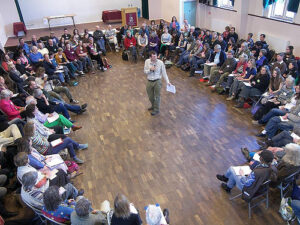
* Everyone sits in a big circle. A facilitator gives some basic instructions, then lets them get on with it.
* There is no prepared agenda, just a big blank board with available time slots and areas to use. Participants are invited to articulate what they really want to know, share, discuss or work on, and co-create the agenda with whatever sub topics they want.
* People then work out what seems most important, urgent or interesting to them, and go there. Some people will likely end up either flitting about from discussion to discussion, or getting a cup of tea and serendipitously having just the brain wave or interaction they need right there.
* Through the event people share what they’ve done, thus building a kind of ‘collective consciousness’ of the whole shebang.
* Toward the end of the event, everyone comes back together in a big circle and shares what they did, learnt, or what they want to happen next.
* Usually all participants get an anthology of the summaries of each session, perhaps with a plan of action, or key outcomes.
* Go home and let go, until the time comes to do something again.
Turn up if you want to, do what feels important, let others do what they feel is important, let go and allow it to happen in whatever way participants conspire to make happen.
The reason it seems to work
Leaders and facilitators allow people to work it out for themselves and get out of the way. No one is coerced, and no one has to be there. Opt-in participation devolves responsibility to individuals to choose to follow their passion.
 There are some basic principles to help people let go of trying to be in control, and embrace what is actually happening. A metaphor would be a surfer, who rather than trying to direct the waves, finds the right place to catch one and ride it.
There is just one firm rule, known as The Law Of Two Feet, although it is more of a playful hint than strict instruction. The Law says that ‘if you are neither learning nor contributing, it is your duty to find another place to be.’ Rather than choosing a session and being stuck in it or feeling obliged, participants are encouraged to move around, increasing impact and efficiency for the individual, for each sub group, and for the whole.
Rather than try to solve a problem with just one brain, perhaps the boss or a management team, or trying to engage numerous individuals over a long period of time, Open Space harnesses the creativity and skills of everyone, all at once. What might take a dedicated team many months, gets accelerated over a very short burst, and results in more brilliant solutions that no one could have predicted.
Organising people is hard work and inefficient. Helping people to organise themselves is surprisingly easy, effective and energising. Meanwhile, it becomes easier for people to really engage, and those voices can be heard which often aren’t. Open Space works particularly well where there is no known outcome, with very complex issues and where any form of pre-planning is futile as letting the future emerge rather than trying to control is essential.
 A part of how Open Space came to be discovered, was Harrison Owen’s experience while co-organising a conference. It took a lot of effort. People showed up, and sat passively in rows of chairs listening to experts. But when the coffee breaks came, the event came alive, buzzing with spontaneous conversation. The coffee break was the best bit. Open Space is an attempt to turn the entire experience into something like the coffee break. Some people started thinking of it as the opposite of a conference, and now the term unConference has become more common.
Lastly, Open Space events can also be significantly greener, utilising human resources more than material. I often refer to them as ‘compostable conferences.’
And that’s it.
“There is no order without chaos.”
Harrison Owen at TEDx, Dancing with Shiva: Are we working too hard?
Further reading and Videos:
Wikipedia: Open Space Technology
Harrison Owen’s Brief History of Open Space
Open Space World resources
How Caterfly is pioneering Open Space for Innovation and Kaizen or using it in organisations to invite cultural transformation
Caterfly’s model is based on Daniel Mezick’s innovative Prime/OS™ model, using Open Space to adopt Agile working and more
Chris Corrigan article, on using Open Space to solve complex problems
Huffington Post Business article, Opening The Space For Innovation
Martin Grimshaw’s Open Space Facilitator’s Checklist
Open Space Facilitators around the world: Open Space World Map
A large collection of video samples in Evocative Open Space Videos, especially the following 3 short videos give a good overview of what Open Space is and what it looks like in action:
- Introduction to Open Space Technology: 2-minute flow of event
- The Art of Hosting: Open Space Technology in 3 minutes
- The Power of Self-organisation (German) in 6 minutes


 Rather than attempting to ‘achieve buy-in’, why not allow people to solve problems and draw up their own action plans? People tend to find solutions that they have helped to co-create more exciting, and once genuine or even enthusiastic consent has been reached, tend to set about the task with gusto. Participation doesn’t just work, it is more effective in the long run, and if harnessed well then multiple view points can lead to smarter decisions. Allowing people to set their own pace and write their own story, helps to dissolve change fatigue so common in organisations, where staff might be under a constant barrage of brilliant new ideas, at the mercy of merry-go-round leadership and consultants.